
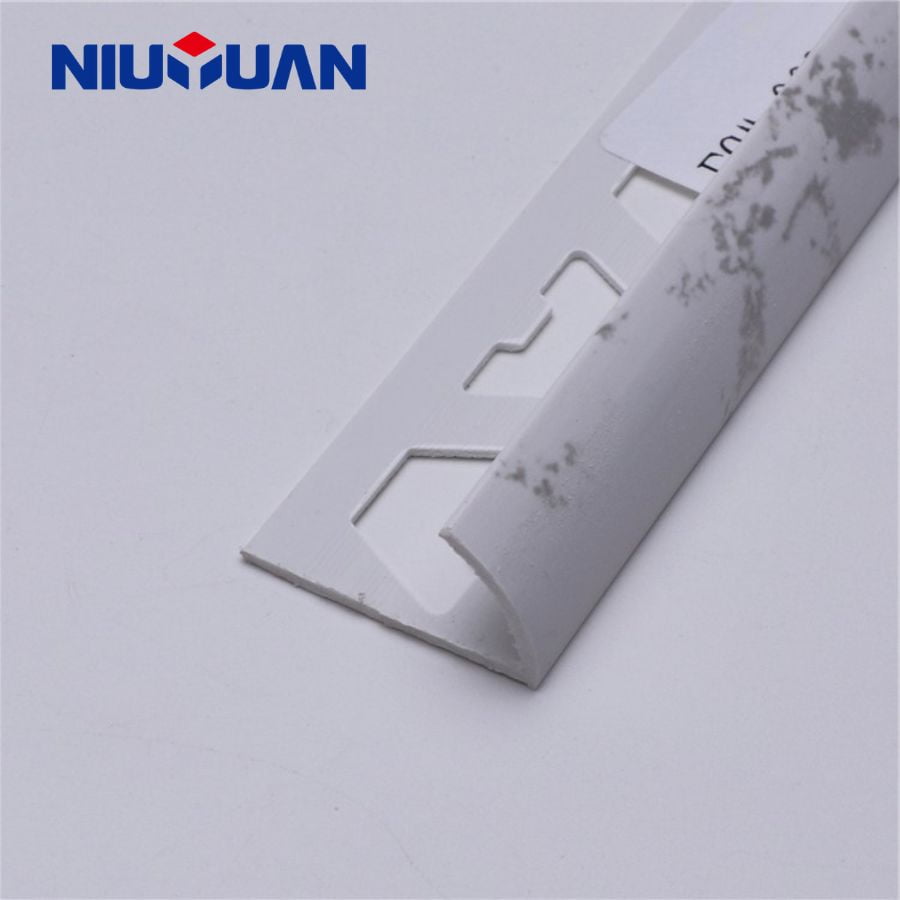
On carbon per metre installed, the two are closer than either side’s marketing suggests. On most other measures, they trade places. Real marble trim wins on service life and end of life: inert stone that serves for decades, then returns to the ground as rubble. PVC marble trim wins on weight, freight, and replacement cost, but it starts as a fossil-based plastic and usually ends as plastic waste. Which one is greener depends on the measure your project is judged on.
Two different products behind one look
PVC marble tile trim is a rigid PVC profile with a marble-effect surface. The stone pattern sits in a printed layer on a hollow extruded profile. Real marble trim is cut from a quarried block and finished as a solid stone piece. Its veining runs through the full thickness, so a chipped marble edge still shows stone, while a chipped PVC edge shows plain plastic.
The PVC side of the account
PVC resin starts from two feedstocks. About 57% of its weight is chlorine derived from common salt, and most of the rest is carbon from oil or gas (ECVM figures). That salt share makes PVC less fossil-dependent than most plastics, but it does not make it a natural material. The industry eco-profile for suspension PVC resin puts it at about 2.1 kg CO2e per kilogram, cradle to gate, before additives and extrusion.
Rigid trim carries little or no plasticiser, because plasticisers are what make PVC flexible. The additive questions for a buyer are the stabiliser system and the printed surface layer. Ask for the stabiliser type in writing, and keep the answer in the product file.
PVC is recyclable, and the VinylPlus programme reports more than 9.5 million tonnes recycled in Europe since 2000. Most of that volume is pipes, window profiles, and flooring collected in bulk. Small decorative trim rarely enters those streams, and removed trim usually leaves with general construction waste. The honest planning assumption is landfill or incineration, not a recycling loop.
The marble side of the account
Marble is quarried, not manufactured, and its costs sit in extraction and mass. One published EPD for a 2 cm marble slab records 75.5 kg of quarried block behind every 56.6 kg of finished slab. Roughly a quarter of the block leaves as sludge and offcuts before the product exists. The stone itself is calcium carbonate: chemically inert, with no plasticisers, stabilisers, or surface films to account for.
That same EPD puts production at about 23.5 kg CO2e per square metre of slab. Per kilogram of stone, marble is a low-impact material at roughly 0.4 kg CO2e. The problem is how many kilograms a project has to move, because marble weighs about 2.7 tonnes per cubic metre. A solid trim piece carries that density along every metre of edge.
In service, marble is the durable option: it does not fade, yellow, or wear through a printed layer. A dull edge can be re-polished instead of replaced. At demolition it is inert rubble, crushable into fill or aggregate. Its footprint is paid once, then spread over a service life that can run to generations.
Per metre and per year: where the verdict changes
Trim is bought by the metre, not by the kilogram, so we ran the comparison that way. The example uses a solid marble strip 20 mm wide and 10 mm thick, set against a hollow PVC profile of the same face size. Your sections will differ, but the pattern holds.
| Measure | PVC marble-look trim | Real marble trim |
|---|---|---|
| Weight per metre (worked example) | About 0.07 kg | About 0.54 kg |
| Production carbon per metre (worked example) | About 0.15 kg CO2e, resin only | About 0.23 kg CO2e |
| Resource base | Salt plus fossil carbon | Quarried stone, non-renewable |
| Service pattern | Print layer can fade or scratch; replacement is cheap | Decades of service; re-polish instead of replacing |
| End of life | Usually general construction waste | Inert rubble, reusable as aggregate |
Production carbon per metre leaves the two close, and neither side can claim a clean win. Freight separates them, because a container of marble trim reaches its weight limit long before its volume limit. Service life separates them the other way: one marble installation can outlast several PVC replacement cycles, and each replacement repeats the production and freight bill. The verdict is a choice of measure, not a property of the material.
Which one to buy, by project
Choose PVC marble trim where the fit-out refreshes on a cycle, such as retail and hospitality interiors renewed every few years. Its low weight cuts freight cost, and replacement lengths are cheap. Our PVC tile trim lines start at 2,000 pieces per order, with standard samples in 7 days. Samples let you check the print and profile against real stone before you commit. Joint finishing differs too, and our notes on caulking PVC and marble trim joints cover where sealant belongs.
Choose real marble trim where the installation is meant to stay: homes, hotels, and public buildings with long refurbishment cycles. Quarry and freight costs are paid once, and the edge should not need replacing. If the real contest on your project is plastic against metal, see how PVC and aluminium trim compare instead. Where a project files environmental documents, ask each supplier for the product-specific EPD rather than a brochure claim. Our EPD and VOC guide for trim importers sets out what to request.
Frequently asked questions
Which trim has the lower carbon footprint?
Per kilogram of material, marble is lower. A published slab EPD works out near 0.4 kg CO2e per kilogram, against about 2.1 kg CO2e per kilogram for PVC resin. Per metre of trim, the gap nearly closes, because the hollow PVC profile uses so little material. Over a long service life, marble pulls ahead, since it avoids replacement cycles.
Is PVC marble trim recyclable?
The material is recyclable, and Europe recycles construction PVC at scale through the VinylPlus programme. In practice, small trim lengths and offcuts are rarely collected separately. Most removed trim leaves with general construction waste. Plan on that basis, not on a recycling claim.
Does real marble trim last longer than PVC marble trim?
Yes, in most interiors. Marble is solid stone with the pattern running through it, and it can be re-polished when it dulls. The marble effect on PVC trim is a surface layer. Deep scratches and long sun exposure can show wear that cannot be polished out.
Which is better for a project with green building certification?
Neither wins by default. Rating systems such as LEED count documents, not material reputations. Ask for a product-specific EPD for the exact trim you are buying. Check the adhesive and sealant reports too, since the wet products carry most of the emissions questions on a tiling job.