Metal beading for tiles is a narrow metal strip that covers an exposed tile edge and turns it into a finished line. It protects the edge from chips, and it gives the wall or floor a clean border at the same time. If you buy tile trim, beading is the decorative end of the range: the strip the eye sees, not the part hidden in adhesive.
Choose it by three checks, in this order. First, the material, because it sets the price band and where the strip can go. Second, the profile, because the shape decides which edge it can finish. Third, the height, because a bead that sits proud of the tile or sinks below it looks wrong and wears badly. Get those three right and the rest is finish and quantity.
What metal beading is, and what it is not
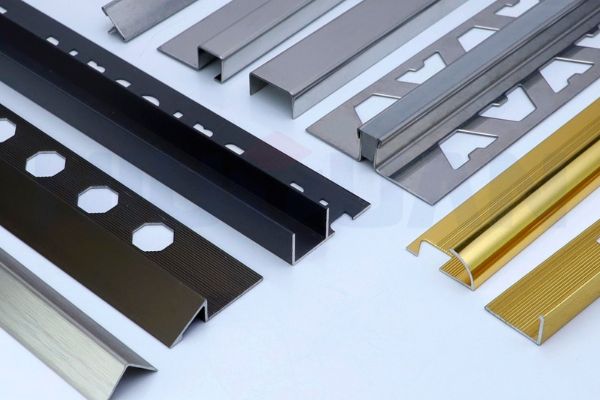
A bead is a length of metal, usually aluminium, stainless steel, brass or PVC. One leg beds into tile adhesive and one face shows. The visible face is the design: a round nose, a flat bar, a square edge or a small step. The leg does the holding. That split is what makes beading different from a tile that is rounded at the factory, which we call bullnose. Bullnose is the tile itself. Beading is a separate metal part you add.
Beading also differs from a transition strip. A transition strip joins two floor surfaces, such as tile to wood. A bead finishes one tile edge and stops there. Buyers who mix the two up order the wrong profile. The strip then has no leg to bed, or a leg that sticks out past the tile. If your job is a floor change, you need a transition product, not a bead.
One more boundary matters. A bead is a decorative finishing strip, not a structural joint. It does not absorb floor movement. Long runs and floor perimeters still need a real movement break, and our guide to expansion joints in tiled floors explains where those breaks belong. Do not ask a bead to do a joint’s job.
Where buyers specify it
Beading earns its place wherever a tile edge stays visible. Five spots cover most orders I see.
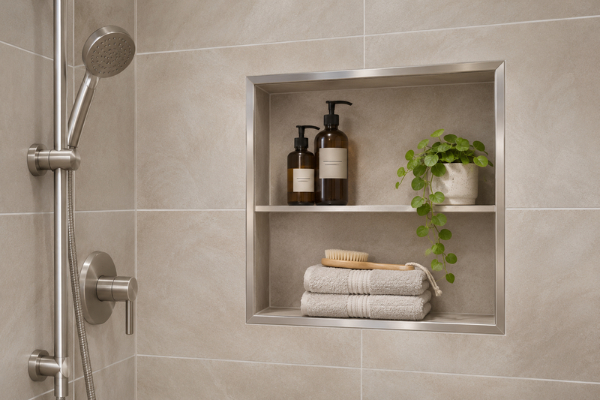
- Bathroom walls and shower niches. Wet-area edges take daily water and cleaning. Stainless steel is the usual pick here, and the bead also frames the niche so the opening reads as finished, not cut.
- Kitchen backsplashes. The bead draws the top line of the splashback and closes the edge where tile meets paint or plaster. Brass or black aluminium suits this spot when the kitchen is the showpiece.
- Feature walls and TV walls. Here the bead is design, not protection. A thin metal line breaks a large tiled surface into panels and gives the wall a frame.
- Stair edges. Treads take impact from feet and cleaning gear. A metal bead on the nosing edge keeps the tile corner from chipping, and it marks the step edge in low light.
- Doorways and window reveals. Where tile stops at an opening, the bead gives the cut edge a clean finish instead of a raw line of adhesive and tile body.
The buying point is simple. Count the visible edges on the job first, then order profiles. Buyers who order by room count often miss the niche, the reveal and the stair, and those are the edges a client notices first.
Profiles: pick the shape by the edge
Start from the edge, not the catalogue. Each profile answers one edge problem, and the table below maps shape to job.
| Profile | Best edge | Look | Watch out for |
|---|---|---|---|
| Round edge | Exposed straight edges in bathrooms and kitchens | Soft curve, forgiving on the eye | A heavy curve can look dated on sharp modern tile |
| Square edge | Straight edges in minimal interiors | Crisp line, deliberately flat | Shows any height mismatch with the tile |
| L-shaped | Edges and outside corners | One clean face, one hidden leg | Needs a firm bed, or the face lifts |
| T-shaped | Joining two tiled areas at one level | Slim bar across the joint | Only suits level joints, not steps |
| U-shaped | Capping the end of a tile run | Closed cap, no raw tile body shows | Must match the tile thickness closely |
| Inside corner | Internal corners where two tiled walls meet | Neat concave line | Pick the material for the room, not just the shape |
| Flat bar | Decorative line on a tiled face | Thin metal stripe, like a pencil line in metal | It decorates, it does not protect an edge |
Most distributor orders settle on two or three profiles. Round edge and L-shaped cover the bulk of bathroom and kitchen work. Square edge suits modern jobs, and the flat bar covers the decorative line. Our full profile range lists each shape with its material options, so check the combination exists before you promise it to a client. Outside and inside corners take different shapes, and our guide to outside and inside corner trim sets out which one goes where.
Materials: four options, four different jobs
Material decides where the bead can live and what it costs to stock. The table gives the grades we supply, the fit and the minimum order.
| Material | Grades | Where it fits | Minimum order |
|---|---|---|---|
| Aluminium | 6063 / 6463 | Most interiors, coloured and anodized finishes | 1,000 pcs |
| Stainless steel | 304 / 316 | Wet areas and heavy use; 316 for harsh or coastal work | 500 pcs |
| Brass | H59 | Premium and heritage looks, feature walls | 200 pcs |
| PVC | Rigid PVC | Budget residential work in dry areas | 2,000 pcs |
Aluminium is the volume choice. It is light and takes anodized colour well. It suits most interior jobs. Stainless steel is the durability choice. Grade 304 covers a home bathroom and kitchen. Grade 316 is the pick for commercial kitchens, pools and coastal air. The water and the salt are harder on metal there. Brass is the premium choice, and its low minimum of 200 pieces makes it the easiest metal to trial in a new range. PVC is the budget choice, and it belongs in dry residential rooms rather than wet commercial work.
Price moves with alloy, finish and length, so I will not quote a figure here. Ask for a quote per material and profile, and compare like with like: the same grade, the same finish, the same length. A quote that drops the grade to cut the price is not the same product. For the full material range, see our aluminium tile trim, stainless steel tile trim, brass tile trim and PVC tile trim pages.
Finishes that survive the room
Finish is not only colour. It decides how the bead ages in its room. Aluminium comes anodized, brushed, polished or powder-coated. Stainless steel comes brushed, polished or PVD-coated, and our comparison of brushed, polished and PVD stainless finishes sets out which one suits which job. Brass comes lacquered, chrome-plated or smoked chrome.
Two rules guide the choice. First, wet rooms punish mirror polish: water marks show on a polished face and need constant wiping, while a brushed face hides them. Second, confirm the finish in writing against a sealed sample. Colour words drift between buyer and factory, and a sample both sides have signed off is the only record that holds. We keep sealed samples on file for two years, so a repeat order can match the first.
Sizing: height against tile and adhesive
A bead must sit level with the tile face. If it sits low, the tile edge stands proud and catches. If it sits high, the bead forms a lip that collects dirt and takes knocks. The height to match is tile thickness plus the adhesive bed under it, not the tile thickness alone.
Most wall and floor tiles fall in the 6 to 12 mm range. Our size guide walks through matching trim height to tile and adhesive thickness. For the full compatibility picture, the dimensions and compatibility chart maps profile against tile thickness. Measure the tile you actually stock and add the adhesive bed your tiler uses. Then order the height that matches that sum. Guessing from a catalogue photo is how height mismatches happen.
What to confirm before you order
Beading is a small line on the invoice and a large part of the finished look. Confirm these nine points in writing before the order goes in.
- Material grade: 6063 or 6463 aluminium, 304 or 316 stainless steel, H59 brass, or rigid PVC.
- Profile and visible face: round, square, L, T, U, inside corner or flat bar.
- Finish and colour, checked against a sealed sample.
- Bead height, matched to your tile thickness plus adhesive bed.
- Length per piece, and how offcuts and spares are handled.
- Minimum order for the material: aluminium 1,000, stainless steel 500, brass 200, PVC 2,000 pieces.
- Lead time: samples in 7 days, custom samples in 7 to 10 days, bulk in 20 to 30 working days.
- Tooling fee terms, including the refund once the agreed cumulative volume is reached.
- Custom packaging and private label, if the range carries your brand.
Two of those points protect you most. The sealed sample locks colour and finish, and we hold it for two years. The tooling refund locks cost, because the fee comes back once the agreed volume is reached. Ask for both in writing, and keep the answers in the product file. Our first technical response comes within one working day, so a question about grade or finish should not hold an order up.
Mistakes I see on orders
The first mistake is ordering by looks alone. A buyer picks a flat bar for a stair nosing because it looks slim, then finds it has no leg to protect the edge. Start from the edge and let the edge pick the profile.
The second is skipping the sample. Colour and finish are the most disputed items on delivery, and they are also the cheapest to lock down. A sealed sample costs days, not money, and it ends the argument before it starts.
The third is mixing finishes across one room. Brushed stainless on the shower, polished brass on the niche and anodized black on the backsplash can each be right alone and wrong together. Pick one metal language per room and hold it.
The fourth is fitting the bead after tiling. A bead beds into adhesive while the tile goes in. Retrofitting means cutting the joint open, and our notes on installing tile trim cover the order of work. Gaps that open later are usually a joint problem, not a bead problem, and our guide to fixing gaps beside tile trim covers the repair.
Beading repays care in proportion to its size. It is the cheapest part of the tile job to get right and the most visible part to get wrong. Confirm the material, the profile, the height and the sample before you order. The strip will then do its job for the life of the tile.
Frequently Asked Questions
What is metal beading for tiles?
Metal beading is a narrow metal strip that covers and protects an exposed tile edge while adding a decorative line. One leg beds into tile adhesive and one face shows, in aluminium, stainless steel, brass or PVC. It finishes edges on walls, backsplashes, niches, stairs and reveals.
Is metal beading the same as tile trim?
Beading is one family inside tile trim. Tile trim covers every profile that finishes a tile edge, including L-shaped, T-shaped and U-shaped trims. Beading is the decorative end of that range: the strips buyers pick when the edge itself is part of the design.
Which metal beading is best for a bathroom?
Stainless steel is the usual pick for a bathroom. Grade 304 suits a home bathroom, and grade 316 suits showers in commercial jobs and coastal areas, where water and salt are harder on metal. Anodized aluminium also works in a bathroom, but keep PVC out of wet commercial rooms.
Does NIUYUAN make pencil bead trim?
No. We do not produce pencil bead trim. For a thin decorative line, use a flat bar or a round-edge bead in the same finish, which gives the same slim metal line and is in production.
What is the minimum order for metal beading?
It depends on the material: aluminium 1,000 pieces, stainless steel 500 pieces, brass 200 pieces, and PVC 2,000 pieces. The minimum applies per material, so a mixed order needs each material to meet its own minimum.