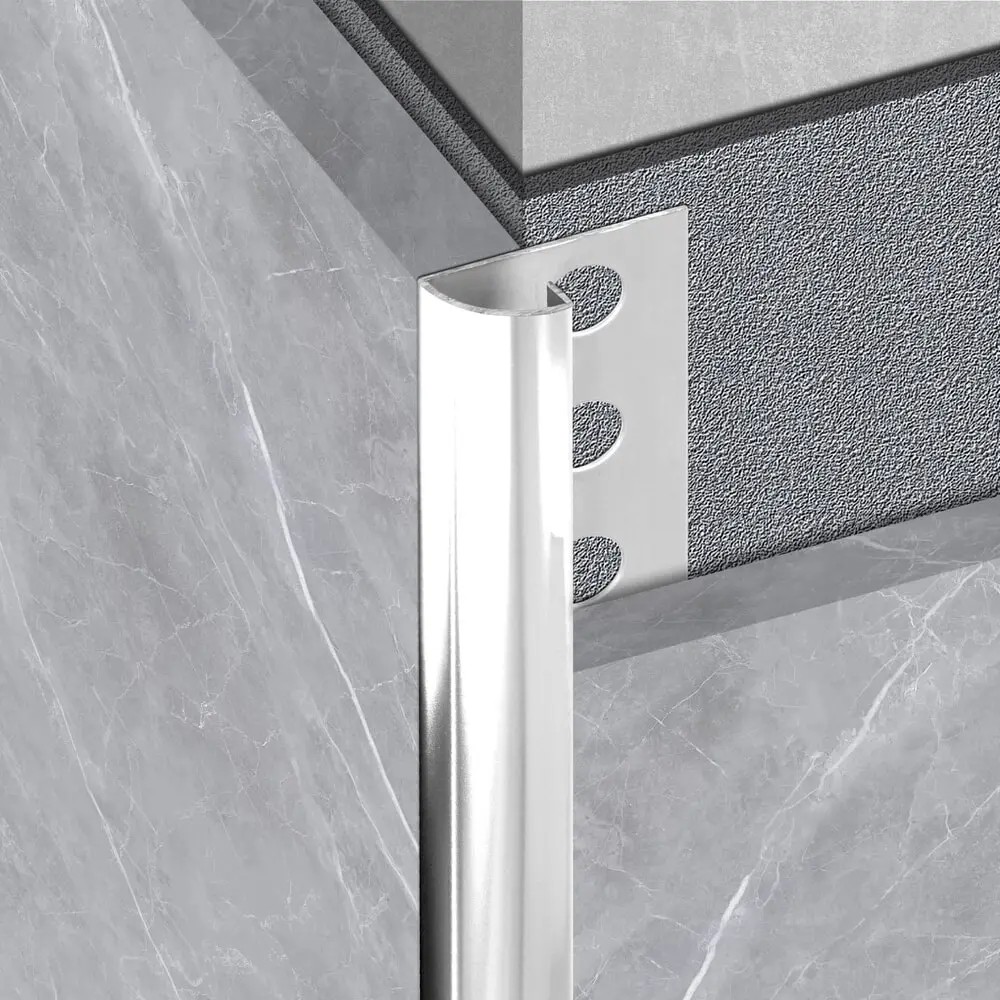
Aluminium Tile Trim for Coastal Projects: Anodising Grade and Corrosion Checks
For a coastal project, specify aluminium tile trim by its anodising class and sealing quality, not by its colour or price. Ask for AA20 or AA25 film thickness in writing, with a sealed finish and a salt-spray test report for the same batch. A thin or poorly sealed film will pit near salt air, even if the trim looks perfect on delivery. This guide explains the grades, the tests, and the questions that protect an order.
Coastal air carries chloride that settles on every exposed surface. The damage rarely shows at handover. It shows months later as white pits, chalking, or colour loss on trim near doors, pools, and sea-facing walls. Buyers who check only the sample finish miss the two factors that decide service life: film thickness and seal quality. Both must appear on the order confirmation, not in a sales message alone.
First, grade the site, not the trim
A trim that survives an inland hotel lobby may fail on a beachfront balcony. The difference is the site, not the brand. ISO 9223 rates atmospheric corrosivity from C1, very low, to CX, extreme, using time of wetness, sulphur dioxide, and chloride deposition. Coastal sites usually sit at C4, high, or C5, very high, where salt deposition and long wet periods combine.
Sites within a few hundred metres of breaking waves sit at the harsher end of that range. Sheltered spots can be worse than open ones, because rain never washes salt off the surface. Distance, wind direction, and shelter all shift the effective category for a single building. Record the site category before choosing a finish, since the category sets the film class that follows.
Anodising grades: read the number, not the name
Anodising builds a hard oxide layer on aluminium by an electrochemical process. The layer is measured in microns, and the grade name states its minimum average thickness. AA10 means 10 microns, AA15 means 15 microns, AA20 means 20 microns, and AA25 means 25 microns. Minimum local thickness runs lower, at 8, 12, 16, and 20 microns in the same order.
A supplier who quotes only a colour name, such as silver or bronze, has given no thickness at all. Colour describes appearance, not protection, and two trims in the same colour can carry very different films. Always ask for the grade code in writing, and check that the code also appears on the order confirmation.
| Grade | Minimum average film | Minimum local film | Where it fits |
|---|---|---|---|
| AA10 | 10 microns | 8 microns | Interior use, or exterior use only with guaranteed frequent washing |
| AA15 | 15 microns | 12 microns | General outdoor architectural use, away from marine influence |
| AA20 | 20 microns | 16 microns | Coastal and industrial sites, the common coastal starting point |
| AA25 | 25 microns | 20 microns | Severe marine exposure and static exterior applications |
For coastal work, AA20 is the usual starting point in published guidance, and AA25 suits severe marine exposure. AA15 belongs to general outdoor use away from marine influence, not to a seafront project. Treat any claim of a marine grade without a grade code as unconfirmed, and ask for the number.
North American practice uses a second scale worth knowing. AAMA 611 Class I requires a minimum film of 18 microns, about 0.7 mil, for architectural aluminium in continuous outdoor exposure. Class II requires 0.4 mil. If a supplier quotes an AAMA class instead of an AA grade, ask which class applies and get the test evidence that matches it. A class label without a report proves nothing.
Sealing: the step that decides whether thickness works
Fresh anodic film is porous, like a sponge at microscopic scale. Sealing closes those pores by hydration, and a sealed film resists chloride far better than an unsealed film of the same thickness. One review reports roughly a 100-fold improvement in corrosion resistance after hot water sealing. Thickness alone therefore never proves performance. A thick but unsealed film can fail before a thinner, well sealed film.
Three standard checks measure seal quality, and a buyer can ask for any of them by name. The dye spot test stains the surface and rates the mark, with a spot strength below 2 passing. The acid weight loss test allows no more than 30 milligrams per square decimetre of dissolved film. The admittance test passes below 20 microsiemens. Ask which method the supplier used, and ask for the result sheet, not a verbal assurance.
Sealing also has a timing trap worth knowing. Cold seals take about a day to complete, so a test run straight after production can fail on a good part. Ask when the test was run relative to sealing, and treat a same-day result on a cold sealed batch with caution. A supplier who can explain this timing is usually a supplier who controls the process.
Salt-spray hours: useful evidence, not a service-life promise
Salt-spray testing exposes samples to a salt fog under ASTM B117 or ISO 9227 and counts hours to first corrosion. The military specification MIL-PRF-8625 sets 336 hours as its standard salt-spray duration. AAMA 611 Class I goes much further. It requires 3,000 hours with no more than 15 isolated pits, none larger than 1 millimetre, across its test area. These numbers describe lab severity, and higher hours mean a tougher test, not a guaranteed number of years on a building.
A salt-spray report still needs careful reading. Check that the alloy, film grade, and sealing method on the report match the trim you will receive. A report for a different alloy or an unsealed sample says nothing about your order. Also check the sample date, since a report from years ago may predate the current production line. If any of these details differ, ask for a fresh report on your batch.
Field exposure adds one more check that lab tests cannot supply. AAMA 611 Class I also requires ten years of South Florida outdoor exposure, with colour change held within 5 delta E. No new supplier can show ten years of history for a new line. Ask what long term evidence exists instead: earlier lines, comparable projects, or third party exposure data. Absence of that evidence is a gap to price in, not a reason to accept a verbal promise.
Aluminium trim or stainless 316: choose by failure mode
Stainless 316 earns its marine reputation from molybdenum, which lifts resistance to pitting and crevice corrosion in chloride-rich air. Industry guidance treats 304 as suitable only where surfaces get frequent fresh water washing. Grade 316 suits deck fittings and places where salt concentrates as it dries. Even 316 is not immune, since pitting, crevice corrosion, and stress cracking have all been recorded in severe marine service. The honest comparison is about failure modes, not about one metal winning everywhere.
| Option | Where it wins | Where it fails | What to confirm |
|---|---|---|---|
| Anodised aluminium trim, AA20 or AA25 | Light weight and clean finish on washed surfaces | Pits if film is thin, unsealed, or damaged at cut edges | Grade code, sealing method, salt-spray report |
| Stainless 316 trim | Strong chloride resistance for exposed fittings | Crevice corrosion where salt sits trapped and oxygen is low | Grade certificate, finish, crevice detailing |
For tile edge trim specifically, weight and finish often tip the choice toward aluminium, while fixings and the wettest details may still call for stainless. Cut edges deserve special attention in either metal, since a cut breaks the protective layer and opens a path for chloride. Cutting and fitting errors rank among common installation mistakes. Ask how cut ends are treated on site, and confirm that the answer covers corners and joints as well as straight runs.
Buyer checklist: ten questions before you confirm the order
Send these questions with the enquiry, and keep the answers with the order confirmation. A supplier who answers in writing, with documents attached, has given you something you can enforce. A supplier who answers only by chat has given you a conversation. Profile size still matters alongside finish, so confirm the trim height against your tile thickness with the tile trim size guide.
- What anodising grade code, AA15, AA20, or AA25, applies to this trim, and does the code appear on the order confirmation?
- What is the minimum average film thickness and the minimum local thickness for the batch?
- Which sealing method was used, and which seal quality test result applies to this batch?
- What salt-spray test standard and duration does the batch report show, and does the report match this alloy?
- What alloy is used, 6063 or 6463, and does the mill certificate match the order?
- How are cut ends, corner pieces, and joints protected against chloride entry on site, and does the installation method cover sealing them?
- Which fixings are supplied, and are dissimilar metals isolated to prevent galvanic corrosion?
- What washing or maintenance interval does the supplier advise for this site category?
- What long term exposure evidence exists for this finish, beyond the lab report?
- What remedy applies if delivered film thickness or sealing falls below the confirmed grade?
Frequently asked questions
What anodising grade should I specify for a coastal project?
Start from the site category. For C4 or C5 coastal sites, published guidance points to AA20 as the usual starting point, with AA25 for severe marine exposure. Confirm the grade code, the sealing method, and a matching salt-spray report in writing before ordering.
Does a higher salt-spray hour count guarantee a longer service life?
No. Salt-spray hours measure lab severity under one fixed condition, not years on a building. Use the report to compare suppliers on equal terms, and check that alloy, film grade, and sealing on the report match your order.
Is anodised aluminium better than stainless 316 near the sea?
Neither metal wins everywhere. Anodised aluminium offers light weight and a clean finish when film and sealing are right. Stainless 316 offers stronger chloride resistance for fittings, but it can still suffer crevice corrosion where salt sits trapped.
How do I check sealing quality without a lab?
Ask the supplier for a seal test result by name: dye spot, acid weight loss, or admittance. A result sheet with the method, the value, and the batch beats any verbal assurance. For cold sealed batches, also check that testing waited about a day after sealing.
What should I do about cut edges on site?
Treat every cut as a break in protection. Ask the supplier how cut ends, corners, and joints should be sealed during installation, and confirm the method before work starts. Untreated cuts near salt air are a common early failure point.
Order decision: five lines that close the file
For NIUYUAN orders, the confirmed commercial facts are aluminium alloys 6063 and 6463, and an aluminium minimum order of 1,000 pieces. Sample lead time is 7 days, or 7 to 10 days for custom work, and bulk lead time is 20 to 30 working days.
Samples are retained for 2 years, and first technical response arrives within 1 working day. The anodising grade for a specific NIUYUAN order is not a fixed catalogue claim in this guide. Confirm it in writing for your batch using the questions above.
A coastal trim order is safe when five facts sit together on one document. They are site category, grade code, sealing method, matching test report, and cut edge treatment. If any one of them is missing, the order is not ready, however good the sample looks. Price comparison only makes sense after those five lines match across suppliers. A cheaper trim with a thinner or unsealed film is a different product.
Send the ten questions with your next enquiry, and ask for written answers with documents attached. Compare suppliers on the five lines above, not on sample appearance alone. When the answers arrive, file them with the order confirmation, so any later dispute turns on documents, not on memory.