A metal trim bonds to a finished tile face with a flexible MS polymer adhesive or a low-modulus epoxy. Standard cement thin-set does not bond to a glazed tile face. Pick the adhesive by the job. Dry indoor edges take MS polymer, and wet rooms and heavy use take epoxy. Load-bearing edges take no glue at all.
I run a trim factory, and this question reaches us after the tiling is done. A buyer has a finished wall, a loose edge, and no way to bed a trim leg in thin-set. That is the job this guide covers: glue on a finished tile face.
New tiling or after tiling: the job decides the adhesive
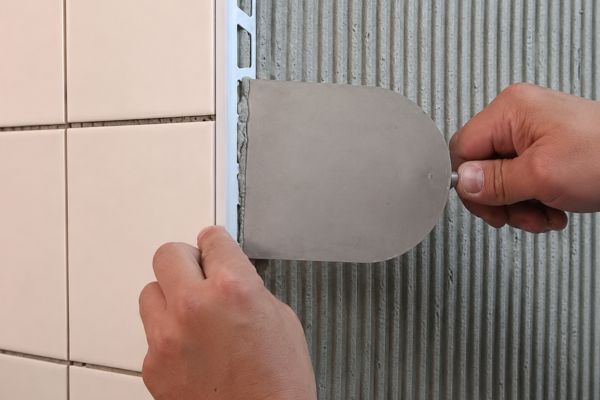
In new tiling, the trim leg sits in the thin-set bed under the tile. The mortar grips the punched leg, and the tile face locks it in place. If the tiles are not set yet, follow the standard installation method, not the glue aisle.
After tiling, the tile face is glazed and sealed, so thin-set cannot grip it: the mortar needs a porous base to key into. That is the job of fitting trim after tiling, and the table below ranks the options for it.
Which adhesive bonds metal trim to tile?
Four products sit on the shelf, and only two of them hold a metal trim on a tile face. Read the technical data sheet before you buy, because the brand name tells you nothing about the bond. PVC trims follow a different rule; our PVC adhesive guide covers that case.
| Adhesive | Verdict | Why |
|---|---|---|
| MS polymer (modified silane) | Best for dry indoor edges | Bonds metal and glazed tile, flexes with the trim |
| Low-modulus epoxy (EN 12004 R2) | Best for wet rooms and heavy use | Strong, water resistant; must be low modulus to flex |
| Silicone sealant | Seal only, not a bond | Seals the joint, but will not hold the trim |
| General construction adhesive | Avoid | Made for porous timber and board, not tile or steel |
| Cement thin-set | Avoid on a finished face | Needs a porous base; bed a leg in new tiling only |
What to check on the label before you buy
A label that lists both metal and glazed ceramic tile as substrates is the first pass. If it lists only timber, board, or masonry, put it back. Next, look for the EN 12004 class: a reaction resin adhesive rated R2 or R2T fits this bond.
Check the movement and wet-area ratings too, because a trim expands and contracts with heat and the cured adhesive must flex with it. For a shower wall, the data sheet must state water resistance. A product silent on movement or water is a guess.
Surface prep and curing: where most glue jobs fail
Peel off the protective film on the trim first, since any film left on the bonding face breaks the bond. Degrease both faces with isopropyl alcohol, then abrade the metal lightly so the adhesive has a key. Wipe the dust off and keep the joint dry.
Support the trim until the adhesive reaches full strength. Tape or a brace holds it in place, and grouting or loading the edge too early will shift it. Cure times run from hours to days by product, so follow the data sheet. ARDEX gives 15 to 25 °C for its marine installs, and cold air slows the cure.
When glue is the wrong answer
Glue has limits: a stair nosing or any edge that takes foot traffic needs a mechanical fix, not a glue line. A pool, spa, or permanently soaked joint needs a full waterproofing system. A sun-baked outdoor edge moves too far for most adhesives.
Aluminium needs one extra warning, because cement-based products attack aluminium. Never bed an aluminium trim leg in thin-set without a primer the maker approves, and never glue tile direct to bare aluminium. Stainless steel trim needs the same flexible bond, and ARDEX pairs it with a reaction resin adhesive after degreasing and abrasion.
My working rule is simple: if the tiles are not set yet, bed the leg in thin-set and forget glue. If the tiles are set, use MS polymer for a dry edge and low-modulus epoxy for a wet one. If the edge carries weight or lives underwater, fix it mechanically.
NIUYUAN Metal makes the trim, not the adhesive, so buy the adhesive from a tile adhesive maker and confirm the match on its data sheet.
Frequently Asked Questions
What is the best adhesive for metal trim on tile?
MS polymer for a dry indoor edge, and low-modulus epoxy for a wet room or heavy use. Both bond metal and glazed tile and flex with movement.
Can I use silicone to glue metal trim to tile?
No, not as the bond. Silicone sealant fills the joint and keeps water out, but it will not hold the trim.
Can I use thin-set to glue trim onto finished tile?
No. Thin-set needs a porous base to key into, and a glazed tile face gives it nothing to grip. Thin-set fits only new tiling, where the trim leg beds into the mortar.
How long must the adhesive cure before I grout?
Follow the technical data sheet for the product you bought. Cure times run from hours to days by product, and grouting early can shift the trim.