Vietnamese tile trim buyers are not short of options. Local suppliers list finishing and floor edge trim in Ho Chi Minh City and Hanoi, trading companies source from China as part of their normal range, and at least one Foshan competitor now runs a factory in Hung Yen Province as well as in Foshan and Cambodia. So the real question for a Vietnamese importer or distributor is narrower: with local and multi-origin supply already available, when does a Foshan top-up order still make commercial sense — and what has to be checked before it is placed?
The short version: Foshan still earns the top-up order when the gap in your range is breadth, not basic supply. One Foshan factory order can combine aluminum, stainless steel, solid brass and PVC profiles, several finishes, matching accessories and your own-label packing in a single written specification, at material-by-material minimums that suit a mixed container. Local buying stays the right route for fast, standard lines. The Foshan route is for the lines your current suppliers do not carry, cannot finish consistently, or will not pack under your label — provided you confirm the import position for every SKU with your own broker before you pay a deposit.
The choice Vietnamese buyers already have
Start from the supply that already exists, because the Foshan decision only makes sense against it. Most established buyers use more than one of the routes below.
Local Vietnamese supply. Business directories list Vietnamese manufacturers, distributors and wholesalers for finishing trim and floor edge trim, concentrated in Ho Chi Minh City and Hanoi, and supplier directories list Vietnamese aluminum profile companies offering tile trim among wider profile ranges. Local supply is close and easy to reorder in small lots. Its limit is usually range: trim may be one line among many for a general profile supplier, and brass, grade 316 stainless or less common finishes may not be in the catalogue at all.
Multi-origin suppliers with a Vietnam plant. The clearest example is Ghonor, a Foshan building-materials maker whose published addresses list a main Foshan factory, a Vietnam factory in Van Lam District, Hung Yen Province, and a Cambodia factory, and whose marketing is built around origin choice. That model is a real option for Vietnamese buyers too — and it proves the point of this guide: origin alone is no longer a Foshan selling point. What a multi-origin supplier offers at its Vietnam plant is still that supplier’s range, finishes and packing terms, not the whole Foshan supply base.
Direct import from Foshan. This is the top-up route this guide covers. Trade-data listings for edge trim buyers in Vietnam show Vietnamese companies appearing in import records for this product family — the listings do not prove how large that trade is, and this guide does not use them as a market-size figure; they simply confirm that importing trim is an established buyer behaviour alongside local buying. Direct import gives the buyer control of grade, finish, length and label, at the cost of minimum quantities, import paperwork and working capital tied up in a container.
| Sourcing route | Best for | Range & spec control | Commitment |
|---|---|---|---|
| Local Vietnamese supplier | Fast reorder of standard profiles and small-lot top-ups | The supplier’s existing catalogue; trim may be one line among wider profile ranges | Small lots, short domestic legs |
| Multi-origin supplier (Vietnam plant) | Origin flexibility inside one supplier’s range | That supplier’s profiles, finishes and packing terms at that plant | Supplier minimums and programme terms |
| Trading company sourcing from China | Coverage without running your own import file | The trader’s chosen factories and spec choices, not yours | Trader pricing and volume tiers |
| Direct Foshan top-up order | Filling range gaps: extra materials, finishes, accessories and own-label lines | Full control of grade, finish, length and label in one written specification | Material MOQs, import checks and container working capital |
Why Foshan still gets the top-up order
None of the reasons below is “Foshan is cheaper” as a blanket claim — landed cost depends on the SKU, the finish and the shipment, and our tile trim cost guide sets out how to compare quotes line by line. The durable reasons are structural: breadth in one order, minimums that fit a mixed range, and custom and packing work handled by the same factory that makes the profiles, as set out on our tile trim profiles page.
1. Breadth across materials in a single specification
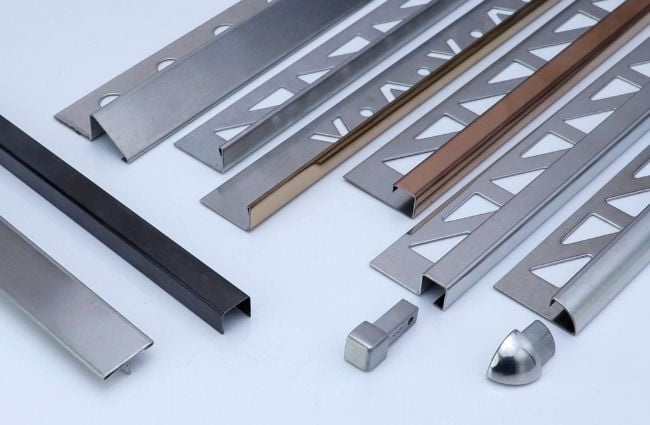
A distributor’s shelf rarely fails on the core aluminum L-shape. It fails at the edges: the grade 316 line a coastal project asks for, the solid brass accent a hotel specification names, the PVC line a price-led channel needs, the LED profile and matching corner pieces that complete a display. Sourcing each gap from a different supplier means different minimums, different finish standards and no single file that says what was agreed. At NIUYUAN, one specification can cover aluminum in 6063 and 6463, stainless steel in 304 and 316, solid brass in H59, and PVC — across L-shape, square edge, round edge, T-shape, U-channel, skirting and transition profiles, plus LED profiles and accessories. The whole gap list, from one factory, against one written spec sheet.
| Range layer | What a Foshan top-up can add | Why it is hard to fill locally in one order |
|---|---|---|
| Core metal | Aluminum (6063 / 6463) L-shape, square edge and round edge in the finishes your range already sells | Usually available locally — top up only when finish consistency justifies a container line |
| Step-up metal | Stainless steel 304 for interiors and 316 for coastal, pool and harsh-cleaning specifications; solid brass (H59) square edge for premium and hotel work | Less commonly held as a documented, graded local range; grade and alloy need to be named in writing, not assumed |
| Volume tier | PVC profiles for budget residential and price-led channels, sold honestly as PVC | Available as a commodity line, but rarely as part of the same graded specification as the metal range above it |
| Completion | Matching corner pieces, connectors and end caps, transition and T profiles, LED profiles, sample boards | The pieces that make a range look finished are the first to be dropped when each gap is bought separately |
2. Minimums that fit a mixed container, not a single SKU bet
A top-up order only works if the minimums let you spread a container across the range instead of betting it on one profile. NIUYUAN’s minimums run by material — 1,000 pieces for aluminum, 500 for stainless steel, 200 for brass and 2,000 for PVC. The brass figure matters most: a premium accent line can be tested at 200 pieces inside a mixed container, alongside the aluminum core that carries the volume. Samples come first — standard lead time 7 days, 7–10 days for custom profiles — so colour and finish are confirmed against the range you already sell before the order is committed.
3. Custom profiles and your own label, from the same factory
Two gaps local buying rarely closes are a profile that does not exist yet and a range that carries your label, not the factory’s. NIUYUAN works from more than 3,000 existing moulds, so a semi-custom requirement can often be matched before new tooling is discussed, and OEM and private-label production runs across the range: carton marks, labels, barcodes and retail artwork arranged with the goods, as set out in our OEM and private label guide. The top-up can arrive shelf-ready under your own name instead of competing as an unbranded import.
4. One finish standard across the whole top-up
Finish inconsistency is the quiet reason repeat orders move factories. A gold that shifts between batches, or a black that arrives in two tones from two suppliers, costs more in returns than the profile itself. In a single Foshan order, every SKU’s finish is locked in the same specification and checked against the same sealed samples: anodized film thickness named in writing for aluminum, and PVD colour over stainless where colour has to survive humid and coastal air. Our tile trim finishes guide compares the options side by side.
What to specify when the Foshan order is a top-up
A top-up order has a different specification job from a first range. It has to sit next to stock you already hold — bought locally or imported before — without creating a second, incompatible version of the same shelf line.
Match the range you already sell
Start with an audit of your current range, not a catalogue. For each gap line, record the profile, the height, the length your customers and racking already use, the finish name your sales team uses, and the channel it will sell through. Trim height follows the same rule as anywhere: tile thickness plus the adhesive bed, worked through in our tile trim size guide. Where a finish has to match, send physical samples of your existing lines with the enquiry — a photograph under showroom light is not a colour standard.
Name the grade, especially for coastal and wet work
Much of Vietnam’s demand sits in humid, coastal cities, and bathrooms, pools and wet commercial areas dominate trim use. Grade 304 stainless is the safe default for dry interiors. Step up to 316 wherever salt air, pool water or chlorinated and acidic cleaning is involved — the molybdenum in 316 resists the pitting those conditions cause in 304. Our 304 vs 316 vs 316L comparison works through the grades, and our pool and outdoor tile trim guide sets out the wet-area specification. For the premium tier, solid brass earns its place in hotel and high-end residential work — see our brass tile trim selection guide.
Decide what stays local
A Foshan top-up is not an argument for importing everything. Fast-moving standard lines that a local supplier delivers reliably usually stay local — the domestic reorder cycle is the advantage there. Reserve the Foshan order for what local supply cannot do in one specification: graded step-up lines, breadth across materials, completion accessories and own-label packing. Writing that split down is the same exercise set out in our guide to building a tile trim range, applied to a range that already exists.
How a Foshan top-up order works, step by step
The sequence follows the same steps as our guide to importing tile trim from China. The Vietnamese difference is emphasis: because this is a top-up into an existing range, the matching work happens at the start, and the import check happens before production, not at the port.
1. Range audit and enquiry. Send the gap list — profiles, heights, lengths, finishes and estimated quantities — plus physical samples of any existing line the new stock has to match. The enquiry is priced as one mixed specification, not as separate single-SKU quotes.
2. Samples against your current stock. Samples confirm colour, finish and profile fit next to the lines you already sell. Standard sample lead time is 7 days, 7–10 days for custom profiles. Approve in writing; the approved set becomes the sealed standard for production and reorders.
3. Specification and import check, in parallel. The quote is built against a written spec sheet — alloy or steel grade, finish, height, length, quantity per SKU, packing and labelling. In parallel, give your broker or forwarder the HS code for every SKU and have them confirm, before you pay a deposit, what applies to each line on entry into Vietnam: the importer-of-record position, the documents needed, and any requirements that turn on the exact classification. Duty rates, taxes and clearance timing are HS- and shipment-specific, so they belong to your broker’s advice for that shipment, not to a guide — what belongs in your file is the broker’s answer, recorded next to the specification.
4. Production and quality checks. Extrusion or forming, surface treatment, dimensional and finish checks against the sealed samples, then export packing. Bulk production runs 20–30 working days, so the reorder point for the fastest lines belongs in the same conversation as the order — local supply keeps covering demand while the container is in production.
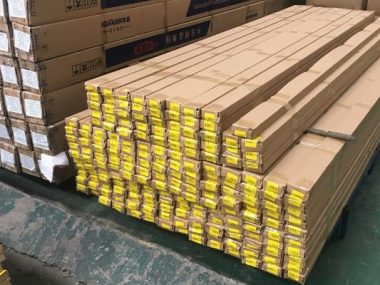
5. Documents and loading. Commercial invoice, packing list and certificate of origin as standard, plus whatever the step 3 check identified. Confirm the packing list against the spec sheet SKU by SKU before loading, and keep loading photos with the shipment file.
6. Arrival, clearance and range integration. Your broker clears the container against the position confirmed in step 3. On arrival, check the top-up lines against the sealed samples before they enter stock, and record which lines came from which order — that record is what lets you reorder the identical line later.
A practical top-up range for a Vietnamese distributor
Build the Foshan order around the gaps, not around a second copy of the core range you already buy well.
| Tier | What to top up from Foshan | Why |
|---|---|---|
| Step-up lines | Grade 316 square and L profiles for coastal and pool specifications; solid brass square edge for hotel and premium residential accents | The grades projects ask for by name, and the lines least likely to be held locally as a documented, graded range |
| Breadth lines | Finishes beyond the local standard set — PVD gold, black and bronze tones on stainless; named anodized finishes on aluminum — in the core profiles you already sell | Same shelf lines, wider choice, one finish standard locked by sealed samples |
| Completion lines | Matching corner pieces, connectors and end caps, transition and T profiles, LED profiles, counter sample boards | The pieces that stop a range looking unfinished, and give counter staff something to sell from |
| Own-label lines | Your best-moving imported lines packed with your carton marks, labels and barcodes | Turns the top-up into a house range your channels reorder by your name, not by a factory catalogue number |
Sourcing from NIUYUAN Metal
NIUYUAN Metal manufactures tile trim in Foshan, Guangdong, in a 31,706 m² facility with more than 250 staff, 40+ machines and over 3,000 moulds, producing more than 2 million pieces a month. The range covers aluminum (6063 and 6463), stainless steel (304 and 316), solid brass (H59) and PVC profiles — L-shape, square edge, round edge, T-shape, U-channel, skirting and transition strips, plus LED profiles and accessories — with OEM and private-label production across the range. Send your gap list, heights, finishes and destination port through our contact page, and the reply will price against a written specification you can file next to your broker’s import check.
What to send in your RFQ
A complete first message gets a price you can act on:
- The gap list from your range audit — profile and shape, with the height for each
- The length your existing range and racking use, per profile
- Material and grade (aluminum alloy, 304 or 316 stainless, brass, PVC)
- Finish and colour, with a physical sample of the existing line to match where relevant
- Quantity per SKU, checked against the minimums above
- Destination port in Vietnam, as advised by your forwarder
- Packaging and labelling, including own-label artwork if required
- The result of your broker’s HS and import check for each SKU
- Target date for the goods in your warehouse
Frequently asked questions
Why would a Vietnamese distributor import tile trim from Foshan at all, with local supply available?
For breadth, not for basic supply. Local buying covers fast, standard lines well. A Foshan top-up order fills the gaps local supply usually cannot close in one specification: grade 316 stainless and solid brass step-up lines, a wider finish set held to one sealed-sample standard, matching accessories and LED profiles, and own-label packing — combined across materials in a single mixed container.
Does importing from Foshan mean replacing my local suppliers?
No. The workable split keeps fast-moving standard lines with the local supplier who delivers them reliably, and reserves the Foshan order for step-up grades, breadth, completion pieces and own-label lines. Local supply also covers demand during the 20–30 working days a Foshan bulk order is in production.
What are the minimum quantities for a mixed Foshan order?
Minimums run by material: 1,000 pieces for aluminum, 500 for stainless steel, 200 for brass and 2,000 for PVC. Because they apply per material rather than to the container as a whole, a mixed top-up can test a premium brass line at 200 pieces alongside the aluminum core that carries the volume.
What import checks should I run before ordering from Foshan?
Give your broker or forwarder the HS code for every SKU before you pay a deposit, and have them confirm the importer-of-record position, the documents the shipment will need, and any requirements that turn on the exact classification of each line. Duty rates, taxes and clearance timing are HS- and shipment-specific, so take them from your broker for that shipment and file the answer with the order specification.
Can a Foshan top-up order carry my own label?
Yes. OEM and private-label production runs across the NIUYUAN range, so carton marks, labels, barcodes and retail artwork can be arranged with the goods. Confirm the artwork and the packing specification in the same written spec sheet as the profiles, finishes and quantities.