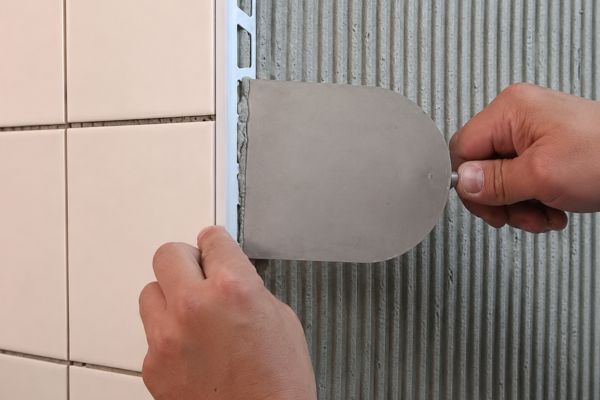
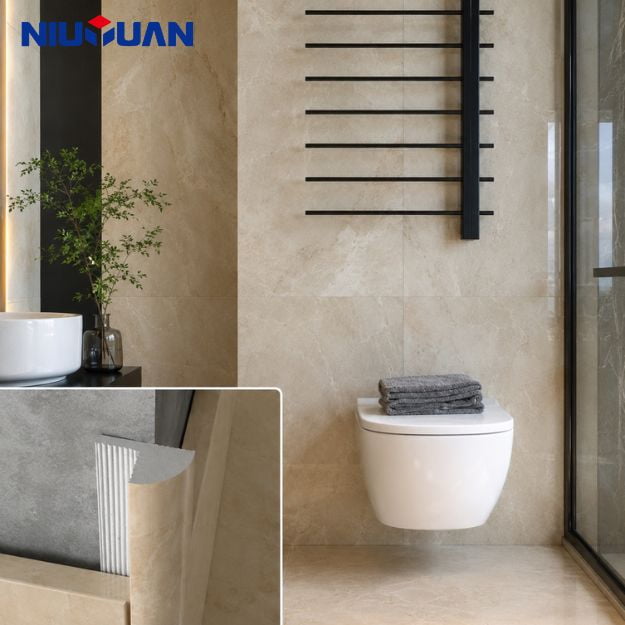
No, PVC tile trim is not compatible with every adhesive, and a standard profile is not glued onto the tile face. It has a perforated anchoring leg, pressed into the tile adhesive bed under the edge tile. The adhesive locks the leg in place through the perforations as it cures.
That design narrows the question, since the trim works with the material that beds the tile and its leg sits inside that bed. Problems start when a glue-type product replaces the setting bed, or when a solvent-based product touches the PVC. Our step-by-step tile trim installation guide shows the leg set before the edge tile goes on.
How the trim is fixed decides the adhesive
Profile makers write their instructions around this leg, and Schluter specifies thin-set mortar for its PVC JOLLY-P profile. The leg is pressed into the mortar, then more mortar is troweled over the perforations. Genesis gives the same sequence for its PVC trims: adhesive first, leg in, adhesive over the leg, tile flush.
So the default answer is simple: use the cement-based tile adhesive that the tile job itself calls for. Modified and unmodified mortars are cement systems, and profile instructions name thin-set without splitting the two. Choose between them for the tile, substrate and membrane, not for the trim. The PVC tile trim range shows the profiles this applies to.
Which adhesives fit, and which stay away
The table sorts adhesive families by one test: can it bed a perforated leg under a tile, and does its chemistry attack PVC? A product must pass both halves before it belongs near the trim.
| Adhesive family | Verdict | Why |
|---|---|---|
| Cement-based thinset, modified or unmodified | Standard choice | Beds the leg and the tile in one operation. |
| Premixed mastic | Dry interior walls only | Type 1 data sheet excludes shower floors, steam rooms, pools and exterior use. |
| Solvent-based contact adhesive | Avoid | A profile maker prohibits solvent-based neoprene in writing. Solvents can soften PVC. |
| PVC solvent cement | Not for trim | Welds PVC pipe and fittings by dissolving their surfaces. |
| Epoxy and reaction resins | Only with written confirmation | Specified job by job, never as the default. |
Two cautions sit behind the table: first, a data sheet limit beats a shop recommendation, every time. Gluing a surface-mounted strip onto finished tile is a different job from setting a leg. It needs a product listed for plastics, plus a test piece first.
Wet areas, heat and outdoor jobs
In a shower, steam room or pool surround, the adhesive reaches its limits before the trim does. That is why mastic data sheets carve out wet areas so carefully. Pick the setting material for the wet service first; the trim follows it. The same logic covers heated floors, where adhesive data sheets state underfloor heating suitability outright, so check that line instead of assuming it.
Outdoors, temperature swing and sun exposure join the list. The adhesive must be rated for exterior use, and the trim colour needs the same check. Our guide to whether PVC tile trim fades outdoors covers the sunlight side.
What to confirm before you order or install
Compatibility is cheapest to settle on paper, before cartons ship. I ask buyers and installers to work through four checks, and each one takes minutes while preventing a different failure on site.
- Read the data sheet for limits on wet areas, heat and substrates, and for warnings about plastics or solvents.
- Ask the trim supplier which setting material the profile was designed for. Get the answer in writing for a bulk order.
- Bond a test piece: fix an offcut with the adhesive, let it cure, then check for softening, colour change or lifting.
- Match the profile height to the tile thickness, so the leg sits flat with no gap behind it.
NIUYUAN supplies L-shaped, square-edge, round-edge and inside-corner PVC profiles, with a minimum order of 2,000 pieces and samples in 7 days. Send the adhesive name with your enquiry, and our technical reply within one working day will confirm the pairing. Still choosing the material? How PVC trim compares with aluminum trim sets out the trade-offs.
My working rule is simple: if the product beds tiles in a cement bed, it can almost always set a PVC trim leg. If it comes in a tube and works by solvent or contact tack, keep it away from the trim. Both makers should confirm that pairing in writing first.
Frequently asked questions
Can I set PVC tile trim with unmodified thinset?
Yes, if unmodified mortar suits the tile, substrate and membrane. PVC profile instructions call for thin-set mortar without separating modified from unmodified, so the choice belongs to the tile system, not the trim.
Can I glue PVC tile trim onto tiles that are already fitted?
Only with a surface-mounted profile and a product listed for plastics. A standard profile needs its leg in the adhesive bed, so it cannot be added afterwards, and its bond should be tested on an offcut.
Is mastic suitable for PVC trim in a shower?
Check the product data sheet first: one Type 1 mastic allows shower walls. Its data sheet excludes shower floors, steam rooms and standing water, so cement-based mortar is the safer default in wet areas.
Which adhesives should I avoid with PVC tile trim?
Avoid solvent-based contact adhesives, especially neoprene types, unless the trim maker confirms them. Keep PVC solvent cement for pipe joints, not trim.