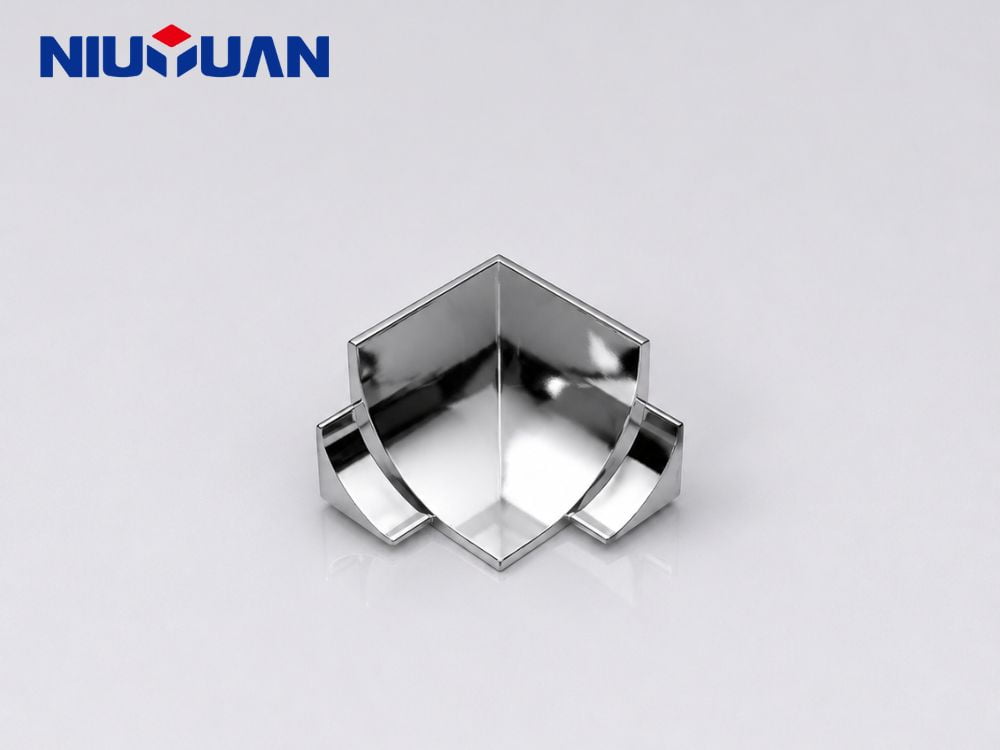
Corner joints are where tile trim work shows its skill level, and on a 90-degree corner you have two honest options. You can mitre the trim itself, cutting both ends at 45 degrees so the metal turns the corner. Or you can fit a ready-made corner piece, a factory-formed joint that the trim lengths plug into. Neither is universally better.
The right choice turns on three things: how true your tiles and walls are, and what the cut edge does to the profile and finish. It also depends on how many corners must come out identical. This guide compares the two methods at the points where they actually fail, and ends with a scenario table to work through corner by corner. For the full setting-out and fixing sequence once you have chosen, see our guide on how to install tile trim.
Mitring the Trim: What It Takes and Where It Fails
A mitred corner keeps one material flowing around the turn. On an outside corner, each length is cut at 45 degrees. The face runs long, so the two faces meet at a point, and on an inside corner the cut reverses. Square-edge profiles and L-shaped profiles mitre most predictably, because their flat faces register against the saw fence. Round-edge profiles are less forgiving, as the curved face has to align in two planes at once.
The tools are ordinary. Aluminium and PVC cut cleanly with a fine-tooth hacksaw in a mitre box. Stainless steel suits a chop saw with a non-ferrous blade, or an angle grinder with a thin cutting disc. What decides the result is not the tool but the dry fit. Both halves must be offered up to the real corner before adhesive is spread, because the real corner, not the drawing, is the reference.
Where Mitres Fail
Mitres fail in predictable places:
- Walls out of square. The method assumes a 90-degree corner, and a wall that leans or bows opens a wedge-shaped gap no grout line can hide.
- Tile and bed variation. Tile thickness and adhesive bed vary along any run, so the apex lands high or low and the two faces step instead of meeting flush.
- Cut faces and finishes. Sawing raises burrs, and de-burring can dull an anodised or brushed edge. On mirror and PVD finishes, a poor cut shows at the most visible point of the whole job.
- The grout line at the apex. The meeting point is a thin edge of metal with little behind it. Grout packs poorly there, and the line can crumble out of a hard-worked outside corner.
- Sharp points. A mitred outside corner ends in a metal point, and in knock-prone areas it is a safety concern and the first place to suffer damage.
None of this makes mitring a bad method, and in skilled hands, on true walls, it produces the cleanest corner available. The question is how often site conditions give it that chance.
Ready-Made Corner Pieces: Consistency, With Limits
A corner piece replaces the cut with a moulded joint. The piece is formed to a true 90 degrees, and the trim lengths push-fit into its arms. NIUYUAN’s tile trim corner pieces cover inside corners, outside corners, two-way joints and three-way junctions.
They are moulded in PVC/ABS and colour-matched to the trim, in white, ivory, beige, silver, black, gold and chrome. Sizes follow the profile: L-shaped, T-shaped, round-edge, square-edge and triangular profiles in 8, 10 and 12 mm leg heights.
The gain is repeatability: every corner on the project comes out the same, whoever fitted it. That matters on multi-bathroom projects, where corners are counted in dozens and the labour grade varies by crew. It also matters on round-edge profiles, whose curved face no longer has to be matched across two angled cuts.
The limits are just as concrete:
- Series coverage. Corner pieces exist only for profile ranges that offer them, in matching leg heights. Confirm availability when the trim is specified, not when the tiler reaches the first corner.
- A material break. The piece is colour-matched moulded plastic, not the profile metal itself. Against solid brass or a mirror stainless finish, it reads as a different material at close range.
- Fixed geometry. A moulded piece fits only the angle it was made for; on a corner visibly off square, it rocks or gaps instead of bedding flat.
- One more line on the order. Corners forgotten at ordering stage stall an otherwise finished wall, so pieces and trim should be counted together, corner by corner, from the drawings.
The Decision, Corner by Corner
Work through the table against your own corner schedule; where one job mixes conditions, mixing methods is normal, as the first FAQ below explains.
| Situation | Default choice | Why |
|---|---|---|
| A few feature corners in square-edge stainless steel, set by an experienced tiler | Mitre | One material turns the corner with no visible break, and the corner count is low enough to cut each one carefully. |
| The same bathroom corner repeated across a housing or hotel project | Corner pieces | Every corner matches. The result stops depending on which installer happened to cut it. |
| Round-edge outside corners in family or high-traffic areas | Corner pieces | The formed piece keeps the curve aligned and replaces the sharp mitred point with a moulded one. |
| A solid brass or mirror-finish corner used as a design feature | Mitre | Only the real metal reads as one material where the corner is meant to be looked at. |
| A corner measured visibly off 90 degrees | Mitre, cut to the measured angle | A saw cut can follow the real angle. A moulded 90-degree piece cannot. |
| Three-way junctions, where two walls meet a counter or floor | Corner pieces | Three mitred ends meeting at one point is the hardest cut in the run. The three-way piece is formed for exactly this. |
| Inside corners in showers and wet rooms | Either — decide by the sealant detail | Inside corners take movement, so the flexible sealant joint matters more than the joint shape. The inside corner tile trim range covers the profile side of this detail. |
Corners Are Only One of Three Joints
Corners get the attention, but a trim run has two other joints. Straight lengths are joined end to end with tile trim connectors, which keep the faces aligned across the joint. Exposed run ends are closed with tile trim end caps instead of a raw cut edge. Our tile trim accessories guide sets out how the three joint types divide the work across a full installation.
Frequently Asked Questions
Can I mix mitred corners and corner pieces on the same project?
Yes, and many projects should: mitre the corners that carry the design, such as a feature wall or a brass detail. Use corner pieces for the repeated, low-visibility corners behind doors and inside cupboards. Keep one method along a single sightline, so the eye does not compare two corner finishes side by side.
Do corner pieces fit any tile trim profile?
No — a corner piece must match the profile shape and the leg height of the trim it joins. NIUYUAN pieces cover L-shaped, T-shaped, round-edge, square-edge and triangular profiles in 8, 10 and 12 mm leg heights. If your profile has no matching piece, mitring or a simple butt joint are the remaining options.
Is a mitred corner stronger than a corner piece?
They fail differently rather than one being stronger, and a mitred corner keeps the full profile material. Its apex, though, is a thin edge that chips and dents at the point. A corner piece puts a moulded, slightly rounded point at the corner, which shrugs off knocks better. Behind both, the adhesive bed decides how much abuse either construction can take.
What if my corner is not exactly 90 degrees?
Measure the real angle before choosing: a mitre can be cut or trimmed to an off-square angle, so it adapts to older walls. A moulded corner piece suits true 90-degree corners and will gap on a wall far out of square. Slightly out-of-square corners are usually absorbed by the adhesive bed and the grout line either way.