
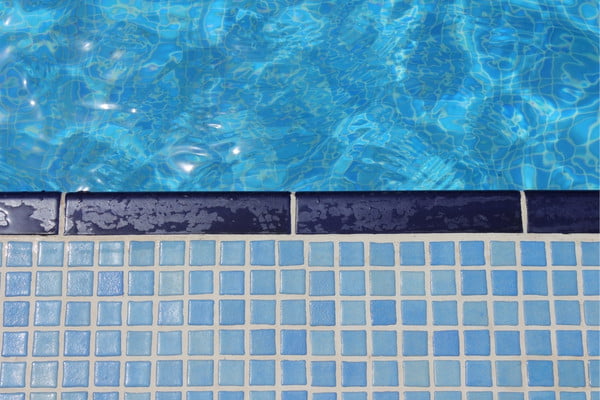
Choose bullnose when your tile line actually offers a matching bullnose piece and you want the edge to disappear into the tile; choose a metal trim profile when it does not, when the edge needs stronger protection, or when one stocked profile range has to finish many different tile lines. That is the whole decision in one sentence — everything below is how to check it in order: availability first, then look, durability, installation timing, and what the choice means for repeat orders. One scope note: “bullnose” here means the factory-rounded edge piece made from the tile material itself, and “metal trim” means the separate profile — aluminum, stainless steel or brass — that is set into the adhesive bed while tiling. Our explainer covers what bullnose tile trim is in detail; this guide assumes that definition and compares the two routes as a buying and specification decision.
The two options, briefly
A bullnose piece is a tile with one edge factory-finished into a smooth radius — single bullnose for a straight exposed edge, corner pieces where two rounded edges meet. Because it is made from the same material as the field tile, the color, texture and sheen match by construction, and it also covers the unglazed tile body that a cut edge would expose. A metal trim profile is a separate product entirely: a length of formed metal with an anchoring leg that embeds in the adhesive and a visible face that caps the tile edge. Profiles come in families — L-shaped, square-edge, round-edge and others, mapped in our tile trim profiles guide — and in heights matched to tile thickness, so the same system finishes ceramic, porcelain, glass or stone without depending on any of their ranges.
Side-by-side comparison
| Decision point | Bullnose tile piece | Metal trim profile |
|---|---|---|
| What it is | A tile piece with a factory-rounded edge, same material as the field tile | A separate metal length set into the adhesive during tiling |
| Availability | Only where the tile line offers one; many modern and large-format lines do not | Independent of the tile line; selected by height, shape and finish |
| Look | Blended and soft; the edge reads as part of the tile | A defined line; can blend by finish or deliberately contrast |
| Color match | Exact by construction, subject to batch variation between tile lots | Matched by finish selection or sample; a metal tone, not the tile glaze |
| Edge protection | Rounded, but still tile — it can chip like the tile around it | The profile caps and shields the raw tile edge from knocks |
| Safety at corners | Rounded by design | Depends on shape: round-edge profiles are rounded; square-edge profiles are deliberately crisp |
| Installation timing | Decided with the tile order; pieces are laid as tiles | Decided before tiling starts; height must match tile plus adhesive bed |
| Range planning | Stock follows every tile line you carry, line by line | One profile range in a few heights finishes many tile lines |
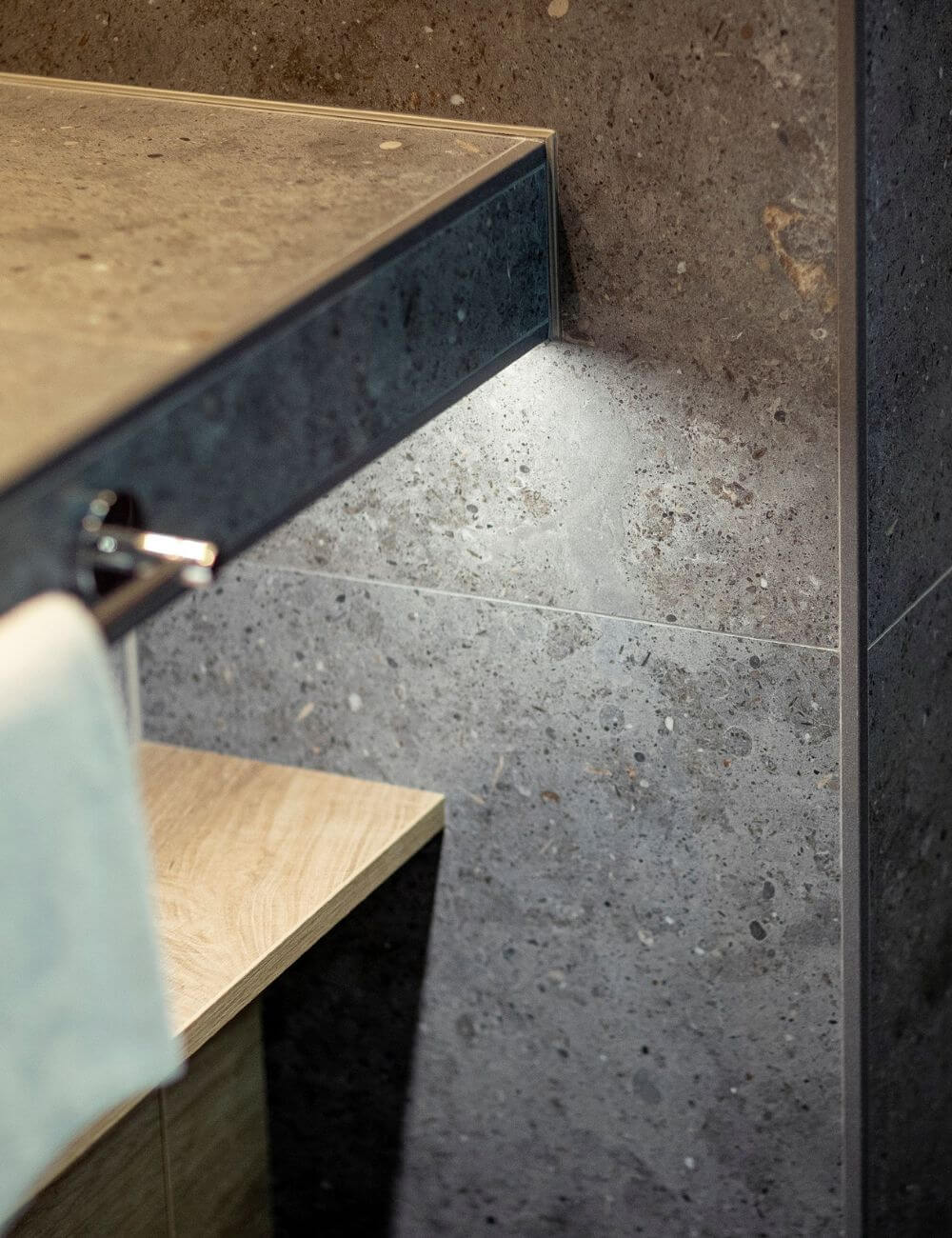
Check 1: Availability — the gate most projects fail first
Before comparing looks, ask one question: does the tile you have chosen actually come with a bullnose? A growing share of contemporary tile lines — large-format porcelain, artisan and imported ranges — are sold without any matching edge piece at all, and no amount of preference changes that. If the answer is no, the comparison is over: the realistic options are a metal (or PVC) profile, a mitred edge, or changing the tile. If the answer is yes, check the second gate: batch. Bullnose pieces and field tiles are glazed products, and pieces bought later or from a different production lot can sit visibly off-tone against the original tiles, so the pieces belong in the original tile order, with spares, rather than on a follow-up purchase. A profile has no equivalent gate — it is stocked by height and finish, and a replacement length bought next year is the same product.
Check 2: Look — blended edge or defined line
Bullnose continues the tile around the edge, so the surface reads as one material with a softened border. That suits traditional, transitional and rustic schemes, and any design where a metal line would interrupt the pattern. A metal profile does the opposite: it draws a deliberate line at the edge. In a square-edge shape that line is crisp and architectural; in a round-edge shape it is softer; in a contrasting finish — black against white tile, brass against stone-look porcelain — it becomes part of the design rather than a repair for a missing piece. Neither is more modern in itself. What dates a project is a mismatched decision: a bulky bullnose forced onto a minimal large-format layout, or a hard square metal line dropped into a soft traditional bathroom. Our guide to which tile edge trim to use works through the position-by-position choices behind this check.
Check 3: Durability and the shape of the edge
A bullnose edge is rounded, comfortable and kind to passing shoulders — and it is still ceramic or porcelain, with a tile’s resistance to impact. On an outside corner that takes trolley, suitcase or vacuum knocks, it chips on roughly the same terms as the field tile, and the replacement is another tile piece, in the right batch if you are lucky. A metal profile separates the two jobs: the tile provides the surface, the profile takes the knocks. Aluminum is the everyday balance of rigidity, finish choice and cost; stainless steel is the step up for heavy-use and wet or coastal positions. Shape carries the safety decision inside the metal option: choose a round-edge profile where people brush past corners, and a square-edge profile where the crisp line is the point and contact is light. Bullnose’s softness, in other words, is available on both routes — it is a shape decision, not a reason by itself to choose tile over metal.
Check 4: Installation and timing
The two options fail at different moments, which is worth knowing before work starts. Bullnose fails at ordering: if the pieces were not ordered with the tiles — in the right quantity, with corner pieces where outside corners occur — the edge waits on a tile delivery. Laying them is ordinary tiling. A profile fails at setting out: its height has to match the tile thickness plus the adhesive bed, it is fixed in the same adhesive while the tiles are laid, and corners are either mitred on site or closed with matching corner pieces from the same system. Get the height wrong and the face sits proud or buried, which no later adjustment fixes. For a specifier, the practical translation is simple: bullnose is a tile-schedule decision, a profile is a trim-schedule decision, and both have to be made before the tiler starts — neither is a finishing-week purchase.
Check 5: What the choice means for a range
For distributors and importers this is the check that outlasts any single project. Bullnose ties your edge stock to every tile line you carry: each line needs its own pieces, its own corners, its own batch management, and a discontinued tile line orphans its bullnose stock with it. A profile range decouples the edge from the tile. One aluminum trim range in the common heights, two or three shapes and a small set of finishes finishes most of the tile lines a distributor sells, turns over independently of them, and gives project customers a specifiable answer when their chosen tile arrives without an edge piece — which, per Check 1, is increasingly often. That is why trim profiles are stocked as a range in their own right rather than treated as an accessory to tile stock.
When bullnose is the right choice
- The tile line offers a matching bullnose and corner pieces, ordered in the same batch as the field tiles
- The design wants the edge to disappear — traditional, transitional or pattern-led schemes
- Edges are low-contact wall borders, niches and backsplash ends where a soft radius is enough
- The project is a one-off with no repeat-order or range implications
When metal trim is the right choice
- The chosen tile has no matching bullnose — large-format, artisan and many imported lines
- Outside corners and exposed edges take regular contact and need a cap that is not tile
- The design wants a defined line, a contrast finish, or one finish held consistent across several tile ranges
- You are building a stocked range: profiles in standard heights finish many tile lines and reorder identically
- Wet, coastal or heavy-use commercial positions call for a specified metal grade rather than a tile piece
If your project sits between the two lists — matching bullnose exists, but the corners take real contact — the deciding question is which failure you would rather manage: a chipped tile edge replaced from spare batch stock, or a metal line you accept visually in exchange for protection. Send the tile, the edge positions and the quantities through our contact page and we will confirm which profile shapes and heights fit the tile thickness you are working with.
FAQ
What is the main difference between bullnose tile and metal tile trim?
A bullnose is a tile piece with a factory-rounded edge, made from the same material as the field tile, so the edge blends into the surface. A metal trim is a separate profile — aluminum, stainless steel or brass — set into the adhesive during tiling, which caps the raw tile edge with a defined line. The practical difference is dependence: bullnose exists only where the tile line offers it, while a profile is selected by height, shape and finish and works with almost any tile.
Can I use metal trim if my tile has no matching bullnose?
Yes — that is the most common reason for choosing it. Many modern and large-format tile lines are sold without bullnose pieces. A profile in the height that matches your tile thickness plus adhesive bed finishes the edge independently of the tile range, in a shape and finish you select. The decision has to be made before tiling starts, because the profile is embedded as the tiles are laid.
Is bullnose cheaper than metal trim?
It can be, when a matching bullnose is readily available in the tile line — the edge is then just more tile pieces on the same order. The comparison changes when pieces must be specially sourced, when corner pieces multiply, or when a chipped bullnose has to be replaced from a later batch. A profile adds a separate product line to the order, priced by material, shape and finish. Compare the complete edge — pieces, corners, spares and replacement risk — not the single-piece price.
Which is better for outside corners?
For low-contact corners where the look should stay soft and blended, bullnose — ideally the line’s corner pieces — works well. For corners that take regular knocks, a metal profile protects better because the cap, not the tile, absorbs contact; choose a round-edge profile where people brush past, and reserve square-edge profiles for crisp lines in lighter-contact positions.
Can metal trim match my tile color?
A metal profile will not reproduce a tile glaze exactly — it matches by finish instead. Finishes range from near-neutral metallic tones that sit quietly against most tiles to solid colors and deliberate contrasts such as black or brass tones. The workable method is to select the finish against a physical tile sample, the same way a custom trim color is confirmed, rather than from a screen image.