
Tile trim profiles come in six main families: L-shaped (the all-rounder), square-edge (the modern flat look), round-edge/bullnose (the soft protective curve), quadrant (for outside corners), T-shaped (for same-level joints and transitions), and U-shaped (the channel). For most projects, choosing comes down to three questions: where does the trim sit — an exposed edge, a corner, or a joint? What is the tile thickness — because trim height is matched to it? And what look does the project want? This guide explains each profile so you can spec the right one on the first RFQ.
This guide is part of our Tile Trims: The Ultimate Guide, which covers materials, finishes, sizing, and applications.
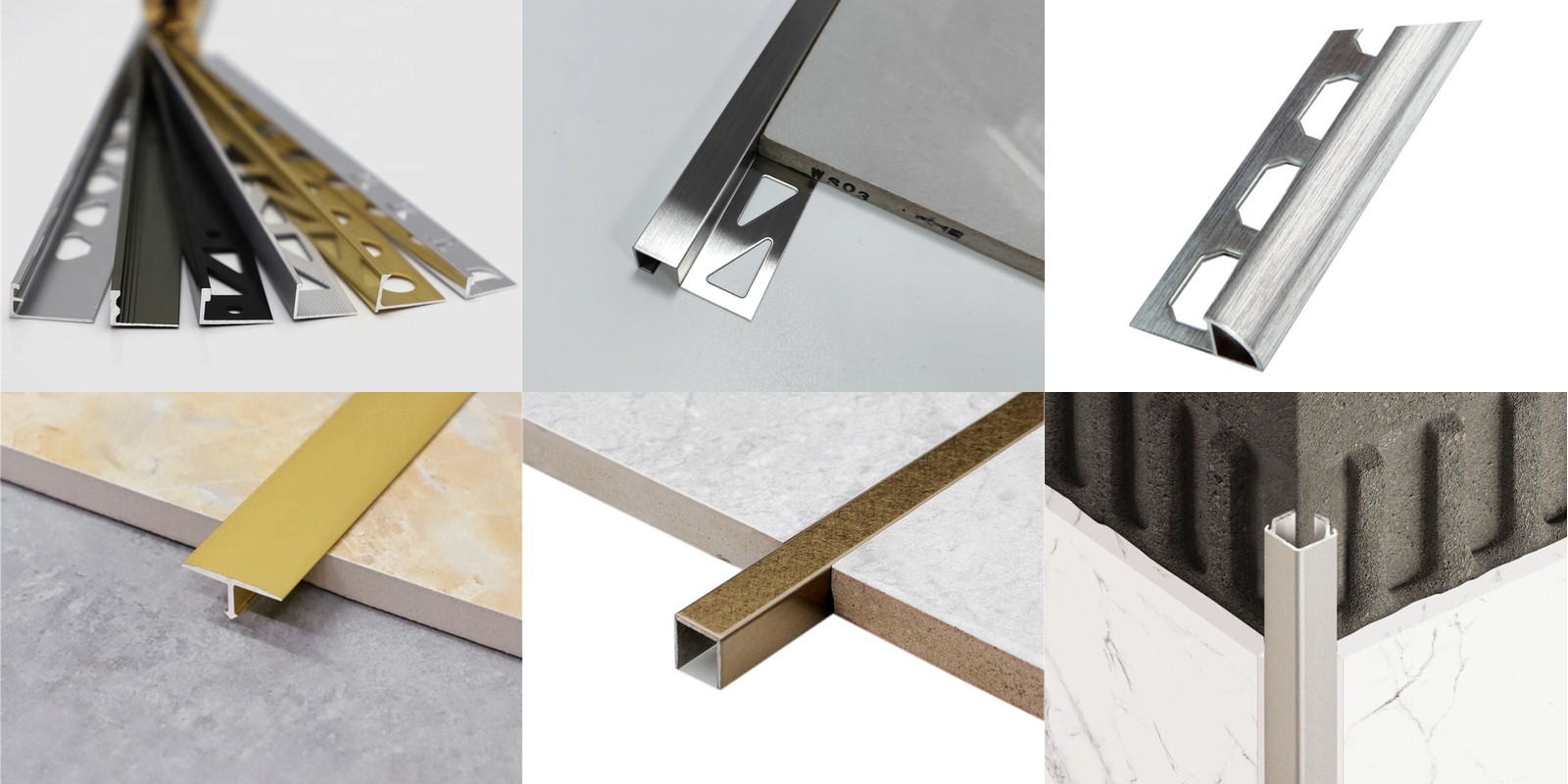
The 6 Core Profiles at a Glance
| Profile | Shape | Job | Typical use |
|---|---|---|---|
| L-shaped | 90° angle | Finishes exposed edges with a straight line | Wall edges, backsplashes, countertops, floor borders |
| Square-edge / flat | Straight, flat face | Minimal, modern edge detail | Contemporary walls, niches, rectified-tile projects |
| Round-edge / bullnose | Rounded curve | Soft, chip-resistant edge | Countertops, window sills, high-traffic corners |
| Quadrant | Curved corner profile | Finishes outside corners | External wall corners, bathtub and shower edges |
| T-shaped | “T” cross-section | Covers joints and same-level transitions | Floor joints, tile-to-tile borders, decorative lines |
| U-shaped | Channel | Wraps an edge or forms a groove | Panel edging, decorative grooves, tile edges |
L-Shaped: The All-Rounder
The L-shaped profile is the workhorse of tile trim. One leg sits under the tile and bonds into the thinset during installation; the visible leg forms a clean 90° finished edge. Use it anywhere an exposed tile edge needs a straight, professional line — wall terminations, backsplash tops, countertop edges, and floor borders.
Because it’s the most common shape, L-shaped trim is where you get the widest choice of materials and finishes: aluminum, stainless steel, brass, and PVC options exist on NIUYUAN’s L-shaped tile trim page. If your order mixes wall and floor applications but the finish must stay consistent, starting from the L-shaped range is usually the simplest path — the same finish line often extends across other profiles.
Square-Edge: The Modern Flat Look
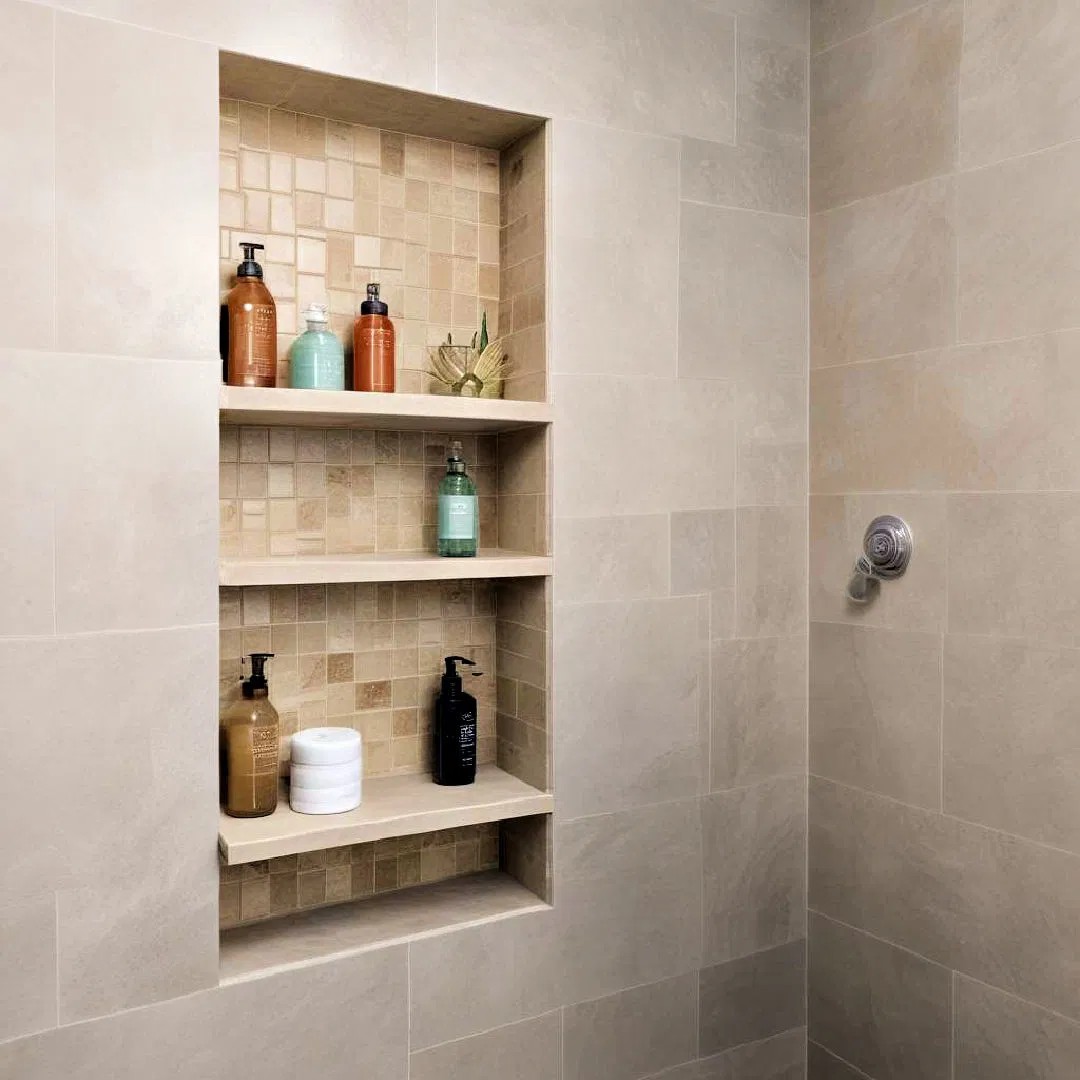
Square-edge (flat) trim finishes exposed edges with a straight, angular face — no curve, no reveal. It’s the go-to for contemporary projects where sharp lines and rectified tiles dominate: shower niches, feature walls, and minimalist bathrooms. Functionally it does the same edge-protection job as L-shaped; the difference is purely the visible face.
One practical note: square-edge profiles show every imperfection, so they pair best with straight cuts and consistent tile thickness. See NIUYUAN’s square-edge tile trim range, available in aluminum, stainless steel, brass, and PVC for selected wall applications. For a broader brand-name reference, this is the equivalent of Schluter’s QUADEC line — the square-shaped profile in their catalog.
Round-Edge / Bullnose: The Protective Curve
Round-edge trim — also called bullnose in the trade — replaces a sharp 90° edge with a smooth curve. The curve isn’t just decorative: it deflects knocks and makes chipped edges less likely on exposed, high-contact spots like countertop edges, window sills, and stair-adjacent corners. If a project has heavy foot traffic or hard-use surfaces, round-edge is the conservative choice.
This is the profile most often compared against ceramic bullnose tiles. A separate guide on which tile edge trim to use covers that trade-off in detail; the short version is that metal round-edge gives you fixture-matching finishes (matte black, brushed nickel) that bullnose tile lines often can’t. Browse the round-edge tile trim range for the metal options.
Quadrant: For Outside Corners
Quadrant trim is the curved profile designed specifically for external corners — the 90° outside corner of a tiled wall, column, or bathtub surround. Where L-shaped or square-edge trim finishes a flat edge, quadrant wraps the corner itself with a smooth radius, protecting the most impact-prone point of the installation while giving it a finished look.
Spec this when the corner is a design feature (hotel bathrooms, retail columns) or a damage risk (corridors, public washrooms). Quadrant is typically ordered in the same finish as the project’s edge trim, so name both on the same PO to keep shades consistent — different production batches can vary slightly. NIUYUAN’s tile corner trim page covers corner-specific profiles and matching accessories like corner pieces and end caps.
T-Shaped: For Joints and Same-Level Transitions
T-shaped trim doesn’t finish an exposed edge — it covers the gap between two surfaces. The stem of the “T” sits in the joint; the top bar bridges it with a clean decorative line. Typical jobs: tile-to-tile floor joints, borders between different tile fields, and same-level transitions where a full transition strip would be overkill.
Size it by the gap, not the tile thickness — the RFQ should state gap width, top-bar width, and finish. Because T-profiles sit proud of the surface, they’re also used as deliberate design lines in large floor fields. See the T-shaped tile trim range (aluminum, stainless steel, brass). For transitions between different floor heights or materials, step up to the floor transition strip family instead.
U-Shaped: The Channel
U-shaped trim is a channel: it wraps around the edge of a tile or panel, gripping it on both faces. Use it for glass-panel edging, decorative grooves in wall fields, and tile edges where you want the trim to read as a frame rather than a line. It’s also the profile behind many LED tile trim designs, where the channel doubles as a diffuser housing.
U-channels are size-critical — the RFQ needs inner width, side height, and material thickness, since the channel must fit the tile or panel snugly. Browse the U-shaped tile trim range; for non-standard channel sizes, custom profiles can be extruded to drawing.
Related Families Worth Knowing
Beyond the six core profiles, four related families come up in most project specs:
- Transition strips — for tile-to-carpet, tile-to-wood, or different-height floors. See floor transition strips.
- Stair nosing — anti-slip nosing profiles for tiled steps; different job from edge trim. See stair tile trim.
- Inside corner trim — concave profiles for wall-to-wall or wall-to-floor internal corners. See inside corner tile trim.
- Expansion joints — movement joints for large tiled areas; a structural requirement, not decoration. See tile expansion joints.
How to Choose: 5 Steps
1. Start with position. Exposed flat edge → L-shaped or square-edge. Outside corner → quadrant. Joint or same-level transition → T-shaped. Wrap-around or channel → U-shaped. Round-edge when the edge takes knocks.
2. Match trim height to tile thickness. This is the sizing rule that matters most — a trim sized for 8 mm tile won’t sit right on 12 mm tile. NIUYUAN’s tile trim size guide walks through the measurement; confirm thickness on the RFQ rather than guessing.
3. Pick the material for the environment. Aluminum (6063/6463) is the standard for most interiors; 304 or 316 stainless steel for wet, coastal, or commercial areas; brass for premium decorative projects; PVC for cost-sensitive wall programs. The material-vs-material comparisons — aluminum vs stainless steel, brass vs aluminum — cover the trade-offs.
4. Choose the finish. Anodized, brushed, polished, powder-coated, or plated — the tile trim finishes guide covers the full menu. Choosing between anodized and powder-coated? Our comparison guide breaks down the trade-offs. For bright mirror finishes, note the 6063 vs 6463 alloy choice, which affects how bright the anodized result gets.
5. Keep one spec per visible run. Same profile family, same alloy, same finish batch across one wall, niche, or floor — mixed specs can show shade differences after anodizing. Name the profile, material, and finish explicitly on the PO.
What to Put in Your RFQ
A clear RFQ gets an accurate quote faster. For profile orders, include:
- Profile family: L-shaped, square-edge, round-edge, quadrant, T-shaped, or U-shaped — plus a drawing or photo for non-standard shapes
- Tile/panel thickness: so trim height (or channel inner width) can be matched
- Material and finish: e.g. 6063 aluminum, matte black anodized; reference the finishes guide
- Dimensions: trim height, length (standard or custom), and for T/U profiles the gap width or channel size
- Accessories: corner pieces, end caps, connectors if the run needs them
- Quantity and packaging: estimated pcs, export carton/pallet requirements, private-label needs
- Target delivery: project timeline and destination port
- Material documentation: tell us in your RFQ if you need mill certificates or test reports
NIUYUAN extrudes tile trim profiles in aluminum, stainless steel, brass, and PVC (per profile range), with OEM custom profiles to drawing, private label, and custom export packaging. Our published aluminum MOQ starts from 1,000 pcs, with the final quantity confirmed by profile, finish, color, packaging, and customization requirements. After the relevant requirements are confirmed, available standard samples are typically prepared within 7 days and standard custom samples in 7–10 days. Sample shipping time is excluded; complex profiles and new tooling require separate confirmation. Regular bulk orders typically take 20–30 working days after order specifications, required approvals, and payment conditions are confirmed. Final MOQ and production timing follow the confirmed quotation and order. Send the list above via the contact page.
FAQ
Which tile trim profile is the most versatile? L-shaped. Its 90° angle and under-tile leg suit the widest range of jobs — wall edges, backsplashes, countertops, and floor borders — and it comes in the broadest material and finish range, including PVC options for cost-sensitive programs.
What is the difference between round-edge and quadrant trim? Round-edge (bullnose) finishes a flat exposed edge with a soft curve; quadrant wraps an outside corner with a radius. Use round-edge where a straight edge takes knocks, and quadrant where the corner itself is the vulnerable point.
How do I choose the right trim size? Match the trim height to the tile thickness — that is the primary sizing rule. Measure the tile (including any underlayment build-up for floors) and confirm it on the RFQ rather than guessing. The dedicated size guide walks through the measurement step by step.
Can I get all profiles in the same finish from one supplier? Usually yes — manufacturers run the same anodizing or powder-coating lines across profile families, which is the simplest way to keep shades consistent. Name the profile, alloy, and finish on one PO so nothing gets substituted between batches.
Do I need corner pieces and end caps? For visible runs that terminate at corners or open ends, yes — matching corner pieces, end caps, and connectors give a finished look that cut-and-miter joints can’t. List them on the RFQ alongside the profile lengths.