
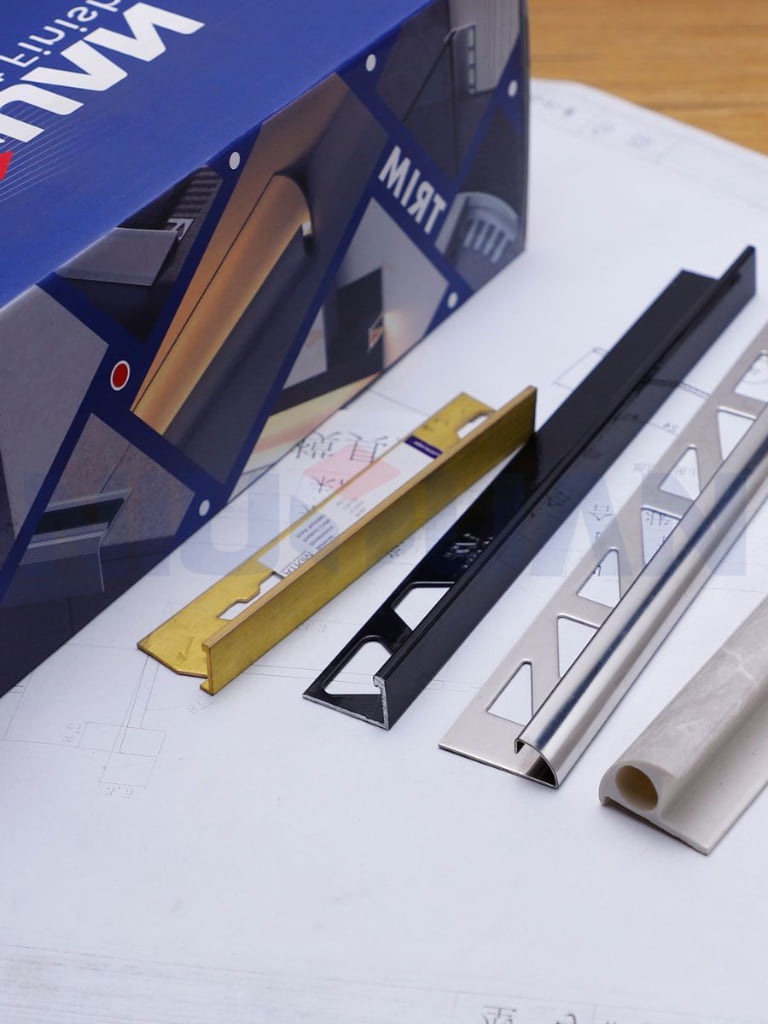
Most distributors who ask about OEM tile trim actually need one of three different things, and the order runs differently for each. Private label means the factory’s existing profiles, sold under your brand: your cartons, your labels, your barcodes. OEM adds your specification on top — a chosen profile, size, finish or color produced to your requirement and packed under your brand. Custom (ODM-style) development goes one step further: a profile that does not exist yet, developed from your drawing or sample, with tooling checked before anything is quoted. This guide walks through how each route runs at NIUYUAN, using the process published on our custom tile trim page as the worked example: where the mold check saves you tooling cost, how samples become the sealed reference your bulk order is judged against, how MOQ is actually set, and which checks happen before your branded cartons are sealed.
Three routes, three different orders
| Route | What changes | Tooling | Typical buyer |
|---|---|---|---|
| Private label | Packaging only: your cartons, labels, barcodes and shipping marks on existing profiles and finishes | None | Distributors building a house brand from a proven range |
| OEM | Your specification — profile, size, finish or color from the existing capability — plus your branding | Usually none; existing molds are checked first | Brands and importers who need a defined spec, consistently repeated |
| Custom development | A new or significantly modified profile from a drawing, CAD file or physical sample | Checked case by case; only when no existing mold can reasonably produce the profile | Buyers with a proprietary profile or a market-specific range |
The routes are not a ladder you have to climb. A private label order on existing profiles is a complete, legitimate program — it is how most house brands start — and it stays the fastest route because nothing about the product itself has to be developed. Development time, sample rounds and tooling questions only enter the picture when the product changes. One boundary applies to all three routes: not every finish, size or accessory option applies to every material or profile, and feasibility is confirmed during drawing review, not assumed from a catalogue line.
Step 1–2: Requirement review and the mold check
Every OEM or custom order starts with a requirement review: profile type, material, finish, quantity and packaging needs are reviewed before development moves forward. Send drawings, CAD files, sketches, dimensions or a physical sample — the review can only be as precise as what it starts from. With sufficient technical information received, the initial technical response is given within 1 business day.
The second step is the one that saves the most money. Your drawing or sample is checked against 3,000+ existing molds before new tooling is discussed. If a match or near-match is found, you skip the tooling cost and reach samples faster; new tooling is usually discussed only when the required profile cannot reasonably be developed from the available options. For a distributor, this check is also a range-planning tool: profiles that already exist as molds can anchor the first order, and genuinely new profiles can be phased in once the program is selling.
Step 3: Feasibility, quotation and how MOQ is set
Before quotation is confirmed, the factory confirms profile feasibility, tooling requirements, MOQ, sample cost, production conditions and the expected development timeline. MOQ is where buyers most often misread OEM offers, because the headline number is a starting point, not a property of the factory. The general reference by material is:
| Material | Reference MOQ | Material page |
|---|---|---|
| Stainless steel (304/316) | From 500 pcs | Stainless steel tile trim |
| Aluminum (6063/6463) | From 1,000 pcs | Aluminum tile trim |
| Solid brass (H59) | From 200 pcs | Brass tile trim |
| PVC | From 2,000 pcs | PVC tile trim |
Three things move the final figure away from that reference: whether new tooling is required (tooling-based custom profiles are confirmed separately), the finish and color program (a matched custom color is a different commitment from a stock finish), and the packaging scope (printed cartons and labels have their own practical minimums). Read any MOQ quote by asking which of the three is driving it — that answer tells you what to change if the quantity does not fit your program.
Step 4–5: Samples and the sealed sample that controls production
Samples are prepared from the confirmed requirements: profile samples, finish samples, color references or packaging samples, depending on what the order has to prove. Custom samples are typically prepared in 7–10 days after technical requirements are confirmed, with shipping time excluded; samples from existing molds — 1–2 pieces — are typically prepared within 7 days, and the buyer covers shipping. New-tooling or complex samples require separate confirmation.
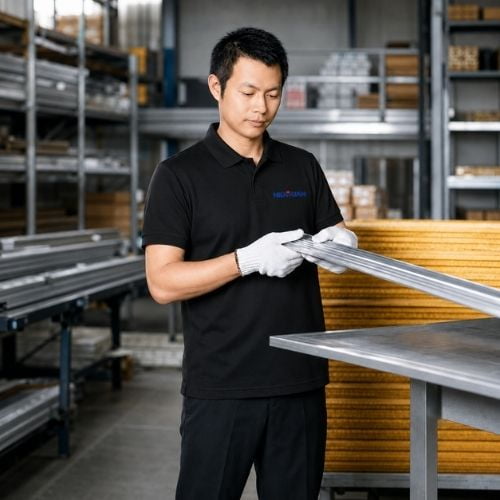
Approval is the control point of the whole OEM process, and it is worth treating it that way. After you approve, sealed samples are prepared from the same batch and retained as the factory reference for 2 years from your last repeat order. That sealed sample is what bulk production is checked against — profile dimensions, surface finish, color and packaging are compared with the approved sample and drawing at key stages. In practical terms: judge the sample as if it were the shipment, because contractually and operationally, it is. If a finish looks slightly off under your warehouse lighting, that is the moment to say so, not after the container is packed.
Color and finish matching under your brand
Custom finishes and color matching are confirmed during the sample stage — anodized, powder coated, brushed, polished, matte, satin, PVD, electroplated, wood grain and marble-effect directions are all handled as sample-first decisions, not as names picked from a list. The same applies to the profile range itself: if you are still mapping which shapes your program needs, our tile trim profiles guide explains the shape families each material is supplied in. Matching accessories — corners, end caps and connectors — can be developed alongside the main profile order, which matters for a branded range: a house-brand profile whose corner pieces arrive in someone else’s finish breaks the program at the shelf.
Private label packaging: what gets customized, what gets checked
Private label packaging covers custom cartons, labels, barcodes and shipping marks produced to your specifications, on top of the standard protective film and export packing. Two practical points decide whether a private label order runs smoothly. First, artwork is a production input: carton and label files need to be final at sample stage, because packaging samples are part of what gets approved. Second, packaging is a QC item, not an afterthought — custom cartons, labels and shipping marks are verified before shipment, alongside the product checks. If your market needs retail-ready presentation rather than distributor cartons, say so in the first requirement review; the packing method changes the quotation, and discovering it at the packing stage changes the timeline.
Step 6: Bulk production, inspection and repeat orders
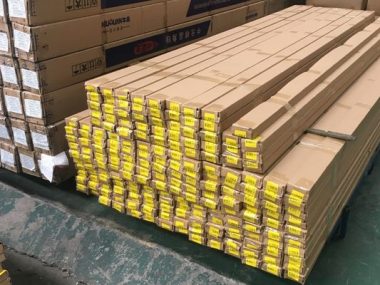
Regular bulk production typically runs 20–30 working days after order confirmation and sample approval. During production, profile dimensions, surface finish, color and packaging are checked against the approved sample and drawing, and the finished order is reviewed before shipment preparation. Repeat orders are produced and inspected against the same sealed sample, which is what makes an OEM program compound in value: the second and fifth orders do not restart the approval argument, they inherit it. If you are also arranging the freight side of the program yourself, our guide to importing tile trim from China covers the shipping and inspection steps that sit downstream of production.
Tooling and mold fees, stated plainly
For tooling-based custom profiles, the mold fee is confirmed before sample development starts — there is no version of this process where tooling begins on a verbal understanding. Once the agreed cumulative order quantity is reached, the mold fee is credited back against your order, and that refund threshold is confirmed in writing before tooling starts. Ask for the threshold number in the quotation stage and keep it with the order documents; it is a normal, expected question, and a factory that cannot state it in writing has not finished its own feasibility step.
What to send to start an OEM or private label order
- Your route: private label on existing profiles, OEM to a specification, or a new profile development
- Profile type and material, with a drawing, CAD file, sketch or physical sample if the product changes
- Size, finish and color requirements, with reference samples where color matters
- Target quantity per profile — and which SKUs are the core range versus trials
- Packaging scope: carton, label, barcode and shipping mark artwork, or a request to develop it
- Any matching accessories the range needs (corners, end caps, connectors)
Send the list through our contact page. The single most useful thing in the first message is the route: it tells the review whether you need a packaging quotation, a specification quotation, or a development feasibility check — three different answers that should not be blurred into one.
FAQ
What is the difference between OEM and private label tile trim?
Private label puts your brand on the factory’s existing profiles: your cartons, labels, barcodes and shipping marks, with the product itself unchanged. OEM produces to your specification — a chosen profile, size, finish or color — also under your brand. A profile that does not exist yet is custom development, which starts with a drawing or sample and a mold check.
Do OEM orders always need new tooling or a mold fee?
No. Your drawing or sample is first checked against 3,000+ existing molds, and a match or near-match avoids tooling cost entirely. New tooling is usually discussed only when the profile cannot reasonably be developed from existing options. Where tooling is needed, the mold fee is confirmed before sample development, and it is credited back once the agreed cumulative quantity is reached, with the threshold confirmed in writing.
What is the MOQ for OEM or private label tile trim?
As a general reference, stainless steel starts from 500 pieces, aluminum from 1,000 pieces, solid brass from 200 pieces and PVC from 2,000 pieces. The final MOQ depends on material, profile type, finish, packaging requirements and whether new tooling is involved — tooling-based custom profiles are confirmed separately.
How long do OEM samples and bulk production take?
Custom samples are typically prepared in 7–10 days after technical requirements are confirmed, and samples from existing molds — 1–2 pieces — are typically ready within 7 days; shipping time is excluded and the buyer covers sample shipping. Regular bulk production typically runs 20–30 working days after order confirmation and sample approval.
How is bulk production kept consistent with my approved sample?
After approval, sealed samples from the same batch are retained as the factory reference for 2 years from your last repeat order. During production, profile dimensions, surface finish, color and packaging are checked against the approved sample and drawing at key stages, and custom cartons, labels and shipping marks are verified before shipment. Repeat orders are produced and inspected against the same sealed sample.