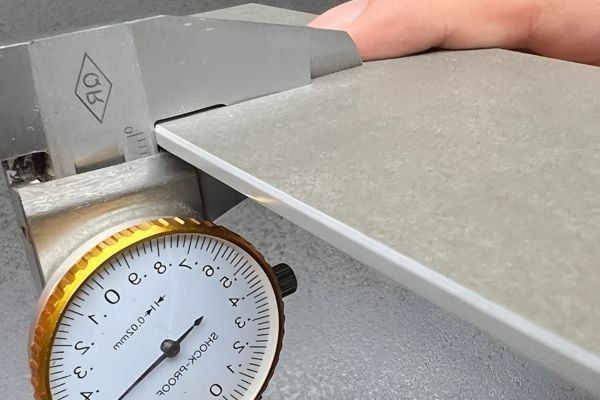
Choose a trim that matches your tile thickness, or goes 1 to 2 mm deeper, as our size guide sets out. A trim at the same height gives a snug fit, while one 1 to 2 mm deeper leaves room for adhesive and tile differences.
Start with the tile, not the box label. Measure the real tile with a caliper or ruler, add the adhesive build-up under it, and the total tells you the trim height to order. If you skip this step, you order by guesswork, and the edge shows it.
Three Steps to Measure Before You Order
The method takes three steps, each one using a number you can check on site, so measure first, add the adhesive, then pick the height.
- Measure the tile: take three or four tiles from the same batch and measure each one. Use the thickest reading as your base number.
- Check the adhesive. Note how thick the adhesive bed will be under the tile. A thick bed lifts the tile face, so the trim must cover that lift too.
- Add the two numbers and pick the height. Choose the trim height at or above the total. Round up to the next size when you fall between two sizes.
Common Tile Thicknesses and the Trim Height to Pick
The table below uses the values from our tile trim size guide, and it covers the tile sizes buyers ask about most. Find your tile thickness in the left column, then read across for the trim height to order.
| Tile thickness | Trim height to order | Notes |
|---|---|---|
| 6 mm | 6 mm, or 7–8 mm | Snug fit, or extra room for adhesive |
| 8 mm | 8 mm, or 9–10 mm | Fits most standard wall and floor tiles |
| 10 mm | 10 mm, or 11–12 mm | Thicker floor tiles and some wall tiles |
| 12.5 mm | 12.5 mm, or 13–14 mm | Natural stone and thicker pavers |
Thin mosaic sheets, at 3 to 6 mm, often take a 4.5 mm or 6 mm trim. Thick natural stone can need 12.5 mm or 15 mm. Check the maker data for both tile and trim when your tile falls outside this table.
What Goes Wrong With the Wrong Height
A trim that is too shallow leaves the tile edge standing proud of the trim. The edge stays exposed, so it chips more easily, and it also traps dirt along the step while the line looks unfinished. Our size guide states the trim face should never sit below the tile surface.
A trim that is far too deep leaves a gap between the tile edge and the trim face. Dirt collects there, and the edge can shift. A trim up to 2 mm deeper than the tile is the normal allowance, not a fault. A wide gap is easy to see and hard to clean.
Aim for a flush finish, with the trim face level with the tile face, or less than 1 mm above it. That small margin covers tiles that vary slightly in thickness, and it keeps the edge protected without a lip that catches cloths or feet. If you are new to profiles, start with what tile trim is and how each shape works.
Before You Order
Measure more than one tile before you order. A tile sold as 8 mm may measure 7.8 mm or 8.2 mm, so the label alone can mislead you. Confirm the profile height, material, and finish with your supplier in writing, and ask for a sample in the same height you plan to order. Test it with your tile and adhesive before you commit to a full order.
For bulk orders, check the minimum order quantity for your material. Our current minimums are 1,000 pieces for aluminum, 500 for stainless steel, 200 for brass, and 2,000 for PVC. Samples take 7 days, and bulk orders take 20 to 30 working days. Confirm these figures when you place the order, as edge trim exists to protect the tile edge.
The decision is simple once you measure, since tile thickness plus adhesive gives you the trim height. Order that height, or the next size up. When the numbers still leave you between two sizes, test a sample first, as it costs less than reordering a full batch.
Frequently Asked Questions
How thick should tile trim be?
It should match your tile thickness, or go 1 to 2 mm deeper. Measure the real tile first, then add the adhesive build-up, and pick the trim height at or above that total.
Should tile trim be flush with the tile?
Yes. The trim face should sit level with the tile face, or less than 1 mm above it. It should never sit below the tile surface, or the edge stays exposed.
What happens if tile trim is too shallow?
The tile edge stands proud of the trim and stays exposed, so it chips more easily, traps dirt, and looks unfinished. Measure the tile and adhesive before you order, and step up one size when in doubt.
What size trim do I need for 8 mm tiles?
Use an 8 mm trim, or a 9 to 10 mm trim when you need room for adhesive. These are the values in our tile trim size guide. Measure your tiles first, since an 8 mm tile may measure 7.8 mm or 8.2 mm.