
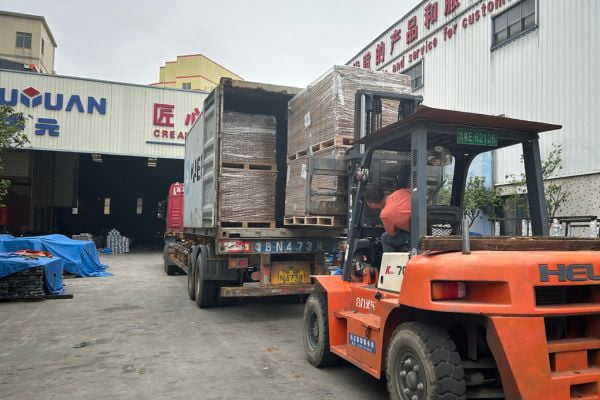
Importing tile trim from China works in seven steps: lock the specification, approve physical samples, agree quality checks in writing, produce in bulk, inspect before packing, load and document the shipment, then clear it at your destination port. For a Foshan-made metal trim order, the factory side of that timeline is predictable — reference MOQs run from 200 to 2,000 pieces depending on material, standard samples are typically ready in 7 days, and regular bulk production usually takes 20–30 working days after order confirmation and sample approval. What catches first-time importers out is rarely the factory. It is the unspecified finish, the unconfirmed packing, and a freight quote treated as fixed when it was only valid for a week. This guide walks through each step with the numbers we can verify, and flags the numbers you must confirm for your own order instead of copying from any article — including this one.
The import process in 7 steps
Every tile trim import follows the same sequence, whether you order one profile or a mixed container. Skipping a step does not remove it; it just moves the cost to later, when it is more expensive to fix.
| Step | What happens | What you should hold in your hand |
|---|---|---|
| 1. Enquiry & specification | You send material, profile, size, finish and quantity; the factory quotes against that exact spec. | A written specification sheet and a dated quotation. |
| 2. Samples | Standard samples are prepared from existing molds; custom profiles or colors take longer. | Physical samples you have approved — not photos. |
| 3. QC criteria agreed | Finish, dimensions and packing are fixed as the acceptance standard before production starts. | Sealed samples and a written checklist (Step 4 below). |
| 4. Bulk production | Regular orders usually run 20–30 working days after confirmation and sample approval. | A production schedule tied to your order. |
| 5. Pre-shipment inspection | Finished goods are checked against the approved sample, dimensions, finish consistency and packing details. | Inspection records or photos for your order. |
| 6. Packing & loading | Profiles are film-wrapped and packed in export cartons; full containers are loaded and documented. | A packing list; for FCL, loading photos/video with the container number recorded. |
| 7. Shipping & clearance | Goods move under the agreed Incoterm; your broker clears them against the invoice, packing list and bill of lading. | A complete document set that matches the physical shipment. |
New to the product itself? Start with the tile trim buying guide hub, which links every profile, material and finish guide on this site, then come back here for the import side.
Specifications to lock before you ask for a price
A quotation is only as good as the specification behind it. “Aluminum trim, silver, 1,000 pcs” can describe a dozen different products at very different prices. Before requesting a quote, fix these six items:
- Material and grade — aluminum 6063 or 6463, stainless steel 304 or 316, solid brass H59, or PVC. Grade changes both price and where the trim can be used; our tile trim profiles guide explains the profile shapes, and the material category pages (starting with aluminum tile trim and stainless steel tile trim) list the grades each line is actually made in.
- Profile and size — L, T, U, square-edge, round-edge or corner profile, with the height matched to your tile thickness. The tile trim size guide covers the thickness-matching logic.
- Finish — anodized, powder coated, brushed, polished or PVD, named precisely. “Gold” is not a specification; a sealed sample is.
- Length — reference lengths on our product pages run 2.44–3.0 m depending on material, with custom lengths by order. Length affects packing and container fit, so it belongs in the first enquiry, not the last email.
- Quantity per profile and finish — MOQs apply per specification, not per order total (see the table below).
- Packaging — retail or bulk cartons, private label, barcodes and shipping marks, confirmed before production, not after.
MOQs and lead times, by material
The figures below are NIUYUAN’s published reference values, checked against our product pages on 7 October 2026. Treat them as the starting point for a quotation, not a guarantee for every profile: final MOQs vary by profile, finish, color and packaging, and the confirmed value is the one in your quotation.
| Material | Reference MOQ | Standard samples | Custom samples | Regular bulk production |
|---|---|---|---|---|
| Aluminum (6063/6463) | from 1,000 pcs | typically within 7 days | usually 7–10 days | usually 20–30 working days |
| Stainless steel (304/316) | from 500 pcs | typically within 7 days | usually 7–10 days | usually 20–30 working days |
| Solid brass (H59) | from 200 pcs | typically within 7 days | usually 7–10 days | usually 20–30 working days |
| PVC | from 2,000 pcs | typically within 7 days | usually 7–10 days | usually 20–30 working days |
Two reading notes. First, sample lead times do not include shipping time to your country — a sample “ready in 7 days” still needs courier time before you can approve it. Second, the 20–30 working day bulk window starts after order confirmation and sample approval, so every week spent deciding a finish is a week added to your delivery date. OEM and custom packaging are supported, but they sit inside the same discipline: artwork and carton specs are part of the specification you lock at Step 1.
Samples and quality checks: agree the standard before production
The cheapest quality system in this trade is a sealed sample. The practice published on our site works like this: once you approve a sample, three sealed samples are made from the same batch — one goes to you, two stay at the factory — and production runs and pre-shipment checks are compared against that sealed standard. It removes the most common import dispute (“the bulk does not match what I approved”) by giving both sides the same physical reference.

Before bulk production, agree in writing:
- Which sample is the sealed standard, and for which profile, finish and color.
- The pre-shipment check items. Ours cover comparison against the approved sample, profile dimensions, visible finish consistency, packing details and shipment records.
- What documentation you need, and its scope. Whether mill certificates or specific test reports can be supplied depends on the material, finish and profile — ask before you order and get the answer in the quotation, rather than assuming any certificate is automatically included.
- What happens with a failed check: rework, re-inspection, or replacement terms, agreed while everyone is still friendly.
If you cannot visit the factory, these written checkpoints plus dated photos and records are your substitute. They are not a formality; they are the mechanism that makes a repeat order match the first one.
Packing and container loading: confirm, don’t assume
Tile trim is long, light and easy to damage at the corners — packing is part of the product. Our published practice is protective film on the profiles and export cartons, with private-label cartons, labels and barcodes supported for OEM orders. For full-container (FCL) shipments, loading photos and video with the container number recorded are the published practice; for less-than-container (LCL) shipments, confirm the equivalent evidence for your order case by case.
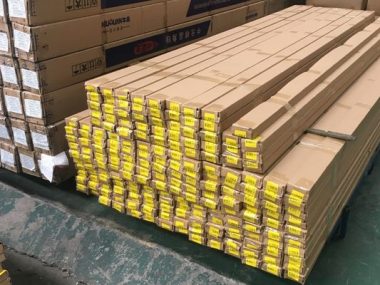
What no honest guide can give you is a universal loading number. Pieces per carton, carton dimensions and gross weight, and how many pieces fill a 20ft or 40ft container all depend on the profile, length and packing you chose. Any article that prints one container quantity for “tile trim” is inventing it. Ask for these figures for your specification, in writing, before you compare freight quotes — a freight quote priced on the wrong carton count is wrong money.
Shipping and Incoterms
Incoterms decide where the seller’s job ends and yours begins. Four cover almost every tile trim import:
| Term | In plain terms | Watch out for |
|---|---|---|
| EXW (Ex Works) | You collect at the factory and arrange everything from the factory door, including export handling. | Looks cheapest on the quote; the work and risk all sit with you from step one. |
| FOB (Free On Board) | The seller delivers the goods loaded on the vessel at the named Chinese port, export-cleared. You arrange and pay the ocean freight, insurance and everything after. | The most common basis for comparing factory quotes, because freight sits outside the product price. |
| CIF (Cost, Insurance & Freight) | The seller pays freight and minimum insurance to your destination port — but risk still passes to you when the goods are loaded at origin. | “Seller paid the freight” does not mean “seller carries the risk.” Check the insurance level. |
| DDP (Delivered Duty Paid) | The seller delivers to your door with import clearance and duty handled. | Maximum convenience, minimum visibility: you see one number and little of what is inside it. |
Freight snapshot — mid-October 2026 (re-check before you ship). Drewry’s World Container Index assessment of 15 October 2026 put the composite rate at USD 4,485 per 40ft container, up 3% on the week as rates rebounded after Golden Week. Asia–Europe spot rates rose for the first time after 13 straight weeks of decline — Shanghai–Rotterdam was USD 3,522 per 40ft, up 6% — and trans-Pacific rates firmed as well, with Shanghai–Los Angeles up 3% to USD 7,884 per 40ft. Carriers are attempting higher FAK rates on Asia–Europe from 19 October, but Drewry expects rates to remain broadly stable in the coming week. Separately, CH Robinson’s October reporting described global port congestion at a four-year high, absorbing roughly 12% of vessel capacity, with trans-Pacific capacity tight after China’s Golden Week holiday (1–7 October) and rollover risk if mid-October demand rebounds. The practical reading: rates and transit times are moving in opposite directions on different lanes, so plan around a dated quote for your route and your week — never around a headline rate from an article, including this snapshot, which will be stale within weeks.
Work out your landed cost before you order
The factory price is one line of the real cost. Build the full picture for your destination before committing:
| Cost line | Where the number comes from |
|---|---|
| Product (per your Incoterm) | Your dated factory quotation, against the locked specification. |
| Ocean freight & insurance | A dated forwarder or seller quote for your route, container size and week. |
| Import duty | Your customs broker, from the HS classification of your exact material and profile and your destination’s tariff. Duty varies by destination and classification — there is no universal “tile trim duty rate,” and any guide that prints one without naming a destination is guessing. |
| Port, clearance & broker fees | Your broker or forwarder at destination. |
| Local delivery & warehousing | Your carrier or warehouse, port to door. |
Two classification warnings. First, agree the HS code with your broker before the goods ship: metal profiles, plastic profiles and accessories do not necessarily classify together, and a mixed container can carry more than one code. Second, keep the commercial invoice, packing list and bill of lading consistent with each other and with the physical cartons — most clearance delays are document mismatches, not duty disputes.
Common mistakes that cost importers money
- Mixing alloys or finishes on one visible surface. Different grades and finish batches can sit side by side in a showroom wall and read as different colors. Keep one visible surface to one material, one finish, one approved batch where consistency matters.
- Ordering on price with no sealed finish sample. A cheaper quote against a vague finish description is how a container of “champagne” arrives in a shade you never approved.
- Treating a freight quote as a fixed price. Spot rates move weekly (see the snapshot above). A quote has a validity date; your production window is 20–30 working days, so re-price freight against the actual ship week.
- Ordering exactly the measured quantity. Cutting waste, damage and spares for future repairs are real. Buyers routinely add a spare percentage for this reason — decide yours deliberately rather than discovering it at installation.
- Leaving packaging to the end. Retail cartons, barcodes and private labels are production inputs. Confirming them after bulk production starts converts a printing job into a delay.
What to include in your RFQ
A complete enquiry gets a complete quote. Send:
- Material and grade, profile type, and a drawing or photo if you have one
- Profile height/size matched to your tile thickness, and required length
- Finish and color — or the physical sample / reference you want matched
- Quantity per profile and finish, and your packaging requirements
- Destination country and port, preferred Incoterm, and target timeline
- Any documentation you require (for example, specific test reports), so its scope can be confirmed in the quote
Send it through the contact page and expect the specification questions in this guide to come back at you — that exchange is Step 1 working as intended. If you are still choosing between materials for a wet or coastal project, the 304 vs 316 vs 316L guide settles the grade question before it reaches an RFQ.
Frequently asked questions
What is the MOQ for importing tile trim from China?
MOQ is set per material, profile and finish, not per factory. NIUYUAN’s published reference MOQs are 1,000 pcs for aluminum, 500 pcs for stainless steel, 200 pcs for solid brass and 2,000 pcs for PVC, and the final figure for your specification is confirmed in the quotation.
How long does an import order take, end to end?
On the factory side: standard samples are typically ready within 7 days (custom samples usually 7–10 days), and regular bulk production usually takes 20–30 working days after order confirmation and sample approval. Ocean transit, clearance and local delivery sit on top of that and vary by route and week, so build your timeline from a dated freight quote rather than a fixed number of days.
Which Incoterm should a first-time importer choose?
FOB is the usual starting point for bulk orders: the factory handles everything up to the loaded vessel, and you keep control of freight and insurance through your own forwarder. CIF can suit a buyer who prefers one seller-arranged number to the destination port, but remember risk still passes at loading. EXW and DDP sit at the two extremes — maximum buyer workload and maximum buyer hands-off — and both deserve a closer look at what is actually included before you choose them.
How do I make sure the bulk order matches the sample I approved?
Use a sealed-sample system: after approval, sealed samples from the same batch are held by both sides, and production and pre-shipment checks are compared against them. Agree the check items in writing before production — approved-sample comparison, profile dimensions, finish consistency, packing details and shipment records — and ask for the corresponding records or photos for your order.
What does the total landed cost include besides the product price?
Ocean freight and insurance, import duty, port and clearance charges, broker fees, and local delivery and warehousing. Duty is the line buyers most often guess: it depends on the HS classification of your material and profile and on your destination’s tariff, so have your customs broker confirm it before the goods ship — there is no single duty rate for tile trim.