Stock three finishes deep and the rest shallow: that is the whole method. A distributor who carries every finish in equal depth ties up cash in slow lines. A distributor who stocks only one finish loses the order when the buyer asks for a second option. The balance is a small core that turns fast, a short list of accent finishes, and a project-only tier.
Read the signals first: what 2026 coverage actually shows
Design coverage for 2026 points one way: warmer and more personal. Australian House & Garden, writing in March 2026, describes a move away from flat beige interiors. The new direction is warmer, deeper and more textured neutrals. Its editors expect decorative trims to keep gaining ground, and they single out a slim 10 mm brass profile. It reads very differently from a chunky white ceramic pencil trim. Tone-on-tone trim reads as texture, not contrast.
A trade-facing overview from February 2026 reads the same shift from the supply side. It links the move to earthy tile palettes in beige, terracotta and caramel, and to textured tiles that must sit against a sculpted surface. The same overview notes the rise of artisan and zellige-look trims, where small colour variation and a gloss surface add depth to a wall. The signal is consistent across both sources: finish is now a design decision, not an afterthought.
None of this tells you what sold last month. No public source in this review publishes distributor sell-through by finish, and this article does not invent one. What the coverage does give you is a shortlist of finishes that buyers keep asking about. It also gives you a way to test each one before you commit shelf space. The next section turns that shortlist into a stocking plan.
A three-tier stocking framework
Divide every finish into one of three tiers. Core finishes are the ones you hold in depth, in the profiles and depths your trade customers ask for most. Accent finishes are the ones you hold in one or two profiles, enough to complete a job or win a sample order. Project-only finishes are the ones you never hold: you quote them, confirm a sample, and order against a signed specification.
The tiers work because they match how buyers actually order. Core finishes cover the repeat contractor work that comes in every week. Accent finishes cover the bathroom or kitchen job where the designer has already picked a tap or a tile and needs the trim to follow. Project-only finishes cover the hotel or apartment scheme where the finish is written into a submittal and the volume justifies a dedicated production run.
| Tier | What it holds | When it earns its shelf | Risk if you get it wrong |
|---|---|---|---|
| Core | Three finishes, full depth range | Weekly repeat orders | Dead stock if you pick the wrong three |
| Accent | Two or three finishes, one or two profiles each | Designer-led jobs | Slow turns, small exposure |
| Project-only | No stock; quote and sample | Specified schemes | Missed margin if you refuse to quote |
Review the tiers every quarter. A finish moves up a tier only when you can point to repeat orders, not a single large job. It moves down when it has sat for two ordering cycles without a repeat request. The review is the discipline: without it, the accent shelf quietly becomes a second core shelf, and the cash follows it.
Five finishes that earn shelf space now
The five finishes below appear again and again in 2026 design and trade coverage. Three of them form a sensible core for most distributors, while the other two round out the range or serve as accents. The table states what each finish does, where it works hardest, and what to watch before you stock it.
| Finish | Why buyers ask for it | Where it works hardest | What to watch |
|---|---|---|---|
| Matte black | Strong contrast against light tile; pairs with black tapware | Bathrooms and kitchens with light tile | Shows hard-water marks; needs pH-neutral cleaning |
| Brushed nickel / satin silver | Soft silver that hides marks; sits well with chrome tapware | General residential and trade work | Tone varies between makers; check samples together |
| Brushed brass / champagne bronze | Warm metal that suits timber and stone | Boutique hotels and warm interiors | Brass tones vary; confirm the exact tone in writing |
| Chrome / polished | Bright and easy to match across brands | Small rooms and mixed schemes | Shows fingerprints; wipes clean fast |
| White / powder-coated | Quiet edge that follows the tile, not the metal | Tone-on-tone walls and tile-led schemes | White shows scuffs; check the coating first |
Matte black is the finish most design coverage keeps returning to. A 2025 trade comparison found it the stronger visual statement against white subway tile. A 2026 bathroom guide notes the same pull toward bold, non-reflective surfaces. The trade-off is maintenance: hard water and soap leave white marks on a matte surface, while abrasive cleaners can leave shiny patches. Stock it in powder-coated aluminium or PVD stainless. Tell the buyer how to clean it first.
Brushed nickel, warm metals, chrome and white
Brushed nickel and satin silver are the quiet core. Brushed surfaces hide fingerprints, water stains and light scratches better than polished ones, and a soft silver sits comfortably next to chrome tapware. The risk is matching. Two makers can call the same tone by the same name and ship different metal. That is why the sample check matters more for this family than for any other.
Warm metals are the growth signal, not the volume base. Brushed brass and champagne bronze keep appearing in 2026 design coverage, usually next to timber vanities and stone-look walls. Treat them as accent finishes until repeat orders prove otherwise. For brass, NIUYUAN offers lacquered, chrome-plated and smoked chrome finishes, while other brass effects are confirmed order by order.
Chrome and white round out the core: chrome has been the default for decades because one maker’s chrome looks much like another’s. A basin mixer, a shower set and a trim line can then match without a fight. White powder-coated trim does the opposite job: it disappears into the tile and lets the tile carry the room. Both are low-risk core lines, and both are easy to explain to a buyer who is choosing fast.
Finish is only half the choice: depth and profile
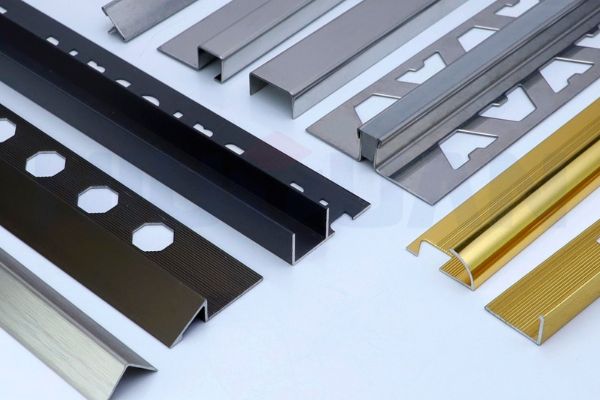
A finish sells only when the profile fits the tile. A matte black L-trim in the wrong depth still leaves a stepped edge. A brushed brass quadrant still fails if the tile is thicker than the trim leg. Check depth against tile thickness on every line. Keep the same depth range across all three core finishes, so a buyer can switch finish without re-measuring the job. See how depth and thickness relate before you set the range.
Profiles follow the same rule: L-shaped profiles suit sharp, modern edges. Quadrant profiles suit family bathrooms and any edge where a rounded corner is safer. Square profiles suit feature walls where the trim is meant to be seen. Stock the core finishes in L and quadrant first, and add square profiles only where designers keep asking for them.
How much of each finish to order
Start with the core. A working rule, not a sales figure, is two thirds of the finish budget on the core. One third goes to accents, and nothing is held for project-only lines. Split the core share evenly between the three finishes until your own repeat orders tell you otherwise. An even split keeps you from betting the shelf on one finish before your market has voted.
Reorder on repeat demand, not on a single large job. A hotel scheme that takes 400 pieces of smoked chrome brass in one order is a project, not a trend. It justifies a project-only quote and a sealed sample, not a permanent shelf line. The shelf line earns its place only when the same finish comes back in a second and third order from different buyers.
What to confirm before you order
Confirm the finish in writing before production starts, because a finish name is not a specification. Two suppliers can read “brushed brass” two ways, and the difference only shows up when the goods arrive. Send a physical reference, a RAL or Pantone code, or an approved sample, and keep the sealed sample on file. NIUYUAN keeps sealed samples for two years from the last repeat order, and bulk batches are checked against them.
Match the grade to the site. Stainless 316 suits coastal sites, outdoor edges and pool surrounds, where chloride in the air attacks 304. Stainless 304 covers general interior and inland volume. Aluminium 6063 and 6463 carry the mainstream anodised and powder-coated range. If a buyer asks for a finish on a material that does not take it well, say so before the order. Do not wait until the sample fails.
The full finish and colour range is listed on the finish and colour series page. The coordination method is covered in how to match trim with taps and handles. Check both pages before you quote a finish you have not stocked before.
MOQ, lead time and the shelf list
| Material | Grade | Starting MOQ |
|---|---|---|
| Aluminium | 6063 / 6463 | 1,000 pcs |
| Stainless steel | 304 / 316 | 500 pcs |
| Brass | H59 | 200 pcs |
| PVC | – | 2,000 pcs |
Ask for a technical answer in writing, and check the lead time in the same message. NIUYUAN gives a first technical response within one working day, and tooling fees are refunded once an agreed cumulative order volume is reached. A finish that starts as a project-only line can therefore pay back its tooling if the volume follows.
Start with matte black, brushed nickel and one warm metal as the core. Add chrome and white where your trade asks for them. Review the tiers every quarter, and move a finish only on repeat orders. Confirm every finish against a physical sample before you order in depth: that is the whole plan, and it fits on one shelf list.
If you need the background first, what tile trim does explains the profile. How brass and aluminium trim differ and matte black trim ideas cover the two finishes most buyers ask about first. Start there before you build the range.
FAQ
Which tile trim finishes should a distributor stock first?
Start with three core finishes: matte black, brushed nickel or satin silver, and one warm metal such as brushed brass. Add chrome and white where your trade asks for them. Keep all other finishes as project-only quotes until repeat orders prove they deserve shelf space.
Is matte black tile trim still popular in 2026?
Yes, as a design signal. Design and trade coverage through 2026 keeps featuring matte black against light tile and black tapware. No public source in this review publishes distributor sell-through by finish, so treat it as a core line on the strength of buyer requests and design coverage, not on a sales ranking.
How do I stop brass finishes varying between batches?
Confirm the exact tone in writing and check it against a physical sample before production. NIUYUAN keeps sealed samples for two years from the last repeat order, and bulk batches are checked against them. A finish name alone is not a specification.
What is the minimum order for each trim material?
Starting MOQs are 1,000 pieces for aluminium, 500 pieces for stainless steel, 200 pieces for H59 brass, and 2,000 pieces for PVC. Finish, profile and quantity are confirmed order by order.
Should I stock a finish I have only sold once?
No. A single large order is a project, not a trend. Quote it as a project-only line with a sealed sample. Move a finish onto the shelf only when it comes back in a second and third order from different buyers.