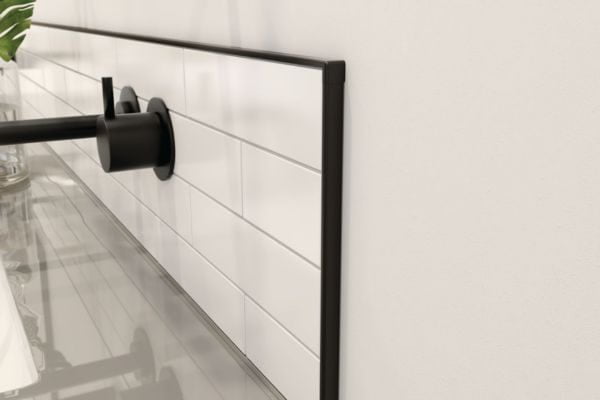
Black tile trim does two jobs at once. It finishes a tile edge and draws a dark line that the whole room reads as a design choice. Get the finish wrong, and the line chips, fades, or fights the fixtures. Get it right, and a metre of black profile can carry the look of a bathroom or a kitchen.
Three black finishes dominate the market: anodized black aluminum, powder-coated black aluminum, and PVD black stainless steel. They look similar in a photo, and they behave differently in a wet room, on a floor edge, and in a bulk order. This guide compares the three, then covers profiles, rooms, grout and hardware pairing, sizing, care, and the checks to run before you order. For the basics of the product itself, see what tile trim is.
Anodized and powder-coated black aluminum
Anodized black starts with aluminum. An electrochemical process builds an oxide layer on the metal, and the black dye sits inside that layer. The colour is part of the surface, not a film on top, and the result is usually matte or satin with a faint metallic depth.
NIUYUAN lists anodized black among the surface finish options on its black tile trim page. The same page lists powder-coated black, brushed black, satin black, polished black, PVD black, and plated black effects.
Powder-coated black is a different build. Dry powder is sprayed on with static charge, then cured with heat into a continuous opaque film. The black can be deeper and more uniform than anodized black, and the texture range is wider, from flat matte to a light satin. The coating resists chipping and scratching in normal use.
It is still a film on the surface, so a deep gouge can expose the metal below. Ask the supplier how a damaged length should be touched up, or whether it should be replaced.
PVD black stainless steel
PVD black stainless steel is the third option. A thin, hard coating is applied to stainless steel in a vacuum chamber, and the black sits on a metal that already resists corrosion. It is the usual pick where the trim faces constant water, steam, and cleaning, such as a shower wall or a commercial washroom.
It generally costs more than the two aluminum routes. It also adds a coating step to the order. Confirm price and lead time per order rather than assuming the aluminum price applies.
Black finishes at a glance
| Finish | How the black is made | Best for | Watch out for |
|---|---|---|---|
| Anodized black aluminum | Dye inside the oxide layer on aluminum | Matte or satin wall edges, backsplashes, niches | Aluminum is sensitive to alkaline cement; clean mortar off the face at once |
| Powder-coated black aluminum | Heat-cured opaque film over aluminum | Deep uniform black, widest texture range | A film on the surface; a deep chip can expose metal; check touch-up rules |
| PVD black stainless steel | Thin hard coating on stainless steel | Showers, wet rooms, high-cleaning areas | Higher cost and an extra coating step; confirm price and lead time |
Profile shapes in black
The finish is only half the choice. The profile shape sets the line the eye follows. An L-shaped profile gives a crisp square edge and suits modern wall ends and backsplash borders. A square-edge box profile reads as a deliberate frame, which is why it works for a niche surround or a mirror border.
A round-edge profile softens the line and is the safer pick where the edge meets hands, feet, or a shower curb. A T-shaped profile covers a joint between two tile fields, and a U-shaped profile caps a free tile edge. NIUYUAN lists square edge, round edge, L-shaped, T-shaped, and U-shaped profiles for black trim, plus drawing-based profiles for custom work.
A shower niche is the lowest-risk place to try black. Frame a white-tiled niche with a black square-edge profile, and the niche reads as a deliberate feature without repainting a room. The same logic works for a single accent wall or a mirror border. Start with one framed area, live with it, and extend the black line only if the room still wants it. Our shower niche trim guide covers the corners and slope details for that job.
Where black trim works hardest
Bathrooms are the natural home for black trim. A black edge line against white subway tile or pale marble gives the sharp contrast that defines modern bathroom design. It also ties the tile work to matte black taps, shower frames, and cabinet handles. The room then reads as one scheme instead of a set of separate parts. Our bath tile trim guide covers tub and wall edges in the same rooms.
Kitchens use black trim differently. A black border on a backsplash can frame the cooking wall. A black edge on a worktop upstand can tie the tile to a black hob or sink. Keep the black line to one or two edges in a small kitchen, because a black frame on every edge will shrink the room visually.
Commercial interiors are the third setting. Hotels, apartments, and retail spaces use black trim to define tile edges in lobbies, washrooms, and feature walls. The same rules apply: one clear line, matched to the fixtures, with a finish that survives cleaning schedules. For project work, confirm the finish against the cleaning products the site will actually use. Our spec checklist for hotels and commercial projects covers the documents and checks that surround a project order.
The trim, grout, and hardware triangle
Three elements decide whether black trim looks planned or accidental: the trim, the grout, and the hardware. The rule that matters most is the least obvious one. Match the grout to the trim, not to the tile. A black grout line beside a black profile makes the edge read as one continuous piece. A white grout line beside the same profile outlines every tile and breaks the black line at each joint.
Grey grout sits between the two, softening the contrast without erasing it, and letting black hardware and trim stand out in a shower niche. One retailer case study shows the same white subway tile finished two ways. On one side, a grey grout matched a pale marble trim. On the other, a black grout matched a black marble trim. The tile was identical. The grout choice changed the room.
Hardware follows the same logic. Matte black taps and shower frames extend the black line. Brass warms it and suits marble and wood, while brushed nickel cools it and suits grey tile and stainless fittings.
The hardware does not have to match the trim exactly. A room can carry matte black trim with brass taps, as long as each finish appears more than once in the room. For the brass side of that pairing, see our brass tile trim selection guide.
Sizing black trim
Black trim follows the same sizing rule as any other trim. Match the profile height to the tile thickness plus the adhesive bed, since a lower profile leaves a sharp tile edge exposed. A profile that stands above the tile creates a lip that catches water, feet, and cleaning cloths.
Confirm the height before ordering, not on site. Tile thickness varies by batch and by range, and a profile ordered for 10 mm tile will not fit 12 mm tile. Our dimensions and compatibility chart lists the published height ranges by profile. Our guide to choosing the right trim height explains the tile thickness plus adhesive rule in full.
Care and limits
Black finishes need gentle cleaning, so use a neutral pH cleaner and rinse well. Acid cleaners, bleach, and paint stripper can attack the black layer, and steel wool or abrasive pads will scratch it. Matte black hides small scratches better than gloss black. It shows hard-water marks more readily, so a shower with hard water needs a quick wipe after use.
Two limits deserve a direct warning. First, the black coating on an aluminum profile is decorative. It is not made for zones that take mechanical wear, such as steps and thresholds. Use a harder finish there, or a different material. Second, aluminum reacts with alkaline cement, so mortar and grout must come off the visible face at once, during installation, not after it sets.
Black floor tile shows dust, footprints, and dried water marks, and the same applies to black trim on a floor edge. A profile with a faint variation in the black reads as more forgiving than a flat, uniform black. Ask for a physical sample and look at it under the project light before approving a batch.
What to confirm before you order
A black trim order fails on details that a sample would have caught. Run these checks before the bulk order, not after it arrives.
- Material and finish process: aluminum, stainless steel, brass, or PVC, and anodized, powder-coated, or PVD black, named in writing.
- Black reference: a physical sample, a RAL number, a Pantone reference, or a fixture sample, approved before production.
- Profile and height: profile shape and height matched to tile thickness plus adhesive, confirmed per tile range.
- Batch consistency: how the supplier holds colour across batches, and what happens if a later batch drifts.
- Sample approval: colour, gloss level, surface texture, and profile size signed off on the sealed sample.
- Quantity and MOQ: NIUYUAN MOQs start at 1,000 pieces for aluminum, 500 for stainless steel, 200 for brass, and 2,000 for PVC.
- Lead time and packaging: samples in 7 days, 7 to 10 days for custom work, and bulk in 20 to 30 working days, with protective film and export-ready cartons.
Black trim is a small purchase that sets the tone of a room. Choose the finish by the room it will live in, match the grout to the trim, and approve a physical sample in the project light. The next step is a sample order in the exact finish and profile, checked against the tile it will sit beside.
Frequently asked questions
Which black finish is best for a shower?
PVD black stainless steel is the usual pick for a shower, because the coating sits on a metal that already resists water and cleaning. Anodized aluminum can dull under strong cleaners, so it needs a gentler routine. Powder-coated aluminum suits dry wall edges, but check the coating rating for wet areas before ordering it for a shower.
Does black tile trim show scratches?
Matte black hides small scratches better than gloss black, but any coated finish can chip to bare metal if it is gouged. Clean with a neutral pH cleaner and a soft cloth, and keep steel wool and abrasive pads away from the visible face.
What grout colour goes with black tile trim?
Match the grout to the trim, not to the tile. Black grout makes the trim read as one continuous line. White grout outlines every tile and breaks the line at each joint. Grey grout is the middle ground: it softens the contrast and lets black hardware and trim stand out.
Can black trim go on a floor edge or a step?
Avoid coated black aluminum on steps and thresholds. The coating is decorative and is not made for mechanical wear. Use stainless steel or a harder finish for those zones, and confirm the choice with the supplier before ordering.
How do I order black trim in an exact black?
Approve a physical sample first, with a RAL number, a Pantone reference, or a fixture sample as the written reference. Sign off colour, gloss level, surface texture, and profile size on the sealed sample before bulk production starts.