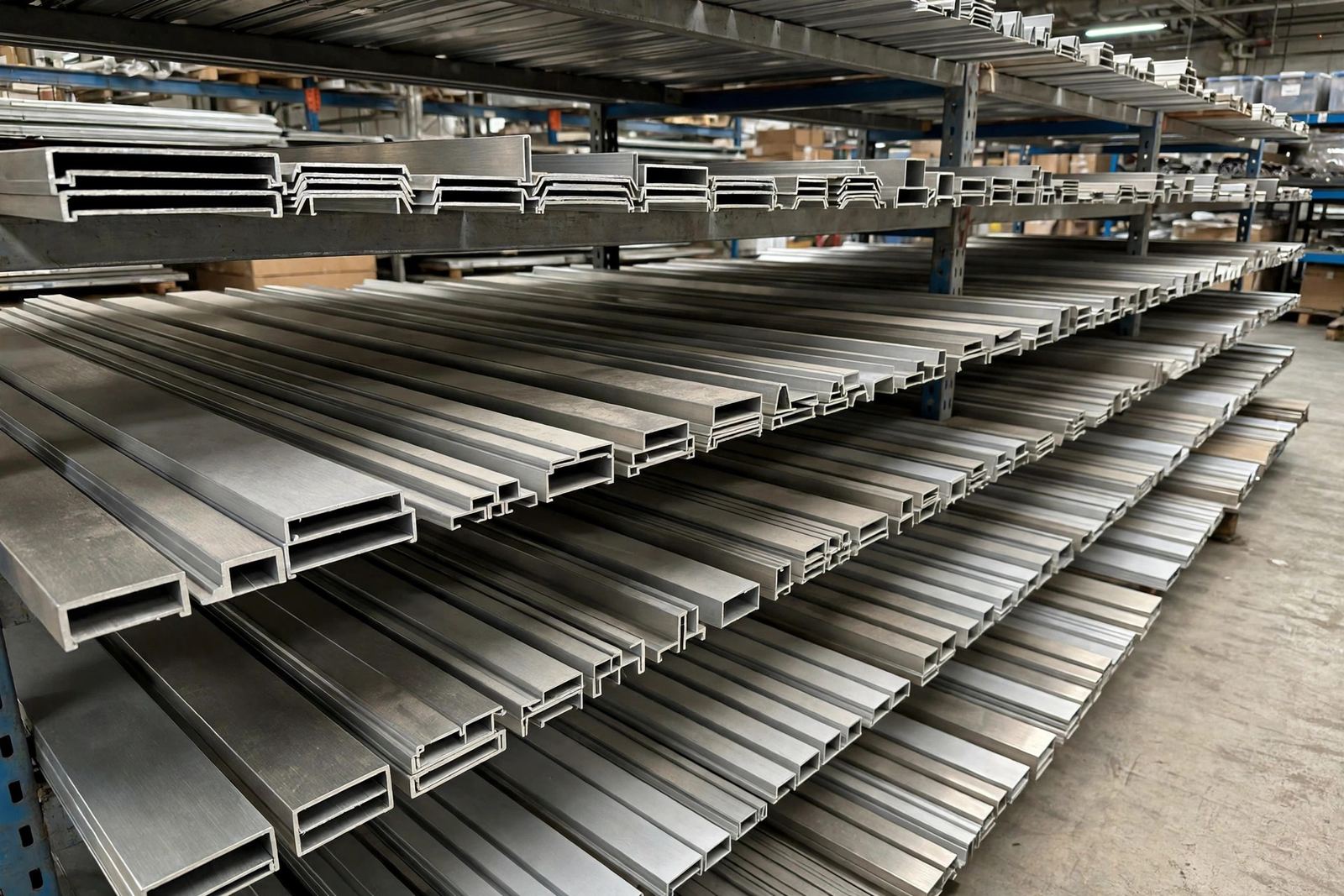
Stock 3-metre tile trim profiles when your customers fit long, straight runs on a regular basis. Skip them when most jobs need short cuts, tight storage, or frequent van deliveries. The gain is simple: fewer joints on each run, a cleaner finish, and less cutting time on site.
The cost is also simple: longer stock needs more rack space, careful handling, and a slower turn on slow-moving profiles. This guide works through that trade-off, so you can decide which profiles earn a 3-metre slot.
How the joint-count gain actually works
Every joint on a visible edge is a point a buyer can see, and longer profiles cut the count on long runs. The effect is easy to test with simple arithmetic, and the example below is illustrative only, not measured site data.
Take a straight 12-metre wall edge as an example. With 2.5-metre lengths, the run needs five pieces and four joints. With 3-metre lengths, the same run needs four pieces and three joints. One joint disappears, and one cut disappears with it.
On a single wall that saving looks small. Across a hotel corridor or a retail floor, the saved joints add up fast. Count only joints that sit on show, since hidden joints change nothing for the buyer. Our metal trim cutting guide covers the tools and deburring steps for each material, so fewer cuts also mean less work at the bench.
Where long lengths help
Long, straight runs are the clear case. Large-format wall panels, long floor borders, and straight stair nosing runs all keep a profile in one line for metres at a time. A 3-metre length covers more of that line before a joint breaks it. Height and profile choice for big slabs matter beside length, and the two choices should be made together.
Commercial work strengthens the case, since hotels, retail units, and office floors repeat the same edge detail across many rooms. Fewer joints also mean fewer places where grout lines and metal edges drift apart. That matters most where a client inspects the finished floor closely.
Where long lengths hurt
Short, cut-up work reverses the logic, since bathroom refits, splashbacks, and small retail units rarely need a full 3-metre run. A long length cut down to 800 mm leaves a 2.2-metre offcut that may never match another job. That offcut still cost the full length price, and it still takes rack space while it waits.
Transport and storage add a second penalty. A 3-metre profile needs a van and racking that fit it without bending, and a store layout that keeps it flat and clear. Profiles bent in transit or crushed under other stock reach the customer damaged, and a damaged length is a return, not a sale.
Decide by job type
Use this table as a first pass for your own range. Match your typical jobs to the row that fits, then check the stocking list below before you order. The rows sort by job shape, not by profile, so start from the work you actually sell.
| Job type | 3-metre length? | Why |
|---|---|---|
| Long straight walls and floors | Yes, trial first | Joints stay on show, so fewer joints pay directly. |
| Large-format slab edges | Yes, trial first | Long slabs need long, clean edge lines. |
| Hotel and retail rollouts | Yes, trial first | Same detail repeats across many rooms. |
| Bathroom refits and splashbacks | Usually no | Runs are short, and offcuts pile up fast. |
| Van-delivered small orders | Usually no | Length exceeds van and rack limits too often. |
| Mixed small jobs, varied heights | No | Height variety beats length variety here. |
Storage, handling and transport checks
A 3-metre length only earns its place if it survives your warehouse and your last mile. Run these checks before you commit rack space to a new length. Each check is a yes-or-no question, and one clear no is enough to hold the order.
- Rack length: can a full 3-metre profile lie flat, supported along its length, without overhang?
- Vehicle fit: does your longest van or truck take 3 metres inside, without bending at the doors?
- Handling: can one person carry a length safely, or does every move need two people?
- Damage path: where would a bent or scratched length go, and who pays for it?
- Pick speed: does a long bay slow picking for your fast-moving standard lengths?
Answer with your real rack and vans, not a supplier catalogue: a profile that fits the catalogue but not your building costs you in returns. Walk the bay and the van before you sign the trial order.
A stocking checklist: trial first, judge on sell-through
Start narrow, not wide, and pick one or two profiles that already sell well at standard lengths and serve long straight runs. That keeps the trial inside demand you have already proven. Add height options only after the first trial earns a repeat order.
- Trial profiles: your best-selling straight-edge profiles in the heights your long-run jobs ask for most.
- Trial quantity: small enough to clear in one normal restock cycle, and confirmed in writing against the supplier MOQ.
- Sell-through test: count lengths sold against lengths stocked over a fixed window, and note which jobs took them.
- Offcut watch: track offcuts left after cutting, and drop the length if offcuts grow faster than sales.
- Repeat test: reorder only when the first batch sells through and at least one customer asks for it again.
Judge the trial on movement, not on enthusiasm. A length that sells through once and then sits is a display item, not a stocked line. A length that clears and reorders has earned its bay. Keep the test window short enough to act on.
When you plan the trial, check height first with the tile trim size guide. Then match the alloy to the job with our comparison of 6063 and 6463 aluminium alloys. Confirm the supplier MOQ in writing before you order. Published baselines on this site run to 1,000 pieces for aluminium, 500 for stainless steel, 200 for brass, and 2,000 for PVC.
What to confirm with your supplier before you order
Long lengths vary by supplier, so treat every point below as a written question, not an assumption. A supplier that answers in writing gives you a basis for your own customer promises, while one that answers vaguely leaves the risk with you.
- Is a 3-metre length actually available in this profile, height, and finish, or only in a narrower set?
- What pack quantities apply, and do they change for long lengths?
- Does the long length carry a price premium, and how is it charged?
- How are long lengths packed for export and for van delivery, and what happens to damaged lengths?
- What are the sample and bulk lead times for this length, against the published baseline?
If any answer changes the trial economics, redo the trial maths before you order and read our guide to planning your stocked range. Keep the trial inside a normal order, so it does not sit apart from your regular buying.
Frequently asked questions
Do 3-metre profiles cost more than standard lengths?
Treat price as a question for your supplier, not a fixed rule, since some suppliers charge a premium for long lengths and some do not. Ask for the premium in writing before you judge the trial.
Which profiles should a distributor trial first?
Start with your best-selling straight-edge profiles in the heights long-run jobs ask for most. Keep the trial to one or two profiles, so the result stays easy to read. Add more only after the first batch earns a repeat order.
How do I judge whether the trial worked?
Count lengths sold against lengths stocked over a fixed window, and note which jobs took them. A length earns its bay when it clears, reorders, and pulls repeat requests. If offcuts grow faster than sales, drop the length.
What transport problems do 3-metre profiles bring?
They need a vehicle and a rack that fit the full length without bending. Profiles bent in transit or crushed under other stock arrive damaged, and damaged lengths become returns. Check your longest van and rack bays before you order.
Do long lengths suit large-format tiles?
Yes, where the edge run stays long and straight. Large slabs show joints clearly, so fewer joints give a cleaner edge line. Match the profile height to the slab first, then choose the length. Cut ends still need a clean finish, as our notes on how cut ends are finished explain.
The decision
The decision comes down to one test: do your customers run long, straight edges often enough to clear a trial batch? If the answer is yes for a proven profile, trial one or two heights, confirm the supplier points in writing, and judge on movement. If the answer is no, keep your range at standard lengths and spend the bay space on a profile that turns faster.