
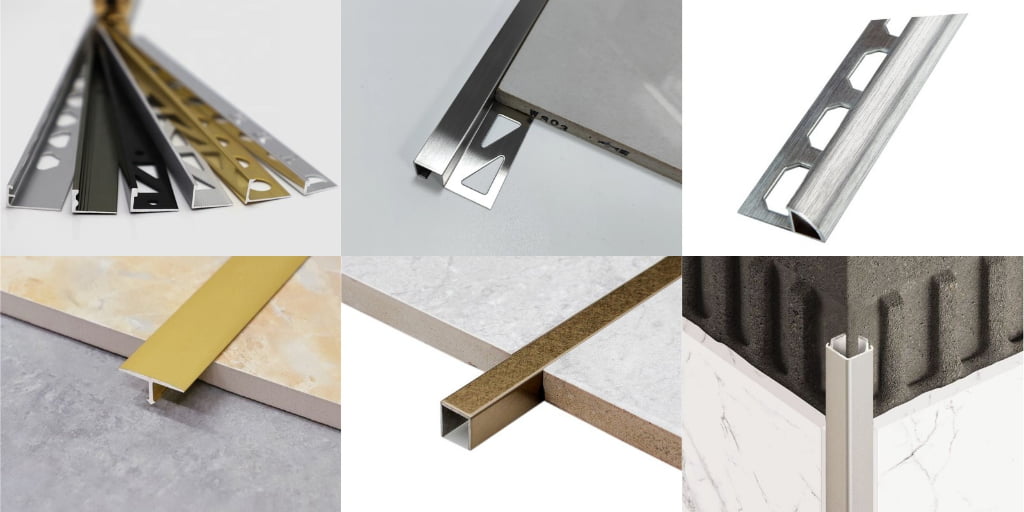
Build a first tile trim range narrow and deep, not wide and thin: a small set of profile-and-material combinations that covers the jobs your customers actually run every week, stocked deep enough to sell from the shelf, beats a catalog-length range that exists one carton deep. This guide sets out the starting matrix — which materials earn a place first, which profiles form the core, which heights and finishes to hold deep and which to hold light — and the layering logic that lets the range grow by evidence instead of by guesswork.
Start from the jobs, not the catalog
Assortment mistakes usually begin with a supplier catalog read top to bottom. Start instead with the four positions trim has to fill on a real job. Exposed edges — wall terminations, backsplash tops, floor borders — take the volume. Outside corners take the knocks. Inside corners close the wall-to-wall junctions in every bathroom and shower. Joints and decorative lines are real but occasional. A first range that covers the first three positions well will outsell a range that spreads the same budget across all four plus every variant of each. Our tile trim profiles guide maps the profile families to these positions; the assortment question this guide answers is which of those families, in which materials, deserve shelf depth on day one.
The starting matrix: four materials, four different jobs
Each material on this site earns its shelf place by doing a different job in the range, not by being a cheaper or dearer version of the same thing:
| Material | Job in the range | Stock it as |
|---|---|---|
| Aluminum | The workhorse: metal appearance, the widest finish flexibility, and profiles for almost every position | The backbone — the deepest and broadest part of the range |
| PVC | The value and color line: economical interior finishing where color matching matters more than metal feel | Deep in the standard colors, in wall profiles |
| Stainless steel | The durability line: wet areas, commercial interiors and positions where corrosion resistance decides | Narrower — core profiles, one main finish first |
| Solid brass | The premium design line: warm decorative detail for visible, design-led interiors | The lightest layer — bought against demand, not speculation |
The detailed ranges sit on the material pages for aluminum, PVC, stainless steel and brass tile trim. One constraint shapes everything below and is worth stating once: each material carries its own minimum order quantity — from 200 pieces on brass up to 2,000 on PVC — so depth decisions are also minimum-order decisions, and a SKU you cannot reorder in sensible quantities is a shelf problem waiting to happen.
Core profiles first, second wave later
Across the four materials, four profile families form the core of a first range. L-shaped trim is the all-rounder for exposed edges and the single highest-turnover family in most markets. Square-edge carries the modern, flat-faced look that rectified-tile projects ask for. Round-edge covers the protective curve for edges that take contact. Inside-corner profiles close bathroom and shower junctions — a small family by SKU count, but one that completes the bathroom job, which is why the PVC inside corner position in a value range matters as much as another edge variant. Hold the second wave — T-shaped joint covers, U-shaped channels and quadrant corner profiles — lighter at launch: they complete projects and win goodwill, but they turn more slowly, and they can be added per material once the core is moving. Whatever the profile mix, count the matching corner pieces, connectors and end caps into the range from the start; a length without its corner piece is an unfinished sale, as our accessories guide sets out.
Heights and lengths: deep in the middle, light at the edges
Trim height follows tile thickness, and tile thickness in most markets clusters. The common heights across our ranges are 6, 8, 10 and 12 mm — and for a first range the practical reading of that list is: stock 8, 10 and 12 mm deep, hold 6 mm light, and let anything outside the list be an order-in item until a customer proves otherwise. The same logic applies to length: pick the one length your market treats as standard from the common 2.5, 2.7 and 3.0 m options and make it the house length across profiles and materials, so cartons, racking and price lists stay simple. Every extra height or length is not one more SKU — multiplied across profiles, materials and finishes, it is a row of slow cartons. Depth in the middle of the size range is what makes a small range feel reliably in stock.
Finishes and colors: few, deep, consistent
Finish is where first ranges most often overreach. The disciplined pattern is a short finish list per material, held consistently across the core profiles so a customer can match an edge, a corner and a joint line in the same finish on one order. For aluminum, that usually means the core anodized tones first. For PVC, the standard colors — white, black, grey and beige — cover most interior demand, with decorative wood-grain and marble effects added only where your tile market actually sells those tiles. For stainless steel, one main finish, typically brushed, earns depth before polished or color options are added. For brass, hold the line narrowest of all: it is a design material, and its finishes should follow demonstrated project demand. A finish stocked in only one profile is a promise you cannot complete on site; a finish stocked across the core is a range.
Depth layering: how the range is tiered
| Tier | What sits there | Depth rule |
|---|---|---|
| Tier 1 — shelf core | Core profiles in aluminum and PVC, middle heights, core finishes and colors | Deep enough to sell from stock through a full replenishment cycle |
| Tier 2 — supported range | Stainless core profiles, second-wave profiles in aluminum, decorative PVC effects | Present and sellable, reordered in step with the core |
| Tier 3 — order-in | Brass beyond the narrow core, unusual heights, custom colors and finishes | Listed and priced, bought against confirmed demand |
The tiers are a cash decision as much as a merchandising one. Money parked in Tier 3 cartons that turn twice a year is money that cannot deepen Tier 1, where a stockout costs a whole bathroom order rather than one line. How the per-SKU economics build up is covered in our tile trim cost guide; the assortment point here is simpler — review the tiers on a fixed cycle, promote what keeps selling out, demote what keeps sitting, and let that movement, not the catalog, decide what joins the range next. Private label belongs to this layering too: it is a packaging treatment applied to combinations that already sell, not a reason to widen the range, and our OEM and private label guide covers how that layer is added.
Replenishment logic: reorder the system, not the SKU
A layered range only works if reordering follows the layer. Bulk production on our ranges usually runs 20–30 working days before shipping time, so Tier 1 reorder points have to be set by cover — weeks of typical sales held against that lead time — rather than by empty shelves. Reorder by combination, not by single SKU: when an aluminum square-edge line in a core finish runs low, check its corner pieces, its inside-corner counterpart and the same finish in L-shaped before consolidating the order, because freight and minimums reward consolidated replenishment and punish dribbled top-ups. Tier 3 stays out of routine reordering entirely; it is bought when a project or a repeat customer confirms demand. The import steps behind a replenishment order — from enquiry to shipment — are walked through in our guide to importing tile trim from China. Planning a first range or re-tiering an existing one? Send the combinations you are considering through our contact page, and the starting matrix can be checked against available profiles, heights and finishes before you commit shelf space.
FAQ
Which tile trim profiles should a distributor stock first?
Start with four families: L-shaped for exposed edges, square-edge for modern flat-faced work, round-edge for edges that take contact, and inside-corner profiles for bathroom and shower junctions. Add T-shaped, U-shaped and quadrant profiles as a lighter second wave once the core is turning, and count matching corner pieces, connectors and end caps into the range from the start.
Which material should form the backbone of a first range?
Aluminum, in most markets: it offers a metal appearance, the widest finish flexibility and profiles for almost every position. Build PVC alongside it as the value and color line for interiors, keep stainless steel narrower for wet and commercial demand, and hold solid brass as the lightest, premium layer bought against demonstrated demand.
How many heights and finishes should a starting range carry?
Fewer than the catalog offers. Of the common 6, 8, 10 and 12 mm heights, stock the middle three deep and 6 mm light, in one house length. Per material, hold a short finish list — core anodized tones in aluminum, standard colors in PVC, one main stainless finish, a narrow brass selection — and keep each finish consistent across the core profiles.
How deep should opening stock be?
Deep enough in Tier 1 — core profiles in aluminum and PVC, middle heights, core finishes — to sell from the shelf through a full replenishment cycle, since bulk production usually runs 20–30 working days before shipping. Tier 2 is held present but lighter, and Tier 3 is listed but bought against confirmed demand rather than stocked speculatively.
When should a distributor widen the range?
When the sales pattern asks for it: a second-wave profile that keeps being requested, a finish customers try to match across more profiles, or a tier item that repeatedly sells through. Promote and demote SKUs on a fixed review cycle, and let that evidence widen the range — widening from the catalog alone multiplies slow cartons across every profile, height and finish.