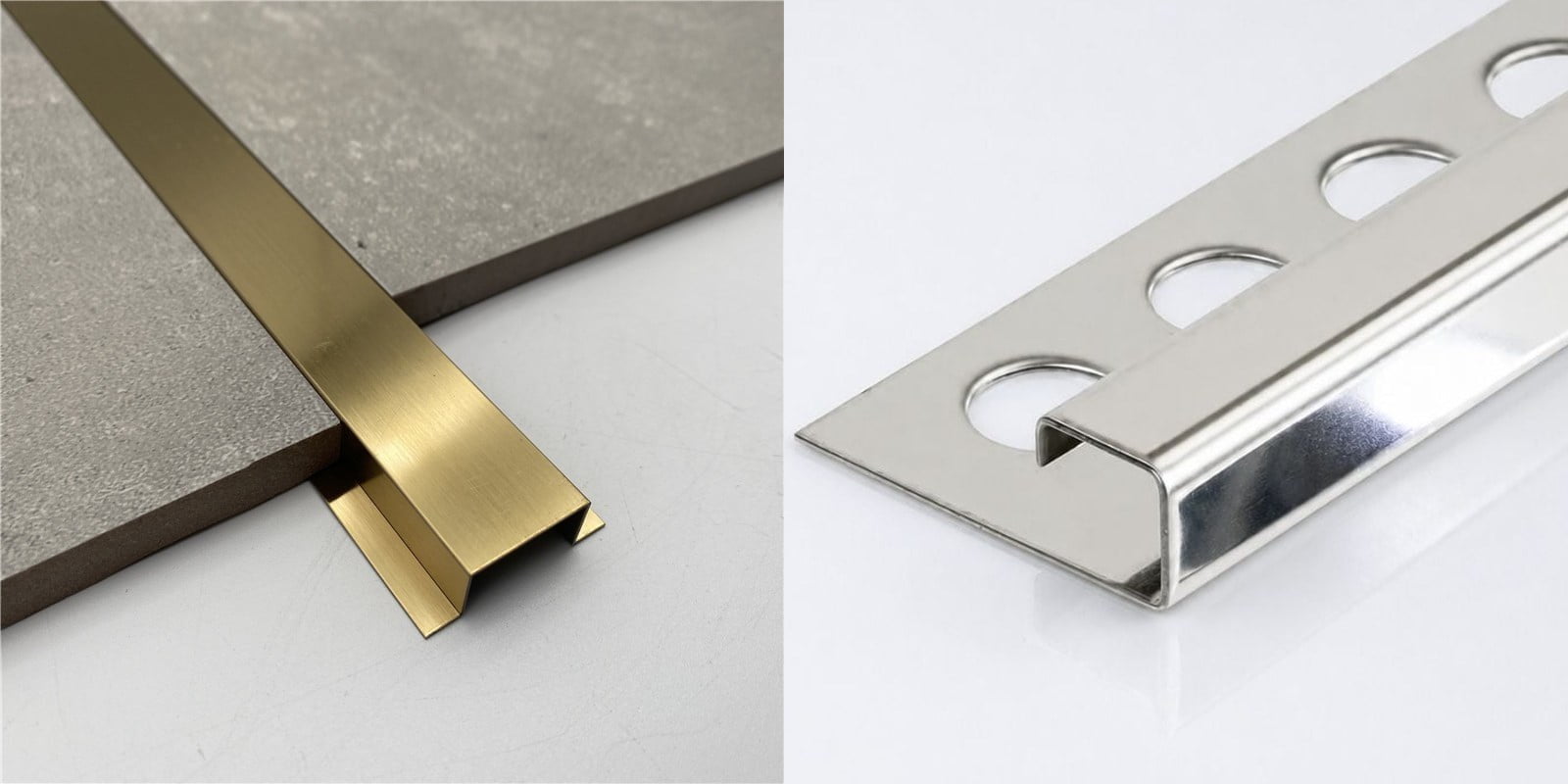
Choose brass tile trim when the project sells on a warm, golden, classic look — luxury hotels, designer bathrooms, high-end residential — and the client accepts a finish that ages gracefully. Choose stainless steel tile trim for maximum hardness, wear resistance, and near-zero maintenance in high-traffic or chemically demanding settings — commercial kitchens, hospitals, transit, pool surrounds.
For distributors, this is a premium-segment pairing: both sit at the top of the price ladder, brass generally the most expensive. The decision is aesthetic direction and maintenance expectation versus durability. Below is exactly where each material wins.
Brass vs Stainless Steel Tile Trim at a Glance
| Brass tile trim | Stainless steel tile trim | |
|---|---|---|
| Upfront cost | Highest — premium positioning | High, but generally below brass |
| Weight | Heavy — marginally denser than stainless (~8.4–8.7 vs ~7.9 g/cm³) | Heavy — roughly three times aluminum |
| Corrosion behavior | No iron — won’t rust, but unprotected brass oxidizes and develops a patina | Excellent — chromium (≥10.5%) forms a passive layer; 316 for chlorides, coastal, pools |
| Maintenance | Polished look needs regular polishing; lacquer/plating reduce upkeep but can chip | Minimal — wipe clean; no polishing needed |
| Hardness and wear | Softer — scratches and dents more easily, but easier to cut and form | Harder — holds its edge under impact, luggage wheels, and cleaning carts |
| Finish options | Natural polished gold, brushed brass, chrome-plated, antique bronze, smoked chrome | Brushed, mirror, and PVD colors (gold, black titanium, bronze) |
| Typical NIUYUAN MOQ | 200 pcs | 500 pcs |
| Best for | Luxury hotels, designer bathrooms, premium residential, heritage styling | High-traffic commercial, hospitals, kitchens, pools, coastal projects |
Cost: Both Premium, Brass Usually Highest
There is no budget winner here: both are specified as premium materials, and across the supplier sources reviewed for this guide, brass consistently sits at the very top of the price ladder — one manufacturer comparison rates brass “Very High” against stainless steel’s “High.” (No factory bulk price multiples were found, so treat that ordering as directional, not a quote.)
For distributors, the question is which premium your customer will pay for: brass commands its premium through material cost and luxury positioning — a golden trim in a hotel lobby reads as deliberate design. Stainless steel’s premium is easier to justify on performance math: in a hospital corridor or commercial kitchen, hardness and low maintenance cut replacement and upkeep costs over the trim’s service life.
Weight: Heavy Either Way
Both metals are substantially heavier than aluminum — roughly three times the density — so neither offers a freight advantage over the other. Brass is marginally denser than stainless (about 8.4–8.7 vs 7.9 g/cm³ by standard material data), but the per-piece shipping difference is negligible.
Tarnish and Corrosion: The Decisive Difference
Brass is an alloy of copper and zinc. It contains no iron, so it does not rust — but unprotected brass reacts with air, moisture, and pollutants: it darkens, then develops a patina that can run from deep brown to greenish, faster in polluted or salty air. Two honest ways to handle it:
1. Embrace it. Unlacquered brass is a “living finish” — it matures gradually, no two pieces age identically, and the aged golden tone is actively sought after in luxury and heritage designs. The original luster can always be restored with a polish. 2. Seal it. Lacquer or electroplating (chrome plating is the industry standard for brass trim, offered by brands like Schluter on solid brass profiles) keeps the bright finish — but lacquer is not permanent: it can chip or break down chemically, and once breached the brass underneath needs attention.
Stainless steel asks far less of the owner. Its chromium content (≥10.5%) forms a thin passive layer that resists rust and corrosion with no polishing regime. Grade selection still matters: 304 covers standard interiors, bathrooms, and kitchens, while 316 is the specification for chlorinated pool surrounds, coastal salt air, and harsh chemical exposure — the full breakdown is in our stainless steel grade guide.
If the client wants a finish that looks identical in year five with zero maintenance, stainless steel. If they buy into the aging character of brass — or accept a plated/lacquered finish — brass earns its place.
Strength, Denting, and On-Site Workability
Stainless steel is the harder metal: it resists scratches and dents under luggage wheels, cleaning carts, and heavy foot traffic — why it dominates high-traffic commercial specifications. Brass is softer and will show wear sooner in the same conditions.
The trade-off reverses at installation: brass is easier to cut and form — one manufacturer comparison rates cutting brass “Normal” versus “Hard” for stainless steel. Brass profiles are typically extruded, which suits custom shapes; stainless profiles are commonly roll-formed.
Finish Options: What Sells on the Shelf
- Brass tile trim speaks warm and classic: natural polished gold, brushed brass, chrome-plated (a mirror-bright protective finish on solid brass), antique bronze, and smoked chrome. It pairs with brass taps, warm marble-effect porcelain, and traditional or art-deco interiors. See gold tile trim and chrome tile trim for these finishes in real projects.
- Stainless steel tile trim speaks cool and modern: brushed, mirror, and PVD-coated colors such as gold, black titanium, and bronze. PVD is a hard coating deposited onto the stainless surface — it bonds tightly and resists scratches, fingerprints, and fading well in supplier descriptions.
One caveat: polished brass shows fingerprints and needs the maintenance story told upfront; PVD stainless is more forgiving. Confirm finishes on physical samples — see our tile trim finishes guide.
Which Should You Stock? A Distributor’s Decision Matrix
| Your customers’ projects | Stock this |
|---|---|
| Luxury hotels, resorts, premium lobbies | Brass — the golden finish is the design statement |
| Designer bathrooms, high-end residential | Brass (lacquered/plated for lasting shine; unlacquered for the patina look) |
| Heritage, art-deco, traditional styling | Brass — antique bronze and natural finishes |
| Commercial kitchens, hospitals, food processing | Stainless steel — hardness plus chemical resistance |
| High-traffic floors: transit, malls, airports | Stainless steel — wear resistance and life-cycle cost |
| Pools, spas, coastal projects | Stainless steel 316 |
| Modern/minimalist interiors | Stainless steel — brushed or PVD black |
Mid-range budgets: see our aluminum vs stainless steel guide for that comparison.
Two practical notes on ordering: NIUYUAN’s MOQ is 200 pcs for solid brass (H59) and 500 pcs for stainless steel — brass’s lower MOQ makes it practical to stock even as a niche premium line. Trim height should match tile thickness — our tile trim size guide covers the sizing rules.
What to Put in Your RFQ
A clear RFQ gets you an accurate quote faster:
- Material: solid brass (H59) or stainless steel (304/316) — and the environment it will serve
- Finish intent: for brass — natural polished, brushed, chrome-plated, antique, or lacquered; for stainless — brushed, mirror, or PVD color with a sample reference
- Maintenance expectation: tell your supplier whether the end client expects a patina-aging finish or a permanently bright one — it changes the finish recommendation
- Profile and size: profile type, height matched to tile thickness, length or custom lengths
- Quantity and packaging: estimated pcs, export carton/pallet requirements, private-label needs
- Target delivery: project timeline and destination port
- Material documentation: tell us in your RFQ if you need mill certificates or test reports
NIUYUAN supports OEM profiles, private label, and custom export packaging. Samples take 7 days (7–10 for complex profiles); bulk orders run 20–30 working days. Send the list above via our contact page.
FAQ
Will brass tile trim tarnish? Yes, if left unprotected — brass is a copper-zinc alloy with no iron, so it won’t rust, but it oxidizes in air and moisture, darkening into a patina (deep brown to greenish). Lacquer or chrome plating keeps the bright finish, though coatings can chip and need care. Many luxury projects embrace the patina as a “living finish.”
Is brass or stainless steel better for bathrooms? Both work. Stainless steel (304, or 316 for constant wetting) is the low-maintenance choice — no polishing, strong chemical resistance. Brass suits designer bathrooms where the golden finish is part of the design; choose lacquered or chrome-plated brass for lasting shine, unlacquered for the aging look.
Which is harder: brass or stainless steel tile trim? Stainless steel is harder and more resistant to scratches and dents — why it dominates high-traffic commercial specifications. Brass is softer: it shows wear sooner but is easier to cut and form on site.
Why is brass tile trim more expensive than stainless steel? Both are premium materials, and brass generally commands the highest price — driven by raw material cost and luxury positioning rather than performance alone. Brass earns its margin on design-led projects (hotels, premium residential); stainless steel justifies its price on durability and low maintenance.
What MOQs should I expect when ordering each material? At NIUYUAN: 200 pcs for solid brass (H59) and 500 pcs for stainless steel. Custom finishes and profiles supported; confirm MOQ for mixed-finish orders in your RFQ.