Choose brushed aluminum tile trim when the edge will be touched, wiped and seen under working light every day. Choose polished when the trim line is meant to be noticed. That second choice only works if the space has a cleaning routine that keeps a reflective surface looking right.
Both finishes start from the same 6063 or 6463 aluminum, so the difference is the surface, not the metal underneath. The decision turns on the room, the handling and the sample, not on which finish looks better in a photo.
This guide answers the three questions a buyer has to settle before ordering. First, how does each finish behave in the room it will live in? Second, how do you keep a bulk order true to the sample you approved? Third, what does each finish ask of the people who clean it?
Anodizing is a separate step that can sit on top of either prepared surface. It is covered in our comparison of anodized and powder-coated aluminum, not in this guide.
What brushed and polished actually are
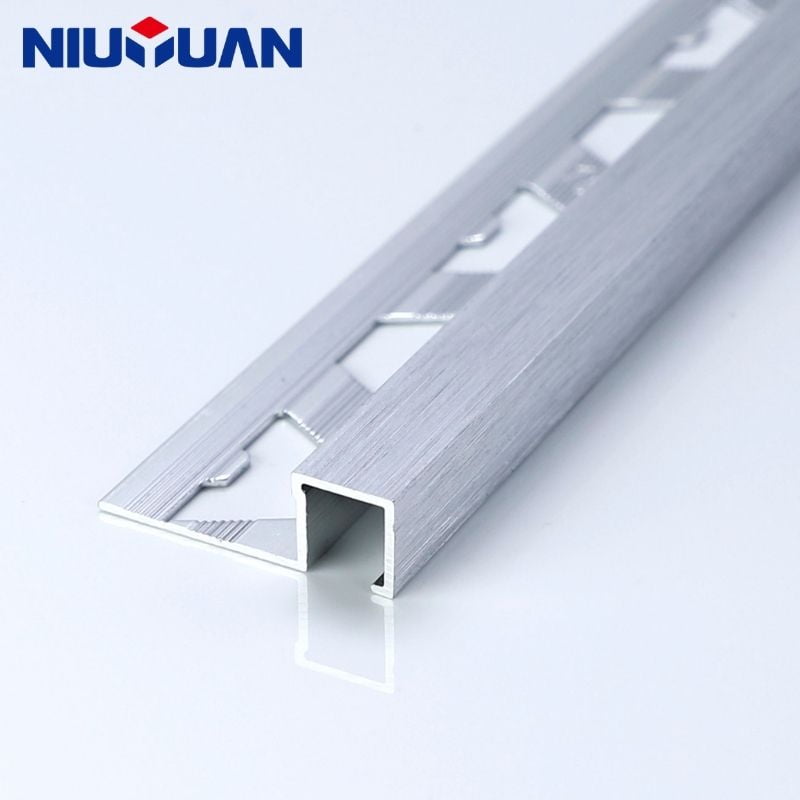
Brushed aluminum is aluminum whose surface has been worked in one direction with an abrasive belt or brush. The result is a set of fine parallel lines that soften glare and give the metal a satin read. The grain is visible up close, and it is part of the finish. You cannot rub it out without changing the finish itself.
Polished aluminum is buffed in stages with finer and finer compounds until the surface turns reflective. On a flat face, the result reads as a bright line, close to a mirror. On a curved face, light rolls across the profile instead of sitting on one plane. Tone and brushing direction then read continuously along the corner.
That is why the same finish can look different on a square-edge profile and on a round-edge profile. Both profiles can come from the same batch and still read differently. Our aluminum tile trim range lists both finishes across its square-edge profile and round-edge profile, with anodized and powder-coated directions alongside them.
Brushing and polishing shape the metal surface first, and anodizing, where it is used, builds on that prepared surface. That order matters when you write the specification. A finish instruction that only says brushed leaves the grain direction open. One that only says polished leaves the reflectivity open. Both gaps are closed on the approved sample, as the next sections explain.
How each finish behaves in a finished room
Brushed trim spreads light instead of throwing it back, and that is the whole practical case for it. Fingerprints, water marks and light handling traces sit inside the grain instead of standing out against it. The edge reads as a quiet metal line, and it stays that way between cleans. This is why brushed is the usual working choice for bathrooms, kitchens and corridors, where the trim is touched and wiped every day.
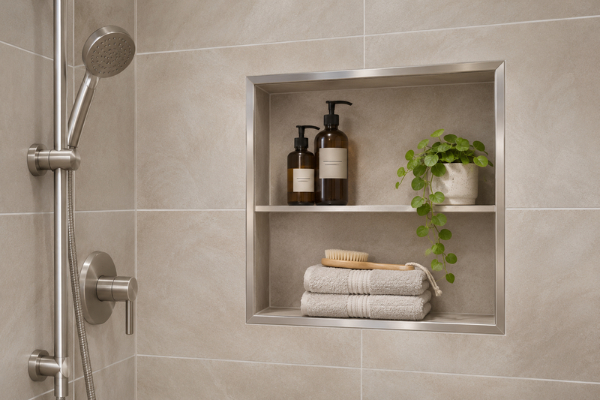
Polished trim does the opposite: it reflects the room, so it draws the eye to the edge itself. On a feature wall, a niche border or a showroom line, that is exactly the effect you want. The trade is visibility in both directions.
The same surface that reflects light also shows every fingerprint, water spot and wipe mark at full contrast. A polished edge in a busy bathroom shows marks soon after it is cleaned, unless the space has a wiping routine. So the question is not whether you like the shine, but whether the space has the cleaning habit to carry it.
Brushed vs polished at a glance
The table below puts the working differences side by side, so use it to narrow the choice and then confirm the direction on a sample.
| Finish | Brushed | Polished |
|---|---|---|
| Surface look | Fine parallel grain, satin read | Smooth, bright, close to a mirror |
| Light and glare | Spreads light, low glare | Throws light back, draws the eye |
| Fingerprints and marks | Sit inside the grain, less visible | Show at full contrast on a smooth face |
| Cleaning routine | Wipe along the grain when dirty | Wipe on a schedule, dry after each wipe |
| Best fit | Touched edges, bathrooms, kitchens, corridors | Feature lines, niches, showroom edges |
| Confirm on sample | Brushing direction and tone | Reflectivity level under room light |
Choose by project environment
No finish wins in every room, so run your project through the closest row and let the room decide before the catalogue does.
| Environment | Brushed or polished | Why |
|---|---|---|
| Bathroom and shower edges | Brushed as the working default | Daily water and wiping punish a reflective surface, while grain hides light marks |
| Kitchen backsplash and worktop edges | Brushed for working edges, polished for a feature strip | Grease and handling touch working edges daily, while a short feature strip is seen more than handled |
| Hotel corridors and retail | Brushed for touched edges | Many rooms and repeat batches make consistency the risk, and grain is more forgiving across batches |
| Feature walls and showroom lines | Polished where the line is the feature | The edge is looked at more than handled, so the shine is the point |
| Outdoor and pool-adjacent edges | Confirm the finish route by sample for that exposure | Finish alone does not settle outdoor exposure, so the sample and the finish route are decided together |
One condition applies to every row: final finish availability is confirmed by profile shape, order quantity and approved sample before bulk production. A table can narrow your direction, but only the sample closes it.
Keeping bulk orders true to the approved sample
More finish complaints come from the gap between the approved sample and the bulk batch than from the original choice. Brushed is the harder of the two to keep consistent, because brushing direction is part of the finish. Two batches brushed in different directions read as two different finishes under the same light.
Polished is easier to describe but harder to judge, because a photo flattens reflectivity. A polished sample has to be seen in hand, under light like the room it will go into.
In my own orders, the sample is where this argument ends. Once a finish sample is approved, sealed samples are kept for two years, and bulk and repeat batches are checked against them. That check covers finish consistency, brushing direction and protective film details before bulk production. If the brushing direction is not named on the sample, two batches can both be called brushed and still look different side by side. Name it, and the argument goes away.
Put the finish in writing the same way. On the order, state the alloy, the profile and height, and the finish direction. Include the brushing direction and the sealed sample reference the batch will be checked against. Repeat that reference on every repeat order. A repeat placed by finish name alone throws away the protection the sealed sample gives you.
Daily care: where the two finishes really differ
Day to day care is where the two finishes diverge most, and it is the part buyers underestimate. Brushed trim asks for little. A soft cloth with mild soap and water, wiped along the grain, keeps it looking right. Rinse and dry the edge after cleaning, so water does not dry on the surface. That is the whole routine for most indoor rooms.
Polished trim asks for the same tools but more often. The same soft cloth and mild soap work, but the wipe has to happen on a schedule, because every touch shows. Dry the surface after wiping, or water spots will mark the reflection you chose the finish for.
Never use an abrasive pad, steel wool or scouring powder on either finish. It will cut new lines into a brushed surface and cloud a polished one. Our cleaning guide for metal trim sets out the full routine and what to avoid.
What to put in your RFQ
A finish-led enquiry needs the same core information as any aluminum trim order, plus the two items finish decisions turn on. State the alloy, 6063 or 6463, the profile type, height, thickness and length, and the finish direction.
If the height is not settled yet, our tile trim size guide sets out the thickness plus adhesive rule. Then add a description of the installation environment, so the finish pairing can be checked. Add your finish reference too, as a physical sample or a named direction to be sampled.
Aluminum trim orders start from an MOQ of 1,000 pieces. Samples take 7 days, or 7 to 10 days for custom work, and bulk production takes 20 to 30 working days. Our first technical response comes within 1 working day. Send the specification and the reference together, and the finish question can be settled before the order is placed.
FAQ
Which aluminum tile trim finish is better for a bathroom?
Brushed, in most bathrooms. The trim is touched and wiped every day, and the grain hides light water marks and handling traces between cleans. Polished can work on a feature edge that is seen more than handled. That only holds if the space has a wiping routine that keeps a reflective surface looking right.
Is polished aluminum the same as mirror finish?
They are close, but the words are not a specification. Polished describes a buffed, reflective surface, and mirror is the brightest end of that direction. If the reflectivity level matters to your project, define it on the approved sample instead of relying on the finish name.
Does brushed aluminum hide scratches?
It hides light marks better than a polished surface, because the grain breaks up reflections. It does not make the trim scratch-proof, and a deep mark will still show. The honest check is the sample: look at it under the light the room will have, and judge the marks you can live with.
How do I make sure bulk production matches my approved finish sample?
Name the finish direction on the order, including the brushing direction, and cite the sealed sample reference the batch will be checked against. Sealed samples are kept for two years, and repeat orders should cite the same reference. A repeat placed by finish name alone gives the factory nothing to check against.
Can I mix brushed and polished aluminum trim in one project?
Yes, if each finish has a job. Use brushed on working edges that are touched and wiped, and polished on feature lines that are meant to be seen. Keep the split in the order paperwork, with a sample for each finish, so the two directions are not confused in production.