By Mason Lee, Operations Manager at NIUYUAN Metal, Foshan, with more than ten years making metal tile trim.
Choose PVD when the project needs a metal tone that holds up under constant touch and water. Choose powder coating when the project needs an exact colour or a brand shade that no metal tone can match. The two finishes are built in different ways, and that difference decides where each one belongs. This guide compares them side by side, then covers bulk colour control and what to send with an order.
Both finishes sit on a metal base, and the base still does the structural work. PVD adds a thin metal layer, while powder coating adds a thicker polymer film. Neither finish turns a soft base into a hard one, so the checks below start with the base metal, then the finish, then the order. That order keeps the decision tied to the project, not to a sample photo.
PVD: a thin metal layer, not a new base metal
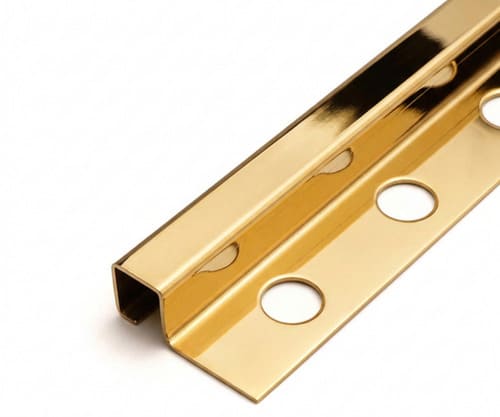
PVD stands for Physical Vapor Deposition. The profile goes into a vacuum chamber, a source metal is vaporised, and the vapour settles on the surface as a thin metal layer. Common tones are gold, bronze, gunmetal, black, and rose gold. The layer is a coating, so it is not the base metal. A PVD gold finish on stainless steel is still stainless steel underneath, with a gold-toned surface. I treat the base grade as a separate decision from the tone.
The layer is thin, so it copies what sits below it. A scratch, a pit, or a dull patch in the base will show through the tone. That is why surface preparation matters more with PVD than with a hiding film. I ask suppliers how the base is polished and cleaned before coating. I check the sample under the same light the buyer will use. A tone that looks right in a factory photo can read differently on site.
Chamber size sets a practical limit. Profiles are coated in batches, and the batch size depends on the chamber. For a large order, ask how many batches the run will take and how colour is checked between batches. A single sealed sample should anchor the whole order.
Powder coating: colour and texture in a thicker film
Powder coating starts as a dry polymer powder. An electrostatic charge holds the powder on the grounded profile, then heat cures it into a continuous film. The film is thicker than a PVD layer and fully opaque, so it hides the metal below, and the colour range is wide. Any RAL shade can be specified in matte, satin, or gloss, and texture can run from smooth to fine grain.
That range is the reason to choose it. When a hotel chain or a housing project needs every trim to match one shade, powder coating is the direct route. The trade-off sits in the build: the film is a polymer layer on the surface, so a deep gouge can expose the metal below. Chips can be touched up, or the piece can be stripped and coated again, which PVD does not offer in place.
PVD vs powder coating at a glance
The table below puts the two finishes next to each other on the points buyers ask about first.
| Point | PVD | Powder coating |
|---|---|---|
| What it is | Thin metal layer from a vacuum chamber | Polymer powder, sprayed on and heat-cured |
| Look | Metal tone: gold, bronze, gunmetal, black | Solid colour with a polymer surface |
| Colour range | Limited to metal tones | Wide: any RAL shade |
| Coat build | Thin; copies the base surface | Thicker; hides the base surface |
| Damage | A deep mark can break the thin layer | A deep gouge can chip the film |
| Repair | Damage usually means replacing the piece | The piece can be stripped and coated again |
| Best fit | Wet rooms and high-touch edges | Exact colour match, matte textures |
Where each finish belongs on a project
Showers and wet rooms are the natural home of PVD on stainless steel. The base grades we run are 304 and 316, and the metal underneath already stands up to water. Start with our stainless steel trim range when the brief names a shower, a steam room, or a washroom.
Kitchens and high-touch edges point the same way, since edges near taps and doorways are touched and wiped every day. A metal tone that keeps its look under that routine beats a wider colour chart. Powder coating can still work on a kitchen wall edge, but ask first which cleaners the site uses. Strong solvents can mark a polymer film.
Brand colour and matte texture point to powder coating. One RAL shade across hundreds of rooms is a powder job. Our aluminium trim options carry most of these orders, since aluminium takes the film well. For black schemes, our notes on black finish pairings show how one shade reads on different profiles.
Floors, steps, and thresholds need a different order of checks. No finish is made for heavy treading on its own, so check the profile shape and the base metal first. If the edge will take foot traffic, say so in the inquiry, so the supplier can confirm whether the profile suits that wear.
Keeping colour steady across a bulk order
Colour drift between batches is the complaint I hear most on repeat orders, and the fix is a sealed sample. We keep the sealed sample and the factory sample on file for two years, so a repeat order can be checked against the same piece. Ask for that sample before the bulk run, and check each batch against it in the same light.
Plan the order around the approved facts. Our minimums are 1,000 pieces for aluminium, 500 for stainless steel, 200 for brass, and 2,000 for PVC. Samples take 7 days, or 7 to 10 days for custom work, and bulk runs take 20 to 30 working days. Confirm the tone, the base grade, and the minimum for your order in writing before production starts. Confirm price and lead time per order, and do not assume an earlier quote still holds.
If a batch drifts, stop and compare it with the sealed sample before anything ships. Agree in advance who checks each batch and what happens to pieces that fall outside the agreed look. PVD tones are checked batch by batch, while powder colours are checked against the RAL reference and the approved swatch. Either way, the rule is the same: no batch ships on a photo alone.
Care, damage, and repair
Care is simple for both finishes, and the rules differ in one place. For PVD, wipe with a soft cloth and avoid abrasive pads, steel wool, and bleach-type cleaners. For powder coating, use mild soap and water on a soft cloth, and avoid solvents such as acetone or thinners, which can soften the film. Full cleaning guidance for coated metal trim covers brass, black, and stainless pieces in more detail.
Damage is where the two part company: a deep mark on PVD usually means the piece is replaced. The thin layer cannot be patched in place. A chip in powder coating can be touched up, or the piece can be stripped and coated again. When you cost a project, count that difference: an easy-to-repair finish can be the cheaper choice over a long fit-out. It can win even when the other finish looks tougher on day one.
What to put in your order
Send the supplier enough detail to quote the finish, not just the profile. Anodized aluminium is a third route, with dye held in the oxide layer on the metal, and our earlier anodized comparison covers it in full. For a PVD or powder order, include these six items:
- The finish name and a physical swatch or approved sample.
- The base metal and grade, such as 304 or 316 stainless steel, 6063 aluminium, or H59 brass.
- Which faces are visible, and which faces can be less critical.
- The project environment: wet room, kitchen, floor edge, or outdoor use.
- Which tests the finish must pass, and the pass criteria you will use.
- How finished pieces must be packed, so they do not scuff in transit.
If the brief names a metal tone and a wet or high-touch room, start with PVD on stainless steel. If the brief names an exact shade or a matte texture, start with powder coating. Send the swatch, the base grade, and the room conditions with the inquiry, and ask for a sealed sample before the bulk run. That sample, checked under site light, is the cheapest way to lock the finish.
Frequently asked questions
Which finish lasts longer on tile trim?
It depends on the setting. PVD is a thin, hard metal layer that tends to hold its tone under constant touch and water. Powder coating is a thicker film that handles colour matching better and can be recoated when chipped. Ask which setting the trim will face, then judge the finish against that setting, not against a general claim.
Can PVD be applied to aluminium tile trim?
Yes. PVD is a coating, so it can sit on aluminium, stainless steel, or brass, and the base grade stays a separate choice. The base must be polished and cleaned well first, since the thin layer copies the surface below it. Confirm the base and the tone for your order before production starts.
Can powder coating match any colour?
The range is wide, including any RAL shade in matte, satin, or gloss, but an exact match still needs a physical swatch. Screen colours are not reliable for sign-off. Send the swatch with the order and check the sealed sample under the same light the buyer will use.
What happens if powder coating chips?
A deep chip can expose the metal below, since the film sits on the surface. Small chips can be touched up, and a damaged piece can be stripped and coated again. PVD damage is different: the thin layer cannot be patched in place, so a damaged piece is usually replaced.
How do I keep colour steady across a bulk order?
Anchor the order to one sealed sample and check each batch against it under the same light. We keep the sealed sample and the factory sample on file for two years. Agree before production who checks each batch and what happens to pieces that fall outside the agreed look.