Choosing a tile trim manufacturer in China is not mainly a price exercise. Almost any Foshan supplier can send a catalogue and a sharp per-piece quote; what separates a factory you can build a range on from one that costs you a season is whether eight things check out before the first bulk order: the profile range and mold library behind it, verifiable material grades, realistic MOQs and lead times, a samples process that represents production, QC you can inspect against, export-grade packing, OEM capability, and documentation you can put in front of your own customers. This guide works through each check in the order an importer or distributor actually runs them, the red flags that end a vetting early, and a checklist you can reuse for every candidate factory — including us.
First, confirm you are vetting a factory, not a storefront
Trading companies have a legitimate place in sourcing, but they are a different purchase: you are buying their margin and their factory relationships, not production control. If the offer is presented as factory-direct, verify it like one. Ask for the production address and check it against the business licence; ask which processes happen in-house — extrusion or forming, surface finishing, cutting, packing — and which are subcontracted, because subcontracted finishing is where colour control and schedules usually slip. A factory visit settles most of this in an hour; if you cannot travel, a live video walkthrough of the production floor, the mold store and the packing area answers the same questions almost as well. A supplier who will not show production at all has told you the most important thing about them.
Check 1: Range depth and the mold library behind it
Trim is a system purchase: your range needs the profiles your market sells, in the heights your tiles need, with the connectors, corner pieces and end caps that complete an installation. Test the candidate’s range against your actual list, profile by profile and height by height, instead of accepting a headline claim of “full range”. Then ask about the mold library. Every profile and height comes out of a mold or die, so the size of a factory’s existing library tells you how much of your range already exists as production tooling — and how much would need new tooling, with its cost and lead time, before your first order can even start. Ask which of your profiles are existing molds, which need new ones, what new tooling costs, and who owns a mold you pay for. The range logic this feeds into — core profiles first, depth by tier — is set out in our guide to building a tile trim range for distributors.
Check 2: Material grades you can verify, not just names
“Aluminum”, “stainless” and “brass” are families, not specifications. The vetting question is whether the factory will name the grade in writing and let you check it:
- Aluminum: 6063 and 6463 are the standard extrusion alloys for tile trim. Get the alloy named on the quotation and the specification sheet, not just in conversation.
- Stainless steel: 304 and 316 behave differently where it matters — 316’s molybdenum content is what resists chloride pitting and tea staining in coastal and wet areas, as our 304 vs 316 vs 316L grade guide sets out. A quote that says “stainless steel” without the grade is not a specification.
- Brass: specify solid brass of a named grade — H59 — rather than a brass colour on another metal, as our brass tile trim selection guide explains.
Verification has three layers, and a serious factory accepts all of them. First, mill certificates: the document issued for the raw-material batch, tying that batch to a grade and composition — ask for it per material, per order. Second, your own testing: retain samples from the sample round and from bulk, and if the order justifies it, have composition checked independently rather than relying on appearance — a magnet, for example, is not a grade test, since cold-worked stainless can be weakly magnetic regardless of grade. Third, sealed reference samples: before bulk production, both sides sign and keep an identical sample of each profile and finish, so “what was agreed” is a physical object, not a message thread. The finish side of this — anodized vs powder coat vs PVD, and locking a finish before bulk — is covered on our tile trim finishes and colours page.
Check 3: MOQ and lead-time realism
MOQ decides whether a factory fits your ordering pattern, so pin it down precisely: per material, per profile, and per finish — the three numbers are often different, and a low headline MOQ that triples per colour changes the economics of a range. Then test the lead time the same way. Ask what the quoted time is made of: samples, tooling if any, production, finishing, packing. A factory with your molds on the shelf and a factory cutting new tooling cannot honestly quote the same first-order lead time, and a lead time dramatically shorter than every competitor’s is a question to ask, not a gift to accept — the missing days usually come out of finishing, curing or QC. Finally, ask what the lead time assumes about your side: artwork for branded packing, for example, is on your clock, not theirs.
Check 4: A samples process that represents production
Samples are your cheapest inspection. Order them as a buyer, not as a souvenir: the exact profile, grade, finish and height you plan to stock, checked against the tile it will sit with — trim height is tile thickness plus the adhesive bed, the method is in our tile trim size guide — and under your market’s lighting, not a photograph. Ask two process questions. Are samples cut from production profiles or made specially? A hand-finished sample proves the factory can make one good piece; a production sample proves what a container looks like. And what is the sample lead time for existing profiles versus custom ones? Keep one of each approved sample sealed as the reference from Check 2 — it is the standard the bulk is inspected against, and the arbiter if a finish argument starts later.
Check 5: QC you can inspect against, and pre-shipment inspection
Every factory says it has QC; the vetting question is what you are allowed to inspect against, and when. Ask what is checked in-process and at final inspection: dimensions against the drawing, finish against the sealed sample, straightness, protective film and packing condition. Then agree the inspection regime before production starts, in writing: the factory’s own reporting (photos or video of finished goods and packing, as a minimum), your right to visit or send someone, and — for a first order or a full container — a third-party pre-shipment inspection booked by you, checking quantity, dimensions, finish and packing against the same sealed samples and specification. Agree in advance what happens when inspection fails: rework, re-inspection, and who carries the cost. None of this signals distrust; factories that run real QC are used to documented inspection, and the ones who resist it are answering your question.
Check 6: Export packing and container experience
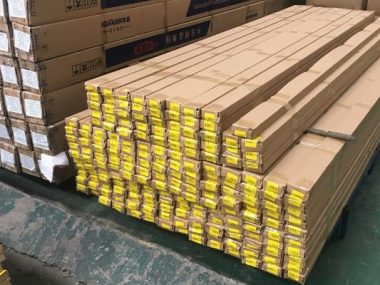
Trim is long, light and easy to damage: bent lengths and scratched finishes are packing failures, not production failures, and they are decided at this step. Ask how profiles are protected (protective film, per-piece sleeving on polished finishes), how many pieces go in a carton, how cartons are built and stacked, and how a container is loaded — mixed profiles and lengths planned, or filled in as it comes? Ask for packing photographs from recent shipments rather than a description. If your market sells shelf lengths or retail formats, state the format here, because repacking full lengths locally is slow and error-prone. This is also where you confirm the factory exports routinely to your region and can produce a clean document set — invoice, packing list, bill of lading — that matches the goods; the end-to-end process is covered in our guide to importing tile trim from China.
Check 7: OEM and private-label capability
If the range will carry your brand, vet it as a production capability, not a marketing promise: branded cartons, labels and barcodes, printed or sleeved pieces, and the artwork and plate lead times that come with them. Confirm minimums for branded packing (they can differ from product MOQs) and whether the factory has shipped private-label product in your format before. Decide branding before the first production run, not the third — the full breakdown is in our OEM and private label guide.
Check 8: Communication and documentation
You are also buying the paperwork. Project and specification business runs on documents: profile specification sheets and material datasheets for submittals, dimensional drawings, finish references that survive being forwarded. Ask for the spec sheet set for your shortlisted profiles during vetting — its quality predicts the submittal file you will hand your own customers. Test communication the same way: ask one hard technical question (a grade substitution, a tolerance, a finish process) and judge the answer’s specificity. A factory that answers technical questions with documents is a factory you can specify with; one that answers everything with “no problem” is telling you the specification is not being read.
The factory-vetting checklist
Run every candidate through the same list, in writing:
| Check | Ask for | What a solid answer looks like |
|---|---|---|
| Factory status | Production address, business licence, in-house vs subcontracted processes | Address matches the licence; finishing and packing in-house or openly declared |
| Range & molds | Your profile/height list marked against their range; mold library size; tooling terms | Each line answered existing-mold or new-tooling, with cost, lead time and mold ownership stated |
| Materials | Named grades on the quotation (6063/6463, 304/316, H59); mill certificates | Grade named per product, certificates offered per batch, sealed samples accepted |
| MOQ & lead time | MOQ per material/profile/finish; lead time broken into stages | Numbers differ sensibly by material; lead-time stages add up and match their tooling answer |
| Samples | Production-run samples of the exact profile, grade, finish, height | Sample lead time stated for existing vs custom profiles; samples match the range you will order |
| QC & inspection | QC points, reporting format, third-party PSI acceptance, failure handling | Documented checks against sealed samples; PSI welcomed; rework/re-inspection terms agreed in writing |
| Packing & export | Packing spec, pieces per carton, loading plan, photos of recent shipments | Film/sleeving, carton spec and loading described concretely; documents match goods |
| OEM | Branded packing options, minimums, artwork lead time | Branding treated as part of the specification, set up on order one |
| Documentation | Spec sheets and datasheets for shortlisted profiles | Documents produced during vetting, matching what a project submittal needs |
Red flags and common mistakes
- The grade will not be put in writing. “Stainless” with no 304/316, “brass” that turns out to be a colour: if the grade is not on the quotation and the spec sheet, it is not in the contract either — and substitution, when it happens, is discovered by your customer, not by you.
- A price far below the field, unexplained. Metal, finish and QC are where trim cost lives. A quote well under every comparable one has usually taken the difference out of wall thickness, grade or finish — ask which, and check the sample’s weight and dimensions against the drawing.
- A perfect sample, but resistance to sealed samples or inspection. The sample is the one piece made to be looked at. Resistance to reference samples or third-party inspection is resistance to being measured against it.
- A lead time nobody else can match. Production, finishing and packing take the time they take. A promise dramatically shorter than the field’s, with no capacity explanation, is usually borrowed from your QC or your finishing.
- No questions back. A factory manufacturing to your specification has questions — about heights, finishes, lengths, packing. A supplier who asks nothing has nothing to manufacture against, and the gaps surface at loading.
- Ordering on photographs. The common buyer-side mistake that enables most of the above: no written spec, no sealed sample, no inspection — three cheap steps skipped, one expensive container.
How NIUYUAN answers these checks
Run us through the same list. The factual answers: NIUYUAN Metal manufactures tile trim in Foshan, Guangdong — a 31,706 m² factory with 250+ staff, 40+ production machines and more than 2 million pieces of monthly capacity. The range is aluminum (6063/6463), stainless steel (304/316), solid brass (H59) and PVC tile trim, plus LED strip profiles and the accessories — connectors, corner pieces and end caps — that complete each profile system, produced from a library of 3,000+ existing molds. MOQs are 1,000 pcs for aluminum, 500 pcs for stainless steel, 200 pcs for brass and 2,000 pcs for PVC. Standard samples are ready in 7 days (custom profiles 7–10 days); bulk production usually runs 20–30 working days after order confirmation, depending on profile, finish, quantity and packaging. OEM production and custom packaging are supported, including branded cartons and labels. Inspection points — photos or video of finished goods and packing — are agreed before production starts, and buyers are free to arrange their own pre-shipment inspection. Where the answer depends on your market — channels, conformity steps, ports — the country editions of this guide series cover the Philippines, Malaysia and Saudi Arabia. Send the RFQ below through our contact page and the quotation is built against it.
What to send in your RFQ
- Profiles (shape and series), material and grade for each
- Trim height per profile, matched to your tile thickness and adhesive bed
- Finish reference for each line — photo, sample, or a finish from the finishes page
- Length plan and cutting format your market sells
- Quantity per SKU, and the total per material against the MOQs above
- Packing: protective film, pieces per carton, your labels/barcodes if private label
- Destination port and the Incoterm you want quoted
- Any submittal documents your projects require (datasheets, specifications, finish samples)
FAQ
How can I verify that the trim I receive is the grade I ordered?
Use three layers together: the grade named in writing on the quotation and specification (6063/6463 aluminum, 304 or 316 stainless, H59 brass); the mill certificate issued for the raw-material batch, tying the batch to its grade; and sealed reference samples, signed by both sides before production, that bulk is checked against. If an order justifies it, have a retained sample’s composition tested independently. Appearance alone — including a magnet test on stainless — cannot confirm a grade.
What MOQs should I expect when buying tile trim from China?
There is no single industry number — MOQ is set per factory, and it usually differs by material, profile and finish, so get all three figures rather than a headline. At NIUYUAN, MOQs are 1,000 pcs for aluminum, 500 pcs for stainless steel, 200 pcs for brass and 2,000 pcs for PVC. What matters commercially is whether the MOQ structure lets you build a balanced range — core profiles in depth, step-up lines in smaller quantities — without over-committing to slow lines.
Is a third-party pre-shipment inspection worth it for tile trim?
For a first order with a new factory, or a full container, yes — it is the only check that compares the actual shipment, before it sails, against your written specification and sealed samples: quantity, dimensions, finish, protective film and packing. On repeat orders with a proven factory, many importers step down to the factory’s documented photo/video reporting with occasional inspections. Either way, agree the inspection terms — including what happens on a fail — before production starts, not when the container is booked.
What should be fixed in writing before I pay a deposit?
The full specification (profile, grade, height, finish reference, length, protective film, packing), the sealed samples, the price and Incoterm with the destination port, the lead time and what it includes, the inspection regime and failure handling, and the document set you will receive. Most disputes in trim importing are specification gaps discovered at arrival; the deposit is the last moment when closing them costs nothing.
Can one factory supply a full private-label tile trim range?
Yes, if the range and the branding are vetted together: the factory needs your profiles in its existing mold library or new tooling agreed, the materials your market specifies, and branded packing — cartons, labels, barcodes — set up as part of the first order’s specification. NIUYUAN produces aluminum, stainless steel, brass and PVC trim plus LED profiles and accessories from 3,000+ existing molds, and supports OEM production with custom packaging; the branding mechanics are set out in our OEM and private label guide.