
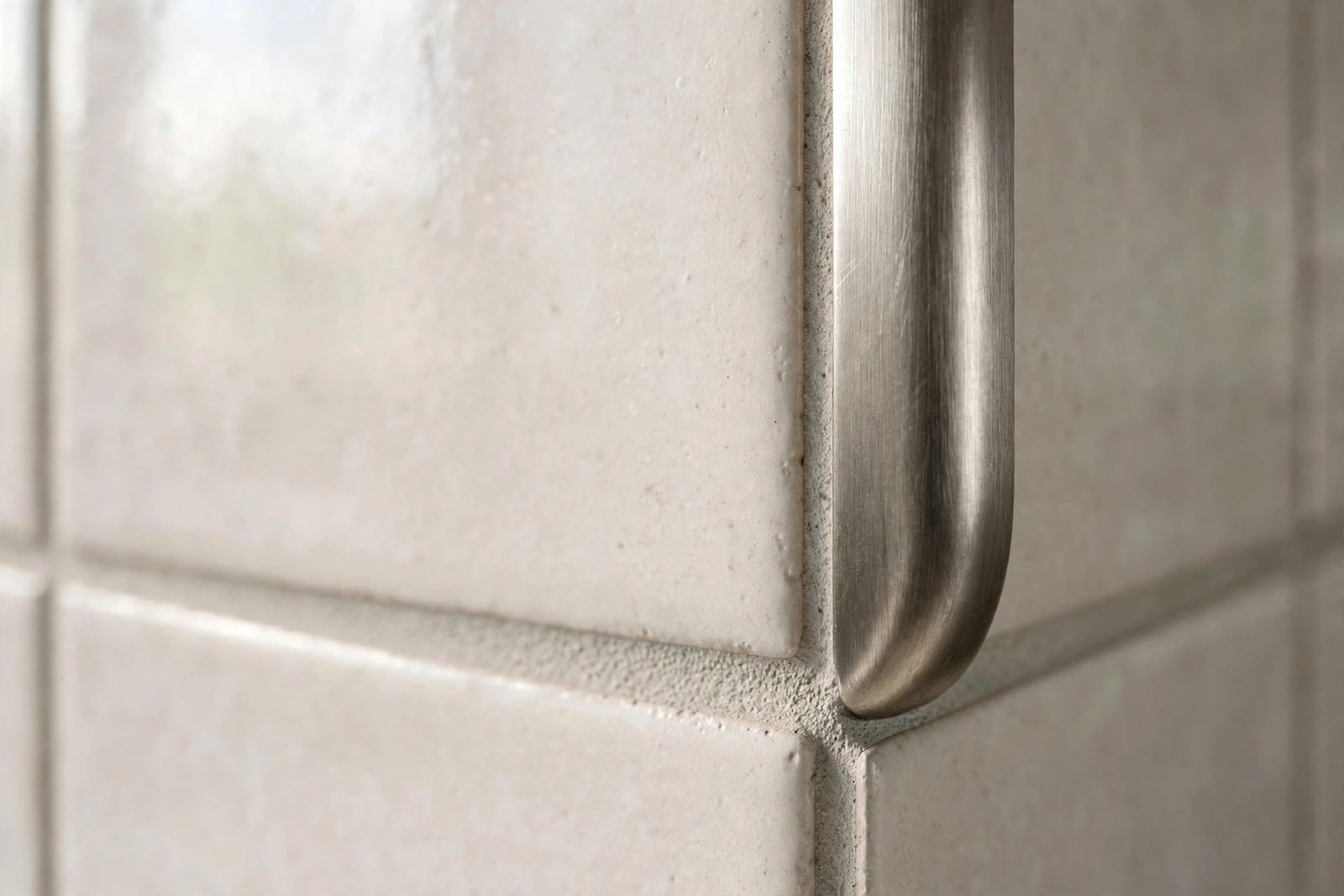
Quarter round tile trim is the right call when an edge needs a soft finish. It is a slim profile with a quarter-circle face. It caps a raw tile edge and hides the joint where wall meets floor. It rounds off a countertop lip without the bulk of a bullnose piece. Pick it when the trim should sit quiet and let the tile lead; pick bullnose or round edge when the edge should be seen.
That short answer hides one trap: two products share the name quarter round. One is a ceramic trim piece fired in glaze; the other is a metal profile in aluminium, stainless steel, or brass. Both cap edges, but they install and cost differently. This guide covers the metal profile first, then shows where the ceramic piece still wins.
What Quarter Round Tile Trim Actually Is
A quarter round profile is a quarter of a circle in cross-section. One flat face sits against the tile edge, and the curve turns the corner. The curve is small, so the trim reads as a soft line rather than a bead. In metal, it is extruded or roll-formed and cut to length, often two and a half to three metres, which suits container orders.
Do not confuse it with round edge. A round edge is a half circle, twice the curve, and it stands proud of the tile face. A quarter round is flatter and lower, and it fills a corner or caps an edge with less weight. If a client wants the trim to disappear, quarter round is the safer pick. If the client wants a visible metal line, round edge is the better pick.
Height follows the same rule as other metal trim: match profile height to tile thickness plus the adhesive bed. An 8 mm tile on a standard bed usually takes a 10 mm profile, while a 12 mm stone-look tile needs a taller one. Get this wrong and the trim sinks below the tile face or stands proud. Our tile thickness plus adhesive rule walks through the maths in full.
Quarter Round vs Bullnose: Same Job, Different Scale
Bullnose is the classic answer to a raw tile edge. It is a tile piece with one rounded edge, fired in the same glaze as the field tile. It caps wall ends, curbs, and niche rims. It works well, but it is bulky, needs a matching glaze, and only fits its own tile range. Our guide on what bullnose is sets out its shapes and limits.
Metal quarter round does the same job with a slimmer footprint and no glaze match to chase. The trade is that metal shows as metal. On a glazed wall, a bullnose edge blends in, while metal quarter round draws a thin metal line. Some buyers want that line; others do not. Ask the client which look they expect before you order, since the two finishes cannot be swapped after install.
| Quarter round metal trim | Bullnose tile piece | |
|---|---|---|
| Form | Slim metal profile, quarter-circle face | Tile piece with a rounded glazed edge |
| Finish | Metal: brushed, polished, anodised, or plated | Same glaze as the field tile |
| Best for | Wall-floor joints, countertop lips, niche rims | Wall ends, curbs, exposed tile runs |
| Weak point | Shows as a metal line on glazed walls | Bulky; needs a glaze match; range-bound |
| Install | Set in adhesive with the tile run | Set like a tile, grouted at the joint |
When a job mixes tile ranges, or no matching bullnose exists, metal quarter round is often the only clean answer. It needs no glaze match, and one profile can serve several tile colours. That is why distributors stock it as a problem solver, not a design feature.
Quarter Round vs Round Edge Metal Trim
Both are metal, and buyers mix them up. The difference is the curve and the presence. Round edge is a half-round bead that sits proud of the tile and reads as a deliberate metal line. Quarter round is a quarter circle that tucks into the corner and reads as a soft shadow line.
Use round edge where the edge takes wear. A countertop lip, a stair tread, or a column corner that hands brush past all suit the fuller bead. The extra metal takes the knock, and people see it and avoid it. Use quarter round where the edge is seen, rarely touched. Wall-floor joints, backsplash ends, and niche rims are its natural home.
Cost follows the metal, not the curve. Both run in the same alloys and finishes, so the price gap is small. The real cost driver is alloy, finish, and order volume. Do not pick quarter round to save money; pick it because the edge should be quiet. Our round edge range shows the fuller bead. The six profile types compared puts both shapes next to L, T, U, and square edge options.
Five Places Quarter Round Earns Its Keep
Wall-floor joints: the floor meets the wall at a right angle, and the joint collects grout, dust, and mop water. A quarter round in the corner covers the joint and sheds water. It also hides small level gaps between the tiles. This is the most common use.
Countertop lips: a tiled countertop ends in a raw edge that hands meet every day. A quarter round softens that edge without the bulk of a bullnose. Stainless steel suits kitchens; brass suits a warm scheme, but confirm the finish route in writing first.
Shower niches and window sills: niches and sills have short edges that are hard to finish cleanly. A short length frames the opening and seals the edge against water. Mitred cuts keep the corner joint tight. Ask the supplier for corner pieces for the turn.
Retrofit over a rough edge: a renovation often leaves a cut edge that cannot be re-fired. A quarter round sits over it and hides it. It needs a sound bed, so check the old adhesive first. Where the old edge is loose, fix the tile first.
Backsplash ends: a backsplash that stops short of a cabinet leaves a thin exposed edge. A quarter round caps it with less weight than a bullnose, which matters on small subway runs. Match the metal to the tap and handles, not the tile, so the line reads as part of the fittings.
Where Quarter Round Is the Wrong Call
Quarter round is light-duty, and it fails when the job asks for more. Do not use it on a floor edge that takes foot traffic. The slim curve has little metal to wear, and a chip shows badly. Use square edge or full round edge there instead.
Do not use it to bridge a large level gap; it covers small gaps, not steps. If floor and wall tiles sit more than a few millimetres apart, the profile will rock or leave a void behind it. Fix the levels first, then trim. The same holds for thick stone-look tiles. A 20 mm outdoor porcelain slab needs a taller, heavier profile.
Wet floor transitions are another no. A shower floor that drains across the trim line needs a profile built for water flow. On a curved wall, a straight metal length will not follow the bend, so ask for a bendable profile instead. If the edge takes impact, water flow, or a bend, quarter round is the wrong tool.
How to Specify It: Height, Material, and Finish
Start with height, then material, then finish. That order avoids the most common error: a finish picked first, then a height that does not fit. Measure tile thickness, add the adhesive bed, and pick the next height up. Confirm the height against a sample tile first. A sample costs little, but a wrong height costs a container.
| Material | Best for | Watch out for |
|---|---|---|
| Aluminium 6063 | General interiors, kitchens, light wet areas | Soft; dents on high-impact edges |
| Stainless steel 304 | Bathrooms, kitchens, most wet areas | Heavier; needs a clean cut to avoid burrs |
| Stainless steel 316 | Coastal and pool-adjacent jobs | Higher cost; confirm grade in writing |
| Brass H59 | Warm schemes, lobbies, feature walls | Patinas unless sealed; confirm the finish route |
Finish is the last decision, and the one buyers regret most. A brushed finish hides small marks, while a polished finish shows every touch. An anodised finish on aluminium holds colour well, but damage cannot be polished out. Confirm the finish against a sealed sample, not a photo, and keep that sample until the order lands. For a hotel or a chain, ask for one finish batch across the order.
Before you send the RFQ, run this check. Tile thickness and adhesive bed confirmed, profile height picked from the sample, not the catalogue, and material and grade named in full. Finish route named, with a sealed sample on file, and lengths and corner pieces counted. If any line is blank, the supplier will guess, and the guess will be wrong. Our bullnose vs metal trim comparison helps when the client is torn between the two.
FAQ
Is quarter round tile trim metal or ceramic?
Both exist. Ceramic quarter round is a glazed trim piece that matches the field tile. Metal quarter round is an extruded profile in aluminium, stainless steel, or brass. They share a name and a shape, but they install differently, so name the material on the order.
When should I choose quarter round over bullnose?
Choose quarter round when the edge should stay quiet, when no matching bullnose glaze exists, or when one profile must serve several tile colours. Choose bullnose when the edge should blend into the tile glaze and read as part of the tile.
What height quarter round do I need?
Match the profile height to tile thickness plus the adhesive bed, then pick the next size up. An 8 mm tile on a standard bed usually takes a 10 mm profile. Confirm against a sample tile before the bulk order.
Can quarter round be used in a shower?
Yes, on niche rims, sills, and wall-floor joints, where it caps an edge and sheds water. Do not use it where shower water drains across the trim line, or on floor edges that take foot traffic.
Does quarter round tile trim need corner pieces?
Yes, where the run turns a corner. A mitred cut works on straight corners, but factory corner pieces give a tighter joint and a cleaner finish. Count them before you order, since they are easy to forget and slow to ship alone.
Quarter round earns its place by being the quietest edge in the range. It suits wall-floor joints, countertop lips, niche rims, and retrofit edges, and it fails where the edge takes impact, water flow, or a bend. Order it by height first, material second, and finish last, and confirm all three against a sealed sample. That order of decisions is what keeps a small trim from becoming a costly reorder.