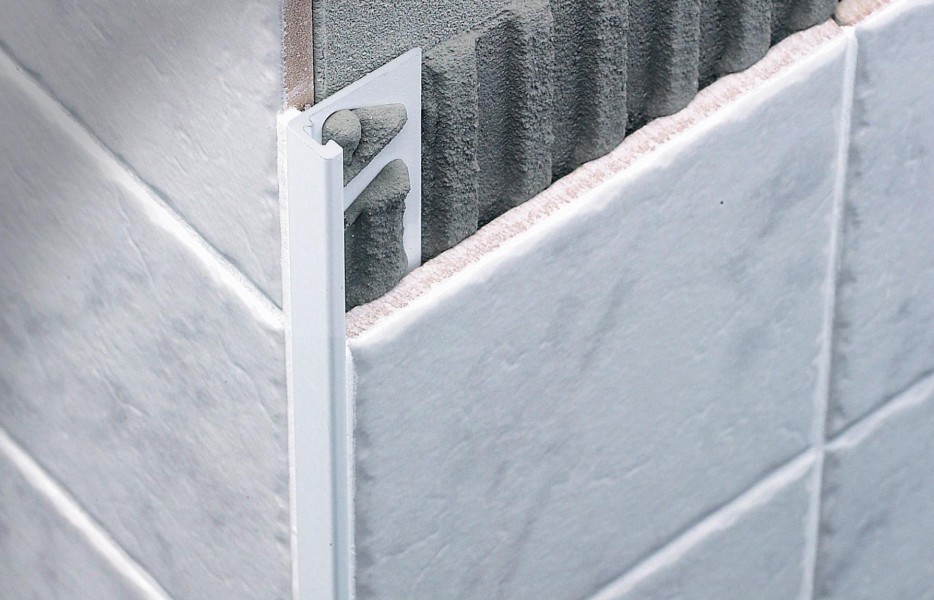
Tile edges chip because the edge is the weakest part of the tile. The glaze ends there, the body stands exposed, and a sharp 90-degree corner focuses every knock into one small point. A chip is not a surface mark but a piece of the tile body breaking away. Once the glaze is gone, the edge stays rough, collects dirt, and can grow into a crack.
The fix is to match the protection to the place and the threat. Outside corners, floor transitions, shower curbs, and worktop edges take the most contact, so they need a metal profile or a finished edge. Field tiles in the middle of a wall rarely need protection. This guide explains each cause, ranks the zones that need protection, and shows how to pick a profile that fits the tile and the traffic.
Why the Tile Edge Is the Weak Point
A tile face is hard, and the glaze and dense body resist scratches and stains well. The edge is a different story, because the glaze layer ends there in a thin line. The fired body below it has no glaze to shield it. A cut edge is even weaker, because the saw leaves tiny fractures along the cut line.
Geometry makes the problem worse, because a sharp corner has almost no area to spread a blow. When a vacuum cleaner, a trolley wheel, or a dropped tool hits the edge, all the force lands on one point. The brittle body does not bend, so it breaks off in a small flake. That is why a tile can look perfect on its face and still show chips along its border.
Tile type changes the risk, but it does not remove it. Porcelain has a denser body than standard ceramic, so it resists a light knock better. Glass tile is hard and brittle, so its edge can chip from a sharp tap, and natural stone can flake along its grain. No common tile body is immune to a hard, focused impact on an exposed edge.
Seven Causes of Edge Chipping
Most chips trace back to one of seven causes. The first three act during installation, while the rest act during use. Knowing which one you face decides what protection will work.
- Impact: dropped tools, moving furniture, trolley wheels, and vacuum cleaners strike the edge. This is the most common cause in corridors, kitchens, and shops, where the hit is short and sharp and lands on the most exposed point.
- Cutting damage: a dull blade, a fast feed rate, or too little water leaves micro-cracks along the cut edge. The edge looks fine at first, but it chips later, often during grouting or the first weeks of use.
- Hollow spots under the tile: when adhesive does not fully support the tile, the edge sits over a void. Foot traffic or a load presses the edge down, and the unsupported edge flexes and breaks.
- Substrate movement: concrete shrinks and cures, timber floors flex, and buildings settle. Movement pushes stress into the tile field, and the stress finds the weakest point, which is often an edge or a corner.
- Thermal movement: tiles and their substrates expand at different rates as temperatures change, and sunlit floors, heated floors, and outdoor areas see the largest swings. Repeated cycles can loosen the bond and open cracks from the edge.
- Moisture and frost: water that gets into a crack or an open joint can freeze outdoors, and the ice expands and prises the edge apart. In wet rooms, moisture behind the tile weakens the bond and leaves the edge unsupported.
- Poor joint spacing: tight joints with no room for movement pass stress straight into the tile. Missing movement joints in large floors have the same effect. The edge takes the load and fails first.
Where Chips Happen First: Zone by Zone
Not every tile edge needs the same protection. The table below ranks the zones by exposure and names the first-choice protection for each. Use it to spend the budget where chips actually happen.
| Zone | Main threat | Risk | First-choice protection |
|---|---|---|---|
| Outside wall corner | Direct impact from people and equipment | High | Metal L-shaped or round-edge profile |
| Floor transition | Trolley wheels, foot traffic, height step | High | Metal ramp or T-shaped profile |
| Shower niche and curb | Daily contact, water, cleaning tools | High | Metal profile, stainless steel in wet areas |
| Worktop and backsplash edge | Pots, cutting boards, cleaning | Medium | Metal profile or bullnose tile |
| Stair nosing | Repeated foot impact on the tread edge | High | Metal stair nosing profile |
| Outdoor and pool edge | Frost, thermal cycles, traffic | High | Metal profile with movement joints |
| Field wall tile | Little direct contact | Low | Usually none needed |
Outside Corners, Transitions, and Wet Zones
Outside corners top the list because they face traffic from two sides. A corridor corner meets trolleys, cleaning machines, and passing feet, while a kitchen corner meets pots and vacuum cleaners. The edge has no wall beside it to take the blow, so it takes the full hit alone.
Floor transitions rank just as high, because where tile meets carpet, timber, or stone, a height step leaves the tile edge standing proud. Wheels and shoes catch it again and again, but a ramp profile covers the step and spreads the load. A documented case in a commercial corridor showed a tile edge chipping after the adjoining carpet sat about 3 mm below the tile. That small step was enough for wheels to strike the edge again and again.
Shower niches and curbs combine impact with water, as hands, bottles, and cleaning tools strike the niche edge every day. The curb edge meets feet and mops, so stainless steel suits these spots because it handles constant moisture. The waterproofing membrane behind the tile does the sealing work, and the trim only finishes and protects the edge.
How to Choose the Protection
Four options cover most jobs. Each one protects the edge in a different way. The table below compares them so a buyer can match the option to the zone.
| Option | How it protects | Best for | Limit |
|---|---|---|---|
| Metal trim profile | A metal reveal takes the impact instead of the tile | Corners, transitions, wet areas, high traffic | Must be set during tiling, not after |
| Bullnose tile | A factory-rounded glazed edge spreads the load | Low-traffic wall ends, matching tile ranges | Not made for every tile range or size |
| Mitered edge | Two 45-degree cuts meet in a sharp corner | Feature walls, low-contact corners | Weakest against impact, needs skilled cutting |
| Caulk line | A flexible bead seals and softens the edge | Thin tiles, low-contact ends | No real impact protection, needs renewal |
Metal Trim, Bullnose, Miter, or Caulk
A metal profile is the strongest choice where impact is a daily fact. Its anchoring leg sits in the mortar under the tile, so the profile becomes part of the assembly.
The visible reveal stands slightly proud of the tile face and takes the hit first. To see what tile trim is and how it works, start with the profile family and its anchoring leg.
Bullnose tile suits quiet wall ends where the tile range offers a matching piece. The rounded glaze spreads a light knock across a wider area. It cannot match metal in a corridor or at a floor transition, and many large-format ranges have no bullnose piece at all. When no matching bullnose exists, a metal profile is the practical answer.
A mitered edge looks clean on a feature wall, where two tiles cut at 45 degrees meet with no trim line. The look is sharp, and so is the risk. The thin cut edge is the weakest form of corner finish, and a single knock can take a piece out of it. Use it only where contact is rare. For corners that take daily traffic, the outside corner protection guide shows profile options that hold up better.
A caulk line is a seal, not a shield: it hides a raw cut and keeps water out of the joint. It does not absorb a hard knock, but it suits the end of a backsplash or a thin tile edge. In a wet area, use a flexible sealant at the joint and a profile at the exposed edge. For edges that will never take a knock, finishing tile edges without trim explains the caulk and bullnose routes in full.
Which Trim Material Fits the Zone
Material choice follows the zone. Aluminum is light and easy to cut, suits most wall corners and floor transitions, and takes anodized and powder-coated finishes that match many tile colours. Aluminum 6063 and 6463 are the common extrusion alloys for tile trim.
Stainless steel is the heavy-duty choice, and grades 304 and 316 handle impact, chemicals, and constant moisture better than aluminum. Use it in commercial kitchens, hospitals, shower areas, and outdoor edges. It costs more than aluminum, and the extra cost is justified where the edge meets water or cleaning chemicals every day.
Brass suits lobbies, hotels, and retail floors where the finish is part of the design, and H59 brass takes lacquered, chrome-plated, and smoked chrome finishes. It needs care in wet areas, because water spots and tarnish show on a polished brass face. Confirm the finish with the supplier before ordering for a shower or pool edge.
PVC is the budget option for dry, low-traffic wall ends: it is light, easy to cut, and comes in many colours. It does not suit heavy impact zones or outdoor use, where heat and sun can age it. Where the edge will take daily knocks, metal is the safer spend.
Whatever the material, the profile height must match the tile thickness. A profile that sits below the tile face leaves the edge exposed, and one that stands too proud becomes a trip lip. Choosing the right trim size explains how to measure tile thickness and pick the matching profile height.
What Trim Cannot Fix
Trim protects the edge, but it does not fix a bad assembly. A profile on a hollow tile still leaves the edge over a void. A profile on a moving substrate still sees the stress pass through the tile. If chips keep appearing after trim is fitted, the cause is usually below the tile, not at the edge.
Movement joints are the main control for substrate and thermal stress. They give the tile field room to move without passing the load into the edges. Movement joint spacing for tile floors sets out where joints belong and how far apart they should sit. A job with no movement joints will crack and chip no matter how good the trim is.
Cutting quality matters too, because a profile covers the cut edge but cannot heal micro-cracks left by a dull blade. Ask the installer about blade condition and feed rate before the job starts. A clean cut under a profile lasts, while a chipped cut can keep shedding flakes at the joint.
What to Confirm Before You Order
Five checks before ordering trim will prevent most mismatches, so run them with the tile sample in hand.
- Tile thickness: measure the actual tile, not the catalogue figure, and order the profile height to match it.
- Zone and traffic: name each zone and its traffic level, since outside corners and transitions need metal while quiet wall ends may need nothing.
- Wet or dry: wet zones need stainless steel or a finish rated for constant moisture, while dry zones can use aluminum, brass, or PVC.
- Finish and colour: confirm the finish against a physical sample, because screen colours shift and a mismatch shows at every corner.
- Accessories: check corner pieces, end caps, and connectors for the profile you chose. A profile without matching corners leaves a raw joint at the worst spot.
For wet areas, the shower trim guide lists the profiles and finishes that suit niches, curbs, and shower walls. Use it to cross-check the material choice before the order goes in.
Tile edge chipping is a predictable failure, not bad luck, because the edge is thin, brittle, and exposed. Impact, bad cuts, hollow spots, and movement all find it first. Protect the zones that take contact, pick the material for the wet or dry conditions, and fix the assembly faults that trim cannot cover. Do those three things, and the edges will outlast the grout.
Frequently Asked Questions
Why do tile edges chip so easily?
The edge is the weakest part of the tile. The glaze ends there, the body is exposed, and a sharp 90-degree corner focuses every knock into one small point. Cut edges are weaker still, because the saw leaves tiny fractures along the cut line.
Can tile trim stop all chipping?
No. A metal profile protects the exposed edge from impact, which is the most common cause. It cannot fix hollow spots under the tile, substrate movement, or missing movement joints. Those faults need to be corrected in the assembly itself.
Which tile edges need protection most?
Outside corners, floor transitions, stair nosings, shower niches and curbs, and outdoor edges face the most contact. Field tiles in the middle of a wall rarely need protection, because nothing strikes them.
Is a metal trim better than a bullnose edge?
For impact protection, yes. A metal profile takes the hit instead of the tile, and it works with any tile range. A bullnose tile spreads a light knock well, but it is not made for every range and it cannot match metal in high-traffic zones.
Can I protect tile edges after installation?
Only in a limited way. Standard profiles must be set into the mortar during tiling, so they cannot be added later without removing edge tiles. Retrofit trims that glue over the finished edge exist, but they sit proud of the surface and give less protection than an embedded profile.