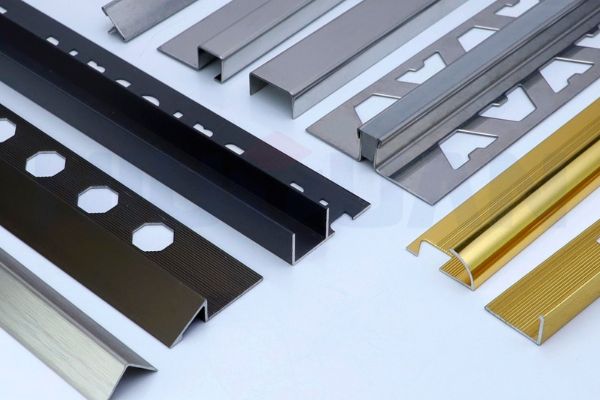
Match the trim height to your tile thickness. Pick a profile that is the same height as the tile, or 1 to 2 mm taller. This chart turns that rule into one lookup table, with the heights each material actually offers.
The chart below covers tile from 3 mm mosaic to 15 mm stone. It also shows which material supplies each height, and which room each material suits. Measure the real tile first. The box label can differ from the tile by a small amount, and that gap is enough to change the size you need.
How to use this chart in three steps
Start with the tile, not the catalogue. A nominal 10 mm tile can measure 9.8 mm or 10.2 mm on site. Measure several tiles with a caliper, and use the largest honest reading as your working height. That reading sets the trim size.
Next, add the build-up under the tile. The adhesive bed raises the finished surface, and a membrane or levelling layer adds more height. A trim chosen from tile thickness alone can end up buried. Work from the finished assembly, not from the tile label.
Last, test fit a short length before you order. Set the trim beside the tile on its adhesive bed. The trim face should sit flush with the tile face, or just below it. If the tile sits proud of the trim, move one size up and test again.
- Measure the tile. Use a caliper on several tiles and keep the largest reading.
- Add the build-up. Count the adhesive bed, membrane, and levelling layer.
- Test fit. Check a short length against the finished assembly before ordering.
Tile thickness to trim height: the master chart
The table below follows the sizing rule published in our tile trim size guide: match the tile, or go 1 to 2 mm deeper. The right column shows which materials stock that height as a standard size. Where no standard height fits, the row says custom.
| Tile thickness | Recommended trim height | Materials with this height in stock | Notes |
|---|---|---|---|
| 3–6 mm mosaic | 6 mm | Aluminum, stainless steel, brass, PVC | Match the depth. Check backer board thickness too. |
| 6 mm ceramic wall tile | 6 mm, or 8 mm with a thick adhesive bed | Aluminum, stainless steel, brass, PVC | Use 8 mm when the adhesive bed is heavy. |
| 8 mm standard tile | 8 mm or 10 mm | Aluminum, stainless steel, brass, PVC | The most common wall and floor sizes. |
| 9–10 mm porcelain | 10 mm or 12 mm | Aluminum, stainless steel, brass, PVC | Go 12 mm when the adhesive bed is thick. |
| 12 mm porcelain or stone | 12 mm or 12.5 mm | Brass at 12.5 mm; others at 12 mm | Check the finished height at both ends of the tile. |
| 12.5 mm stone | 12.5 mm, or 13–14 mm | Brass at 12.5 mm; other materials by custom height | Stone varies in thickness. Measure each batch. |
| 15 mm and above | Custom height by drawing | Custom order in any material | Confirm by sample and test fit before bulk order. |
One more check applies to every row. The trim face should finish flush with the tile face, or up to 1 mm above it. It should never sit below the tile edge. A trim that sits low leaves the tile edge exposed, and that edge chips easily.
Heights, lengths, and order terms by material
Height is only one part of the order. Length, wall thickness, and minimum order quantity shape the quote too. The table below gathers the standard options from our four material pages, so you can compare them in one place. All four ranges come from one tile trim manufacturer in China, so heights and finishes can be matched across materials in a single order.
| Material | Grade | Common heights | Common lengths | Wall thickness | MOQ |
|---|---|---|---|---|---|
| Aluminum | 6063 / 6463 | 6 / 8 / 10 / 12 mm | 2.44 / 2.5 / 2.7 / 3.0 m | 0.5–3 mm | 1,000 pcs |
| Stainless steel | 304 / 316 | 6 / 8 / 10 / 12 mm | 2.44 / 2.5 / 2.7 / 3.0 m | 0.6 / 0.8 / 1.0 mm | 500 pcs |
| Brass | H59 solid brass | 6 / 8 / 10 / 12 / 12.5 mm | 2.44 / 2.5 / 2.7 / 3.0 m | 1.5–5.0 mm | 200 pcs |
| PVC | PVC | 6 / 8 / 10 / 12 mm | 2.5 / 2.7 / 3.0 m | 0.8 / 1.0 / 1.2 / 1.5 mm | 2,000 pcs |
Standard samples ship in about 7 days when the profile is an existing mold option. Custom samples take about 7 to 10 days, based on profile and finish. Bulk orders run about 20 to 30 working days, based on quantity, finish, packaging, and production schedule. Sealed samples are kept for 2 years from the last repeat order, so a repeat run can be checked against the approved sample.
Which material fits which room
Room conditions decide the material more than tile size does. A dry interior wall asks little of a trim. A shower wall, a commercial floor, or a coastal site asks much more. Match the grade to the room, not just to the tile.
| Material | Best rooms | Watch out |
|---|---|---|
| Aluminum tile trim | Dry interiors, standard porcelain walls and floors | Check the grade first for coastal or pool work. |
| Stainless steel 304 | Kitchens, bathrooms, commercial floors | Confirm the grade before wet or coastal use. |
| Stainless steel 316 | Showers, coastal areas, wet spaces, commercial kitchens | Ask for a grade recommendation in writing. |
| Brass tile trim | Premium interiors and feature walls | Confirm the finish by sealed sample before bulk production. |
| PVC tile trim | Interior walls, backsplashes, light-duty floor edges | Interior use only. Confirm color by approved sample. |
Brass is the only material in our standard range with a 12.5 mm stock height. If your stone measures 12.5 mm and you want aluminum or stainless steel, plan for a custom height. That choice adds sample time, so raise it early in the order.
Length: when a 3-metre profile earns its place
Long profiles cut the number of joints on a straight run. Take a 12-metre wall edge as an example. With 2.5-metre lengths, the run needs five pieces and four joints. With 3-metre lengths, the same run needs four pieces and three joints. One joint disappears, and one cut disappears with it.
Short, cut-up work reverses the logic. A bathroom refit or a splashback rarely needs a full 3-metre run. Cutting a 3-metre length down to 800 mm leaves a 2.2-metre offcut that may never match another job. That offcut still cost the full length price, and it still takes rack space while it waits.
Check storage and transport before you commit. A 3-metre profile needs racking that holds it flat along its full length, and a vehicle that takes 3 metres inside without bending. Our 3-metre profile guide for distributors works through the stocking math, including the rack and vehicle checks.
Edge cases: thin panels, bevelled tiles, and thick stone
Thin porcelain panels break the standard table. A panel of 3.5 to 6.5 mm needs a low profile matched to that thickness. A tall profile on a thin panel leaves a raised metal edge that catches feet and cloths. Order the low height, and test fit it the same way.
Bevelled metro tiles need a different measuring habit. The bevel counts toward the finished height, so measure the tile at several points along the edge and use the largest honest reading. Then apply the same rule: a depth equal to the measured tile, or 1 to 2 mm deeper. Our notes on bevelled metro tile trim show the measuring points.
Thick stone is the third edge case. Stone from 15 to 20 mm needs a custom height, and its thickness varies from piece to piece. Measure each batch, and confirm the height against a sample.
Large format work adds one more check: substrate flatness. For tiles with one edge of 15 inches or longer, the ANSI tolerance is no more than 1/8 inch in 10 feet. It is also no more than 1/16 inch in 2 feet. If the floor is out of tolerance, no trim height will fix the lippage. Our large format tile trim guide covers height, length, and handling for big slabs.
Buyer checklist before you order
Run this list before the order goes in. Each item is a yes-or-no check, and one clear no is enough to hold the order until it is confirmed.
- Tile thickness measured. Caliper readings from several tiles, largest reading kept.
- Build-up counted. Adhesive bed, membrane, and levelling layer all added.
- Profile height test fit. A short length sits flush with the finished tile face.
- Material and grade chosen. Grade matches the room: dry, wet, coastal, or commercial.
- Length and joints planned. 3-metre lengths only where runs stay long and straight.
- Finish confirmed by sample. Sealed sample approved; the factory keeps it for 2 years.
- Terms confirmed. MOQ, sample time, bulk lead time, and packaging in writing.
If any item cannot be confirmed, hold that part of the order. A short delay for a sample or a test fit costs far less than a full delivery of trim at the wrong height. Send the tile thickness, target profile, finish reference, and estimated quantity, and ask the supplier to confirm each checklist point in writing before production starts. For the basics of what trim does and why it matters, see what tile trim is.
FAQ
What size tile trim do I need for a 10 mm tile?
Use a 10 mm trim, or 11 to 12 mm when the adhesive bed is thick. Measure the real tile first, then test fit a short length against the finished assembly.
Should tile trim be flush with the tile?
Yes. The trim face should sit flush with the tile face, or up to 1 mm above it. It should never sit below the tile edge, because the exposed edge chips easily.
What heights do NIUYUAN tile trims come in?
Common stock heights are 6, 8, 10, and 12 mm across aluminum, stainless steel, brass, and PVC. Brass also stocks 12.5 mm. Other heights are made by custom order, based on a drawing or sample.
Which material should I use in a shower or coastal project?
Use 316 stainless steel for showers, coastal areas, and wet spaces. Ask the supplier for a grade recommendation in writing before you order, and confirm it against a sample.
Can I order 3-metre lengths in any height and finish?
Not always. 3.0 m is a common length across our materials, but availability varies by profile, height, and finish. Confirm the exact combination before you order, and check that your racking and vehicle fit a 3-metre length.