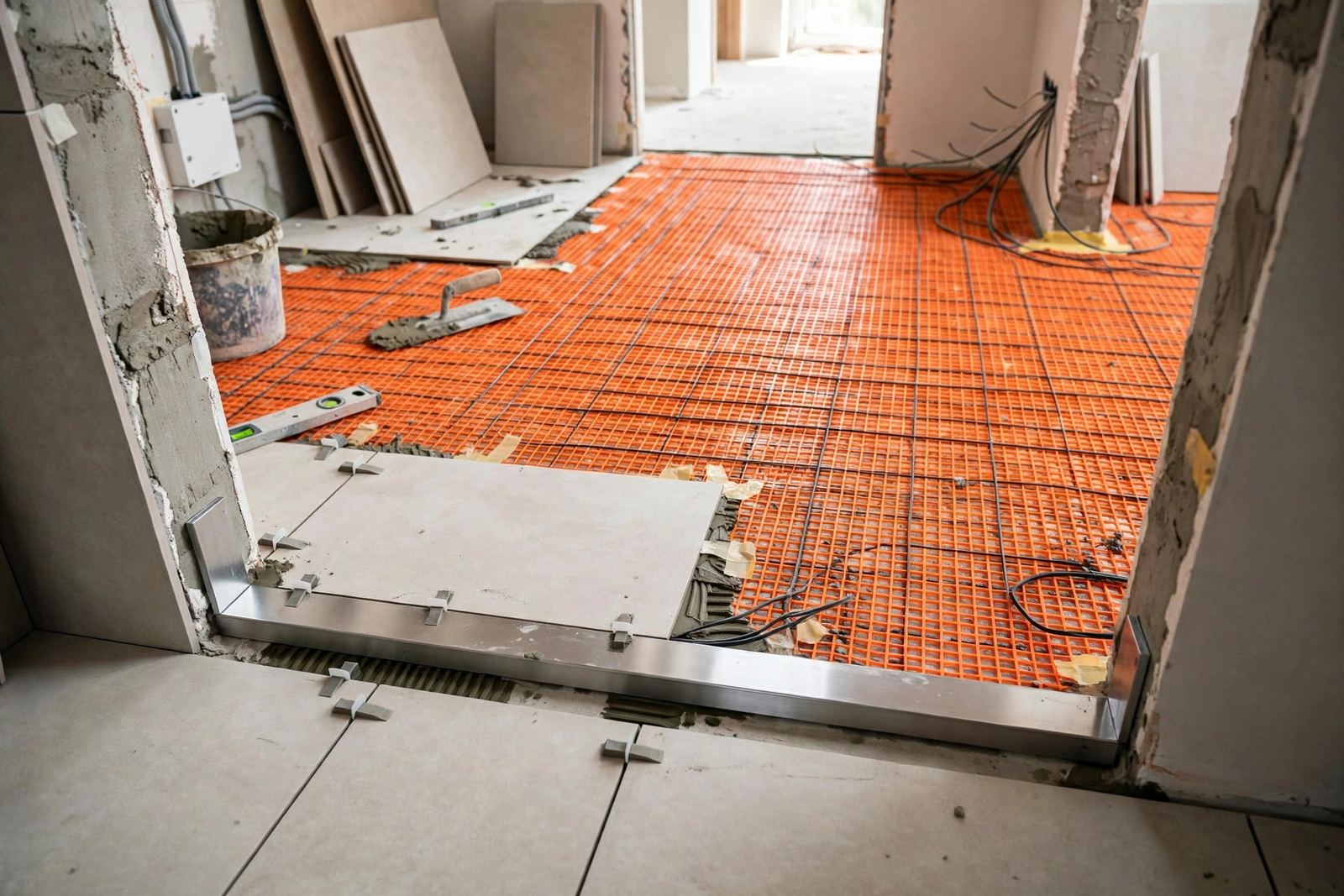
Yes, a heated floor needs more care at its edges and joints than an unheated one. Every heating cycle makes the floor expand slightly, then contract as it cools, and edge trim cannot absorb that movement; only a movement joint can. The rule is simple: trim finishes the edge, and a flexible joint takes the movement.
Why a Heated Floor Moves More
Tile, adhesive, and screed expand at different rates, so unheated floors stay low-stress. On a heated floor, each on-off cycle adds a larger swing, and the tile bond takes the strain. With nowhere to move, the weak point gives way: tiles crack, grout splits, or a tile lifts (tenting).
A movement joint prevents that failure by giving the floor a planned place to move. Weber, one adhesive maker, advises keeping the system off for at least five days after fixing. It advises raising temperature by no more than 5°C per day, to a 27°C ceiling, which is an adhesive maker’s limit, not a trim rating.
Edge Trim and Movement Joints Do Different Jobs
Confusing the two parts is the common mistake on heated floors. Trim is often expected to do a joint’s job, but one finishes an edge while the other absorbs movement. Treating them as interchangeable removes the joint’s purpose.
| Part | Job | Must not |
|---|---|---|
| Edge trim | Protects tile edge | Bridge a joint |
| Joint profile | Absorbs movement | Act as rigid finish |
| Perimeter joint | Floor moves from walls | Be filled with grout |
| Flexible sealant | Fills joint elastically | Glue bays |
A trim piece bedded across a joint defeats the joint, since the two sides no longer move apart and stress returns to the field. Cut trim at the joint, and let the joint profile or sealant carry the gap.
Choosing and Fixing Trim on a Heated Floor
Metal trim is the usual pick for a heated floor edge. Aluminium and stainless steel hold their shape in traffic and resist knocks, while plastic trim is cheaper but wears faster under heat cycling. NIUYUAN’s heated-floor profile is still unconfirmed; confirm before ordering. Depth must still match tile thickness; see our tile trim size guide.
Fix trim with a flexible adhesive rated for underfloor heating, since a rigid adhesive can crack as the floor cycles. Bed the fixing leg fully in adhesive, flush with the tile face. A leg that stands proud will catch feet and cleaning tools, so never fix trim over a heating cable or pipe run. Keep fixings in the adhesive bed only.
Where Joints Must Line Up
A tile movement joint must sit directly over the matching joint in the screed below. A bridging tile layer will crack when the screed moves. The same rule applies at door thresholds, heated-unheated boundaries, and between separate heating zones, since each zone cycles on its own schedule.
For bay sizes, British Standard BS 5385 guidance as summarised by ARDEX is often quoted. For ceramic and natural stone, bays are capped at 40 square metres, with no bay edge longer than 8 metres. These are planning limits for the floor itself, not trim sizes. Full spacing rules are in our companion guide to movement joint spacing for tile floors, to be rechecked after publication.
At the perimeter, fill the open gap with flexible sealant, not grout, even where a skirting board hides it. The gap must stay flexible to work. See our tile expansion joints guide for joint types.
Checklist: Confirm Before Tiling
Ask these questions before work starts, and get the answers in writing. A missing answer is far cheaper to chase than a failed floor later, and written answers settle disputes if the floor later fails.
- Does the trim suit heated floors? NIUYUAN’s rating is unconfirmed.
- Is the adhesive flexible and rated for underfloor heating?
- Does the joint plan follow the screed joints exactly?
- Is there a joint at heated-unheated boundaries?
- Which sealant fills the joints? Does it suit the trim?
- When can heating restart, and how fast may it rise?
If any answer is missing, pause the trim order, since a wrongly fixed trim detail on a heated floor is costly to reopen. Confirm the joint plan on paper first, rather than lifting tiles later. See our guide to cutting metal tile trim.
Frequently Asked Questions
Does tile trim itself need to expand on a heated floor?
Trim expands slightly with heat, like any metal. But its expansion is small next to whole-floor movement. So the joint, not the trim, must absorb floor movement, since that division of labour is the whole point.
Can I grout over a movement joint to hide it?
No, rigid grout locks the joint shut and removes its purpose. Fill movement joints with flexible sealant or a joint profile with a flexible core, since a sealed joint still looks neat once it is finished.
Can edge trim run across a heated and unheated section?
No, stop trim at the boundary joint between the two sections, since each section moves on its own cycle. A rigid trim piece across the boundary will stress the joint, so the boundary joint must stay open and flexible.
Does a heated floor need joints in a small room?
Small rooms still need a perimeter joint at walls and upstands, while intermediate joints depend on bay size and zone boundaries. Check the joint plan even for a small room, since room size alone never removes that need.