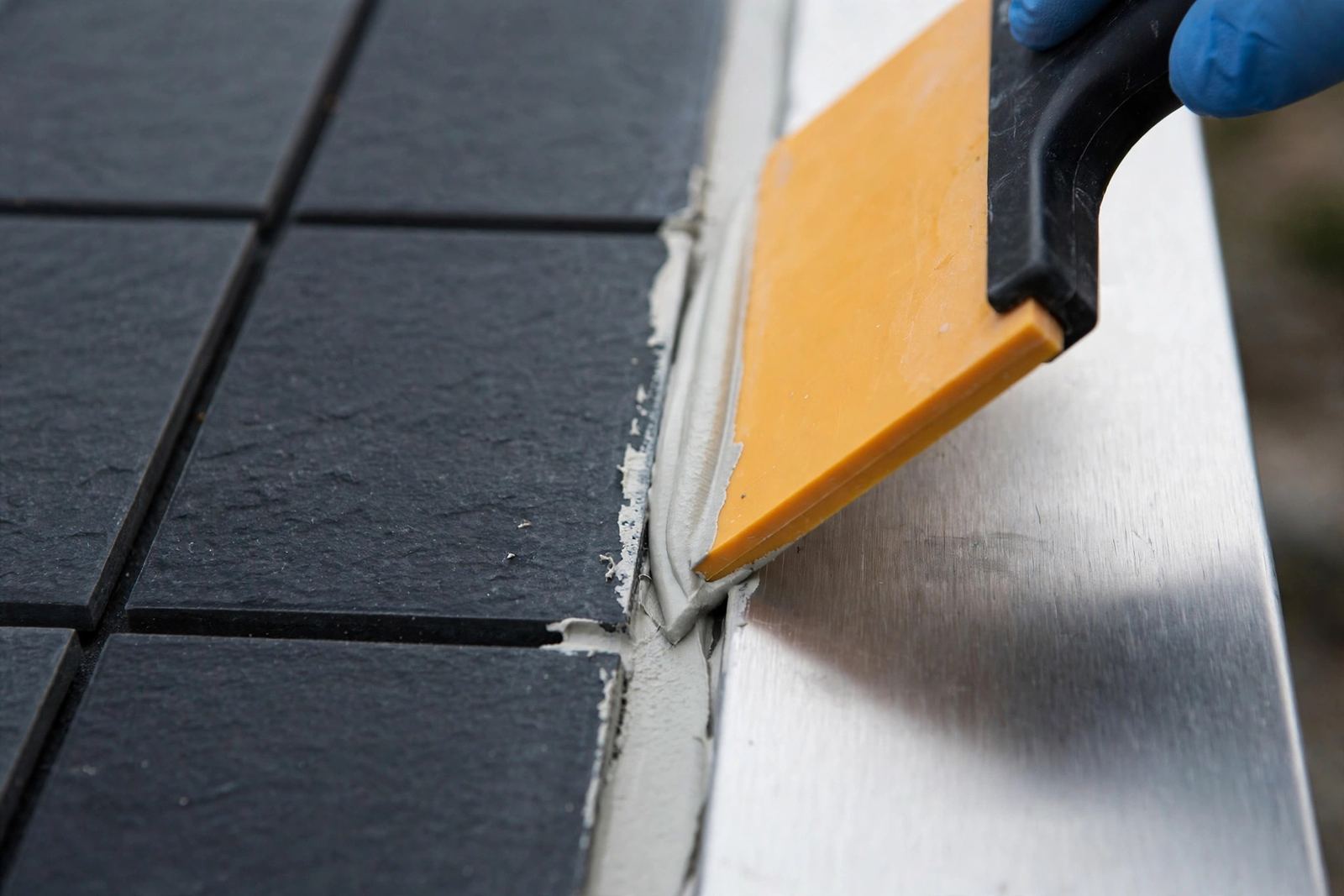
Epoxy grout will not ruin every tile trim finish. It does, however, leave little room for a slow cleanup. Fresh residue can be wiped away on the day. Cured residue bonds hard, and the remover it needs may harm the finish itself. Protect the trim, clean it on the day, and never let a tile-cleaning recipe touch an unchecked finish.
Why Epoxy Grout Is Less Forgiving Than Cement Grout
Epoxy grout is a two-part system. A resin and a hardener react and form a rigid, cross-linked plastic. Once that reaction finishes, the joint resists water, stains, and most household cleaners. Installers value that resistance in showers, kitchens, and pools.
The same strength makes cleanup time-critical. Cement grout residue can often be washed off later with mild effort. Epoxy residue hardens into a film that bonds to the surface it sits on. One grout maker’s guide calls cleanup critical, and another warns that hardened grout is very difficult to remove.
The Same-Day Rule for Every Finish
Work in sections small enough to wash before the grout firms up. One maker’s guide puts the first wash at about twenty minutes after spreading. Timing shifts with temperature and humidity, so read your own grout maker’s label before you mix the first batch.
Use a damp sponge, not a dripping one, and rinse it often in clean water. Change the water when it turns cloudy. Dirty water spreads a thin resin film back over the trim instead of lifting it off. A second clean-water pass catches leftover haze.
Mask the visible face of the trim where masking will not lift the finish, and wipe any splash at once. Do not flood a fresh joint with water to speed the wash. Excess water can weaken the joint and leave a patchy result, so patience here protects both grout and trim.
Anodized Aluminium: Clean It at Once
Anodized aluminium carries a hard oxide layer, but that layer is not proof against every grout chemical. A trim maker’s bulletin warns that caustic ingredients in mortar and grout can discolour anodized surfaces. It states plainly that residue must be removed at once to prevent damage.
That bulletin also rules out two common shortcuts. Do not use cleaners with hydrochloric or hydrofluoric acid on anodized aluminium. Do not use aggressive or abrasive cleaners either, since they can scratch the surface. A profile maker’s guide agrees: setting materials must be removed immediately, especially from aluminium.
Stainless Steel: Brushed and Mirror Need Different Care
Stainless steel tolerates more than anodized aluminium, but its finish still shows mistakes. Brushed steel has a grain direction, and a scrub across the grain can leave visible marks. Mirror steel has no grain to hide behind, so even a thin haze stands out clearly.
Wipe along the grain on brushed trim, using a soft sponge or a non-metallic pad. Do not use steel wool or a metal scraper on the visible face. On mirror trim, check the face at an angle after each wash, since haze is easy to miss head-on.
Brass: Protect the Colour, Not Just the Metal
Brass trim is often chosen for its warm colour, and that colour is the part most at risk. A harsh cleaner or an abrasive pad can dull the surface or change its tone unevenly. Once the tone changes in patches, the whole run can look mismatched, even if the metal below is sound.
Clean brass on the same day, with a soft cloth or sponge and clean water. Test any cleaner on a hidden offcut before you use it on a visible run. If the test piece changes colour or loses lustre, do not use that cleaner on the job. Our brass tile trim selection guide covers brass finishes in more detail.
Powder-Coated and Coloured Finishes: Treat the Coating as the Finish
Powder-coated and colour-coated trims wear a coating over the metal, so the coating is the finish to protect. A scratch through the coating exposes the metal below and cannot be wiped back to an even colour. Solvents that soften epoxy residue may also soften or dull some coatings.
Wash coated trim while the grout is fresh, with a soft sponge and clean water only. Do not use a solvent-based stripper on a coated face unless the coating supplier has confirmed it in writing. If a coating is already damaged, our guide to painting tile trim explains when paint holds and when it fails.
Same-Day Rules by Finish
| Finish | Same-day rule | Do not use |
|---|---|---|
| Anodized aluminium | Remove residue at once, with water or a gentle cleaner | Hydrochloric or hydrofluoric acid, abrasive pads |
| Stainless, brushed | Wipe along the grain with a soft sponge, rinse often | Steel wool, metal scrapers, cross-grain scouring |
| Stainless, mirror | Check at an angle after each wash, repeat while fresh | Harsh abrasives, strong acids, metal tools |
| Brass | Clean the same day, test any cleaner on a hidden piece first | Strong acids, coarse pads, untested cleaners |
| Powder-coated or coloured | Wash while fresh, mask before grouting where possible | Solvent strippers unless the coating supplier confirms them |
The table states a work rule, not a guarantee for any single product. Coatings, anodizing thickness, and grout formulas all vary. The grout maker’s label and the trim supplier’s care notes still outrank this table on a real job.
If Residue Has Already Hardened
Do not panic, but do not improvise either. Cured epoxy is a cross-linked plastic, and household cleaners will not dissolve it. Removal guides describe a different process: a specialist epoxy remover softens the film during a dwell time, then a non-metallic pad lifts it.
Before any remover touches the trim, test it on a hidden offcut of the same finish. One remover guide asks users to protect neighbouring surfaces, including metal, and to check for softening before wiping. If the test piece dulls or discolours, stop and seek advice from the grout maker.
Never let a remover dry on the trim during its dwell time. Never use it on the grout joint itself unless its label allows that use. Rinse fully after removal, since residue left behind can re-bond as it dries. A failed strip may force a trim replacement, so a careful test is cheap insurance.
Before You Grout: Questions for Your Supplier and Grout Maker
| Ask this | Why it matters |
|---|---|
| What is the first-wash window for this grout, at this temperature? | Wash timing shifts with heat and humidity, so a generic window can mislead |
| Which haze remover, if any, is safe on this exact trim finish? | A remover safe for tile may still damage a coating or an anodized layer |
| Should this finish be masked, sealed, or left bare before grouting? | Protection chosen in advance beats cleanup chosen under time pressure |
| What cleaner must never touch this finish? | One wrong cleaner can dull a whole run before the room is finished |
| Is a hidden test piece available for cleaner and remover trials? | A failed test on an offcut costs little, while a failed test on a wall costs much more |
Get the answers in writing where the job is large or the finish is costly. A verbal assurance is hard to act on once a run has dulled. This article covers grout day only. It does not replace the full installation guide, the cutting guide, or the grout maker’s own instructions.
Frequently Asked Questions
Does epoxy grout damage tile trim finishes?
It can, but the damage usually comes from residue left on the face, not from the joint itself. Fresh residue can be washed off on the day with a damp sponge and clean water. Cured residue is far harder to remove, and its remover may harm a delicate finish.
How soon must I clean epoxy grout off tile trim?
Clean it on the same day, inside the window your grout maker states. One maker’s guide puts the first wash at about twenty minutes after spreading. Timing shifts with temperature and humidity, so do not leave residue overnight on anodized or coated trim.
Can I use vinegar to remove epoxy grout haze from trim?
Do not transfer a tile-cleaning recipe to trim without checking the finish first. Vinegar and other acids may suit some tile faces, but acids are the cleaners that trim guides warn against for anodized aluminium. Test on a hidden piece first.
What should I do if epoxy grout has already cured on the trim?
Test a specialist epoxy remover on a hidden offcut of the same finish before you touch the visible run. Let it dwell as its label directs, lift the softened film with a non-metallic pad, and rinse fully. If the test piece dulls, stop and ask the supplier.
Is masking the trim before grouting worth the time?
Yes, where masking will not lift or damage the finish, since prevention beats any cure. Masking keeps most grout off the visible face and leaves only light splashes to wash. Remove it promptly after the wash, and check for grout that crept underneath.