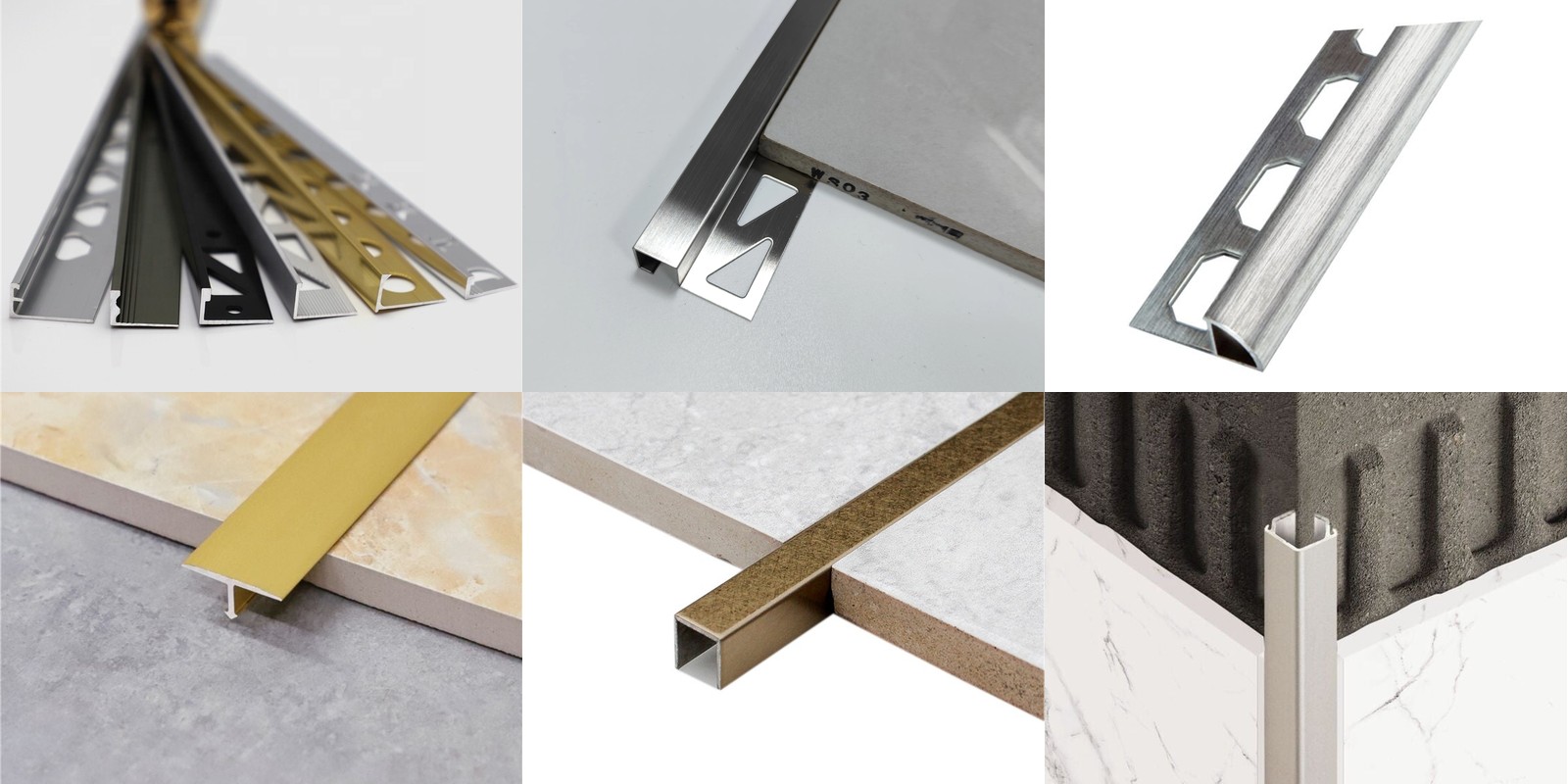
Tile trim is also called tile edging, tile edge trim, tile profiles, or simply edging. All five names describe the same product. It is a rigid strip, usually metal or PVC. An anchoring leg sits under the tile, and a visible face finishes the edge.
The confusion starts because the trade also uses shape names, brand names, and regional terms for the same category. A buyer who searches only one name can miss suppliers who list the same product under another. This guide sorts the names into three groups: true synonyms, profile names, and names that describe a different product. For the product itself, see what tile trim is.
True synonyms: five names for one product
Tile trim is the most common name in the US trade, and tile edging runs close behind it. Tile edge trim appears in retail listings and DIY guides. Tile profiles and edge profiles are the terms manufacturers and exporters use, and they match the category pages on supplier sites. Tile molding shows up in US retail copy, but it is the least precise of the five, because molding also covers wood trim.
| Name | Where you will see it |
|---|---|
| Tile trim | US trade, supplier catalogues, most search results |
| Tile edging | Retail listings, DIY guides, Australian suppliers |
| Tile edge trim | Product pages, how-to guides |
| Tile profiles, edge profiles | Manufacturer and exporter catalogues |
| Tile molding | US retail copy, least precise of the five |
Profile names are shapes, not synonyms
Bullnose, quarter round, pencil liner, V-cap, and cove describe a shape or a tile piece, not the whole category. A bullnose tile has one rounded, glazed edge, and it finishes an edge without a metal strip. A quarter round, called a quadrant in the UK, is a profile with a quarter-circle face.
A pencil liner is a thin, rounded ceramic strip used as a decorative border. A V-cap, also called a sink cap, is an L-shaped tile for countertop edges, and a cove is a concave profile for floor-to-wall inside corners. None of these names covers the category. Ordering bullnose when you need a metal L-shaped profile will bring the wrong product.
Three names buyers often get wrong
Stair nosing is the most common mix-up: it is the finished edge of a stair tread, also sold as stair edging or step edging. It is a stair product, not a general name for tile trim.
An aluminum strip is another false friend: a flat, general-purpose piece of aluminum with no anchoring leg and no tile edge function. A supplier who lists aluminum strip is not selling tile trim.
Tile bead is not a verified term for this product. Searches return only the phrase a thin bead of caulk, which describes sealant, not trim. Do not use it in a purchase order or a search.
What the UK and Australia call it
Importers who source from the UK or Australia will meet a second set of terms. In the UK, round-edge profiles are sold as quadrant trims, L-shaped profiles as L-strip trims, and transition pieces as tile to carpet trims or doorbars. In Australia, strip edging is a common local term for the same metal or PVC strips. Tile edging is used as widely as tile trim there.
| Market | Common terms |
|---|---|
| United States | tile trim, tile edging, tile profiles, edge profiles |
| United Kingdom | tile trims, quadrant trims, L-strip trims, doorbars |
| Australia | tile trims, tile edging, strip edging |
Schluter names, decoded
Schluter is a brand. Its profile names are used as shorthand across the trade, much like a brand name used for a whole product type. Jolly is the square, L-shaped finishing profile for wall edges, with an 87-degree sloped vertical wall. Rondec is the rounded profile, with a symmetrically rounded reveal of 1/4 inch radius. Quadec is the square reveal profile. Schiene is the floor-edge and transition profile in the same L-shaped family.
When a drawing or a specification names one of these, it is naming a shape. Match the shape and the tile thickness, not the brand. A supplier who does not carry that brand can usually supply the same shape under its own range. For the full range of shapes, see our tile trims ultimate guide. For why the edge matters at all, see the purpose of tile edge trim.
What to ask a supplier
Names alone do not specify a product. When you request a quote, give four facts: the profile shape, the tile thickness with adhesive, the material, and the finish. A quote that only says tile trim leaves the supplier guessing on all four, and the sample that arrives may not fit the tile.
- Profile shape: L-shaped, square edge, round edge, or another shape, named plainly.
- Tile thickness plus adhesive, so the profile height can be matched. Our guide to matching trim height to tile thickness explains the rule.
- Material: aluminum, stainless steel, brass, or PVC.
- Finish: anodized, powder-coated, PVD, brushed, or polished, with a sample reference. Our dimensions and compatibility chart lists the published ranges by profile.
The name on the search box matters less than the specification behind it. Use tile trim, tile edging, or tile profiles to find suppliers, then specify the shape, the tile thickness, the material, and the finish. The next step is to check the size guide and confirm the profile height for the tile on the job.
Frequently asked questions
What is tile trim called in the UK?
Tile trims, as a category. A round-edge profile is sold as a quadrant trim, an L-shaped profile as an L-strip trim, and a transition piece as a tile to carpet trim or a doorbar.
Is bullnose the same as tile trim?
No. Bullnose is one type of edge finish: a tile with one rounded, glazed edge. Tile trim is the whole category of edge profiles, including metal and PVC strips. A bullnose tile and a metal trim profile are different products.
What is tile nosing?
Tile nosing is the finished edge of a stair tread, also sold as stair edging or step edging. It is a stair product. It is not a general name for tile trim, and it should not be used for wall or floor edges.
What should I write in a purchase order?
Write tile edge trim plus the profile shape, the tile thickness with adhesive, the material, and the finish. A purchase order that only says tile trim leaves the supplier guessing on all four, and the sample may not fit the tile.