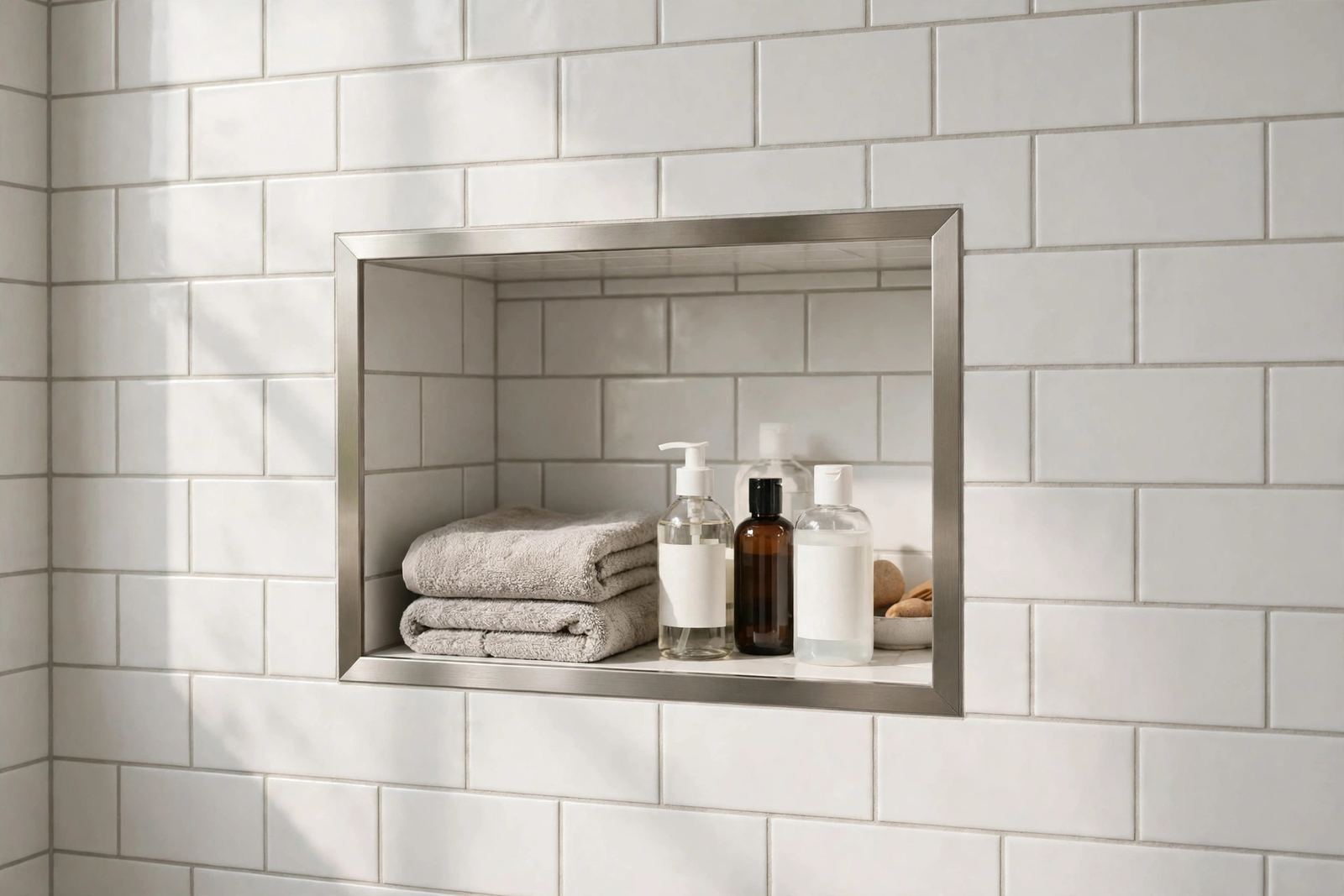
A coastal apartment project picked stainless steel tile trim for every bathroom, balcony, and corridor, and the grade call came first. 316 went to balconies, pool edges, and any trim that faces salt air, while 304 stayed in sheltered interiors. Brushed finish carried the main runs, and mirror and PVD stayed as accents. That split is the core of this case.
This is a de-identified project story, so no client name, place, unit count, or price appears here. What matters is the decision path, which runs from site conditions to a written spec, then to a sealed sample and a bulk order. The same path fits any seaside apartment block. It also fits any buyer who must defend a grade choice to a client or a project team.
The site sets the spec
Salt air decides the spec before any catalogue does, because wind carries salt onto every exposed surface. Rain washes some of it off, but sheltered spots keep it, so a balcony edge that never sees rain holds salt the longest. A shower wall gets rinsed daily, while a corridor stays dry, and each zone earns its own grade and finish. That is why the project team mapped exposure first and picked profiles second.
The map split the building into three exposure bands, with the outer band covering balconies, terraces, and pool edges. The middle band covers bathrooms and kitchens, while the inner band covers corridors and dry rooms. The outer band got the strictest spec, and the inner band got the lightest. That split kept cost in check without gambling on the exposed edges. Our companion guide to aluminium trim for coastal work takes the same zone-first approach for aluminium.
304 or 316: the grade call
304 and 316 look the same once finished, but the difference sits in the alloy. 316 carries 2.0 to 2.5 per cent molybdenum, while 304 carries none specified. Molybdenum lifts resistance to pitting from chlorides, the salts in sea air, pool water, and many cleaners. That single addition is why 316 is the default pick near the sea. It is also why the grade must be named in the order, not left to a catalogue line.
No stainless grade is rust-proof, and that point matters for a coastal buyer. 316 resists salt attack far better than 304, but it still stains where salt sits in a crevice or under dirt. The grade buys margin, yet it does not remove the need for a finish and a wash routine. Treat any claim of rust-proof trim as a warning sign. Ask for the grade in writing, with a mill certificate or a material check behind it.
| Grade | Alloy note | Where it fits | Watch out for |
|---|---|---|---|
| 304 | No molybdenum specified | Sheltered interiors, dry rooms | Salt air and pool water push past it |
| 316 | 2.0 to 2.5% molybdenum | Balconies, pool edges, wet rooms | Costs more; still needs washing |
| 316L | Low carbon, same molybdenum | Welded work, same zones as 316 | Confirm the grade, not just the family |
Where each grade goes
The project team assigned grades by zone, not by floor. Balconies, terraces, and pool edges took 316. Showers and steam rooms took 316 as the safer pick, and kitchens took 316 where strong cleaners were in use. Corridors and dry rooms kept 304, because this is a zone rule, not a building rule. A single apartment can hold both grades, so the order must list each zone, and the factory packs the right grade for each run.
Distance from the sea shapes the call, since trim near the surf faces the harshest air. Trim further inland, behind other buildings, faces less, and wind direction and shelter matter as much as distance. A sheltered balcony behind a windbreak may need less, so record the exposure for each elevation. Then match the grade to the worst zone on that elevation, not the average. Our pool and outdoor trim guide covers the same grade logic for pool decks.
Mixed grades need clear marking, because a 304 length and a 316 length look identical on a pallet. The project marked each bundle by zone and grade, and the packing list carried the same split. Installers then fitted the right grade in the right zone without guessing. A mixed pallet with no marking invites the exact error the spec was written to stop.
Brushed, mirror, or PVD
Brushed stainless is the workhorse finish, with fine lines running in one direction across the surface. The grain hides light marks and fingerprints, and it suits long runs in bathrooms, kitchens, and corridors. It also suits balconies, where sun and salt punish a bright face. For most of the project, brushed was the default. The team moved away from it only where the design asked for a different look.
Mirror finish is the opposite trade, since it reflects the room and lifts a feature wall. It also shows every mark, print, and scratch, so the project kept mirror trim for low-touch feature lines. Those lines sat out of reach of hands and cleaning pads. A mirror edge at hand height in a busy corridor would look tired within weeks. Keep it high and short, away from traffic.
PVD adds colour to stainless steel, in gold, black, or bronze, and the colour follows the surface beneath it. A PVD coat on a brushed base reads softer than a coat on a mirror base. PVD adds a coating step, so price and lead time need a per-order check. The project used PVD only where the design called for a metal tone. Everywhere else, brushed steel carried the job. Our stainless steel trim page lists the grades and finishes offered.
Name the finish, not just the word
One warning applies to every finish word, because brushed and satin name a family, not a finish. Two suppliers can read the same word two ways, so the project spec named the finish code and the approved sample side by side. A physical sample settles what words cannot. Ask for the sample before the bulk order, and keep it as the reference.
| Finish | Look | Best for | Watch out for |
|---|---|---|---|
| Brushed (No.4 / 2J) | Fine directional grain, soft sheen | Main runs, balconies, wet rooms | Name the code and sample, not just the word |
| Mirror (No.8 / 2P) | Most reflective, fine lines up close | Low-touch feature lines | Shows every mark; keep out of reach |
| PVD colour | Colour over the base finish | Warm metal tones on stainless | Extra coating step; confirm price and lead time |
Height, joints, and corners
A coastal spec still fails on height, so match the profile height to the tile thickness plus the adhesive bed. A low profile leaves a sharp tile edge exposed, while a high profile stands above the tile and catches water, feet, and cloths. Tile thickness varies by range and by batch, so confirm the height per tile range before ordering, not on site. Our guide to choosing the right trim height explains the tile thickness plus adhesive rule in full.
Corners and joints decide whether the install looks factory made, and outside corners take the most knocks, so they need matching corner pieces. Joints need a butt joint with no step, and long balcony runs need an expansion gap where the design allows for movement. Check the profile against the real tile, not the catalogue drawing. A sample length settles the fit before the bulk order ships. Our dimensions and compatibility chart lists the published height ranges by profile.
Tea staining, and how the spec stops it
Tea staining is the brown film that appears on coastal stainless steel, and it is a cosmetic fault. It does not weaken the metal or cut its life, since salt deposits sit on the surface and stay wet. Humidity dissolves the salt into a corrosive film, and the stain shows most within about five kilometres of the surf. It grows worse closer to the sea, while wind, shelter, and heat can push it further inland.
The spec fights tea staining on three fronts, and the grade comes first: 316 as a minimum near the surf. The finish comes next: a smooth surface holds less salt than a rough one. A polished face stays cleaner between washes. The wash routine comes last: fresh water rinses salt off before it can sit. Rain-washed faces need less help, while sheltered faces need more. Never use hydrochloric acid near stainless steel, since it frosts the surface and causes pitting.
The project wrote the wash routine into the handover, not just the spec. Balcony trim gets a fresh water rinse after storms, and shower trim gets a wipe with a mild cleaner and a soft cloth. Bleach and chloride cleaners stay off the visible face, and abrasive pads stay off it too. The routine is short on purpose, since a routine the site team will actually run beats a long routine they will not.
Keeping every unit looking the same
An apartment block repeats the same trim across many units, so one batch can look right while two batches can drift. The drift shows first on long balcony runs and on walls where two lengths meet. The project answer was a single production batch, reserved before the first length shipped, and spare lengths came from the same batch. That choice cost planning time, yet it saved rework on site.
The sealed sample is the reference for the whole order, and the factory keeps its copy for two years. The buyer keeps the copy, and colour, gloss, texture, and profile size are signed off on that sample before production starts. Every later check goes back to it, so compare several lengths under the project light. A single length can hide drift, but five lengths in a row cannot. For the basics of the product, see what tile trim is.
What to confirm before you order
A coastal trim order fails on details a sample would have caught, so run these checks before the bulk order, not after it arrives. Each item goes into the purchase order in writing, since a verbal promise does not hold a grade or a batch.
- Grade by zone: 316 for balconies, pool edges, and wet rooms; 304 only for sheltered dry interiors, named per zone.
- Finish code and sample: brushed, mirror, or PVD, with the finish code and an approved physical sample.
- Profile and height: profile shape and height matched to tile thickness plus adhesive, confirmed per tile range.
- Corners and joints: matching corner pieces and connectors, with a sample length checked on site.
- Batch reservation: one production batch for the project, with spare lengths from the same batch.
- Sealed sample: colour, gloss, texture, and profile size signed off; the factory keeps its copy for two years.
- Quantity and MOQ: the stainless steel MOQ is 500 pieces; confirm the count per zone before ordering.
- Lead time and packaging: samples in 7 days, 7 to 10 days for custom work, and bulk in 20 to 30 working days; protective film and export-ready cartons.
- Technical response: the first technical reply comes within 1 working day; confirm the contact and the reply time in writing.
The project lesson is simple: exposure picks the grade, and the room picks the finish. A sealed sample then holds both choices in place. A buyer who writes those choices into the order has already done the hard work. The next step is a sample order in the exact grade and finish, checked against the tile it will sit beside.
Frequently asked questions
Should a coastal apartment use 304 or 316 tile trim?
Use 316 for balconies, pool edges, and wet rooms that face salt air. Keep 304 for sheltered dry interiors only. Assign the grade by zone, not by floor, and name each zone in the purchase order.
Does stainless steel tile trim rust by the sea?
No stainless grade is rust-proof. 316 resists salt attack far better than 304, but salt left in a crevice can still stain it. Grade, smooth finish, and a fresh water wash routine together keep the trim looking clean.
Brushed or mirror finish for a coastal project?
Brushed is the default for main runs, because the grain hides light marks. Mirror suits low-touch feature lines only, out of reach of hands and cleaning pads. PVD adds colour, but it adds a coating step, so confirm price and lead time per order.
How do you keep trim looking the same across many units?
Reserve one production batch for the whole project, with spare lengths from the same batch. Sign off colour, gloss, texture, and profile size on a sealed sample first. Compare several lengths side by side under the project light.
What should the purchase order name in writing?
Grade by zone, finish code, profile and height per tile range, batch reservation, and the sealed sample reference. Add the MOQ, lead time, and the technical reply time, all confirmed in writing before production starts.