
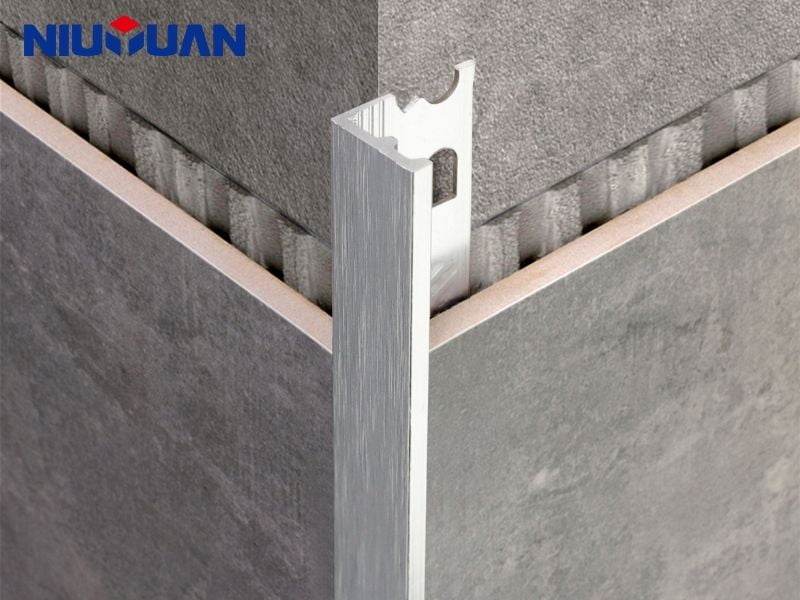
Yes, you can add tile trim over existing tiles, but only with a surface-mounted profile. Standard trim has an anchoring leg that must sit under the tile during installation, so it cannot be added later. A retrofit profile has no anchoring leg.
It sits on the finished surface and is fixed with adhesive, or with screws where the substrate allows it. The result works well on dry wall edges and floor transitions. It is a weaker fix in wet areas, and it cannot rescue loose or hollow tiles.
Which profiles can go over existing tiles
Three shapes do this job. An L-shaped profile covers the tile edge with one leg and bonds to the wall or floor beside it with the other. A slim T-shaped strip fits into a grout joint or a gap between the tile and the next surface. A flat cover strip sits across the edge and hides a rough cut or a small chip.
All three are surface-mounted, which means they need no slot under the tile. For the full range of shapes, see what tile trim is.
Adhesive or screws: how the trim stays put
Adhesive is the usual fix for a retrofit profile. A construction adhesive or a hybrid polymer sealant bonds the metal or PVC to the glazed face and to the wall beside it. The bond needs a clean, dry, grease-free surface, and it needs time to cure before the edge takes a knock.
Screws are the other option, but only where the wall behind the tile can take a fixing and where a screw head can be hidden. Most retrofit jobs use adhesive alone, so the bond must be right. Our guide to common installation mistakes lists the errors that weaken a glued edge.
The glaze problem: why adhesion can fail
Glazed tile is smooth and non-porous, so adhesive has little to grip. A light key helps: clean the surface with a degreaser, then scuff the bond area with fine abrasive until the shine dulls. Wipe away the dust before you apply adhesive. Do not scuff the visible tile face, only the strip the trim will cover.
In a shower or a wet room, use a sealant rated for constant moisture, and seal the top edge of the trim after fitting. Even so, a glued edge will never match a leg set in mortar, so treat it as a finish, not a structural fix.
Height and thickness: making the trim sit flush
Measure the tile plus its adhesive bed before you order. The trim face must cover the edge, and the bonding leg must sit flat on the wall beside it. A leg that bridges a gap will flex and peel. If the tile stands proud of the wall, choose a profile with a deeper return. Or pack the gap with a filler that cures hard before you fit the trim. The trim height mismatch guide explains how to measure the step.
When you must remove tile instead
Retrofit trim cannot fix a failed substrate. If tiles sound hollow when tapped, adding trim only hides the damage. The same is true if grout is cracked and water has reached the wall, or if the edge is crumbling. Remove the loose tiles, repair the substrate, and refit.
The same applies when the old edge carries heavy impact, such as a stair nosing or a commercial floor edge. A glued profile will not hold under repeated knocks. For trim that is already fitted and damaged, see our guide to replacing damaged trim.
What to confirm before you order
Order the profile against the tile, not the room. Confirm the tile thickness, the edge length, the material, and the finish before you request a quote. A sample tells you whether the profile sits flat on your tile. It also shows whether the adhesive grips your glaze, so ask for one before a bulk order.
NIUYUAN supplies aluminum, stainless steel, brass, and PVC profiles, with samples in 7 days and bulk orders in 20 to 30 working days. Confirm the minimum order for your material: aluminum 1,000 pieces, stainless steel 500, brass 200, and PVC 2,000.
- Tile thickness and edge length, measured on the job.
- Profile shape that covers the full edge.
- Adhesive or sealant suited to glazed tile and the room moisture level.
- Sample fitted and checked before the bulk order.
Painting tile trim only changes the colour of trim that is already fitted. It adds no profile and covers no raw edge, so it is a different job from adding trim over tile. If the edge is bare and unprotected, a retrofit profile is the fix; paint is not.
Frequently asked questions
Can you add tile trim to a finished backsplash?
Yes, with a surface-mounted L-shaped profile fixed with adhesive. Measure the tile edge first so the profile covers it fully.
Will adhesive hold tile trim on glazed tile?
It can, if the surface is clean and lightly keyed. Glazed tile gives adhesive little grip, so clean, degrease, and scuff only the area the trim will cover. In wet areas, seal the top edge after fitting.
Can you add trim to a shower edge without removing tiles?
Yes in many cases, but a shower is the hardest retrofit. Use a sealant rated for constant moisture, seal the top edge, and check the tiles are solid first. Loose or hollow tiles must come off.
What size trim do I need for existing tiles?
Match the profile to the tile thickness plus its adhesive bed. The face must cover the full edge, and the bonding leg must sit flat on the wall beside it.