
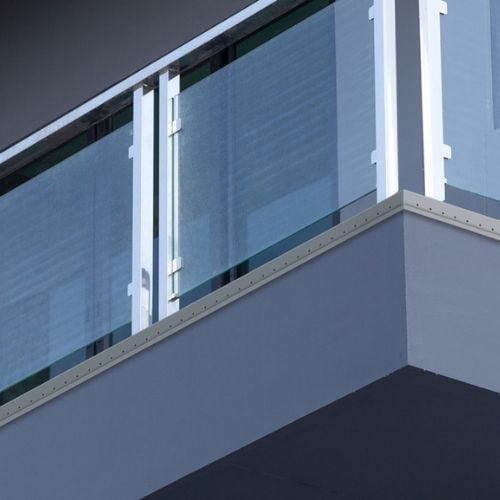
Pool and outdoor tile trim fails in predictable ways — pitting in the splash zone, tea-staining on a coastal balcony, a standard-height profile that cannot cover a 20 mm porcelain paver — and almost every failure traces back to specifying by room name instead of by exposure. The working rule: trim that is immersed in, splashed by, or regularly washed with chlorinated or salt water belongs in 316 stainless steel; areas well away from pool water can stay in 304; anodized or powder-coated aluminum covers most general exterior edges; and PVC is a sheltered, light-duty option whose UV and color stability must be confirmed before it is specified outdoors. This guide turns that rule into an exposure-zone framework for buyers, using the ranges published on our outdoor tile trim page as the worked example.
Start with exposure zones, not with products
The same pool project contains at least three different corrosion environments, and they do not deserve the same material. Zone the project first:
| Exposure zone | Typical positions | Material direction |
|---|---|---|
| Immersion and constant splash | Pool waterline edges, overflow channels, step edges in the water, constantly drenched fittings | 316 stainless; for saltwater pools, 316 with electropolishing is the recommended combination in stainless industry guidance |
| Pool surround and pool hall | Pool deck edges, coping transitions, wet-room and shower corners near the pool | 316 stainless — chlorinated splash and pool-hall air carry chlorides even where the trim is not immersed |
| Coastal outdoor | Balconies, terraces and facades within salt-air reach, seaside hotels | 316 stainless is usually recommended here; aluminum only with a finish confirmed for the exposure |
| General outdoor, away from salt | Patios, terraces, walkways, raised porcelain edges inland | Anodized or powder-coated aluminum is the common choice; 304 stainless where a stronger metal edge is wanted |
| Away from pool water | Change rooms, entrance areas, dry interiors of a pool building | 304 stainless is adequate — there is no chloride load to justify the 316 premium |
Zoning is also a cost control. Specifying 316 everywhere wastes budget in dry zones; specifying 304 everywhere guarantees replacement work in the splash zone, where labor and tile damage cost far more than the grade difference.
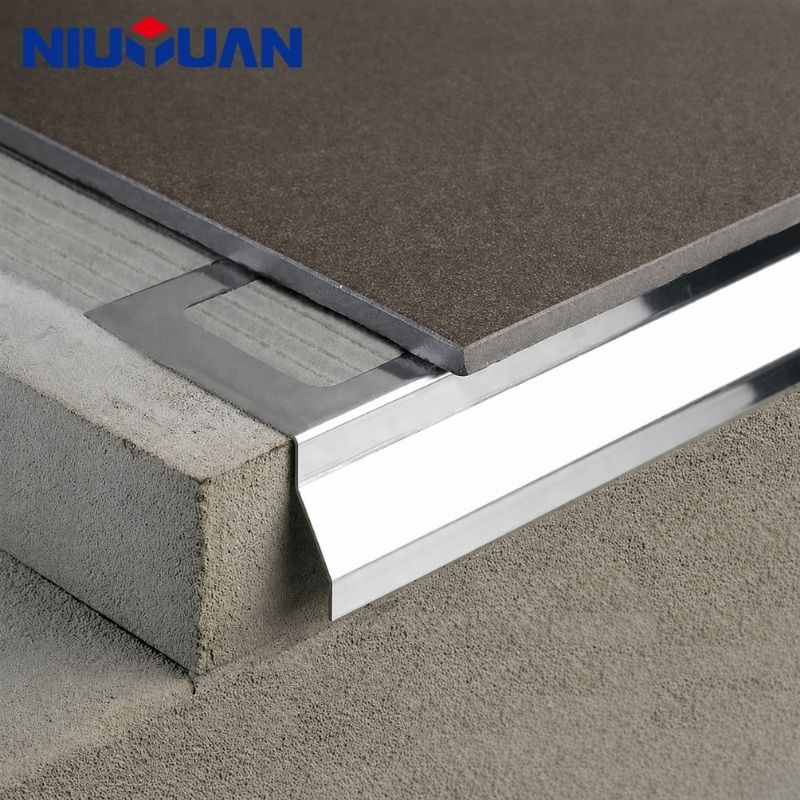
Stainless grades in brief: 304, 316, 316L
304 and 316 are both austenitic stainless steels; the practical difference is molybdenum, which 316 carries at roughly 2–3% and 304 does not. Molybdenum is what improves resistance to pitting and crevice corrosion — the localized attack that starts under deposits and in crevices, and the attack chlorides specialize in. That is why 316 is sold as the marine grade, and why stainless industry guidance for swimming pool buildings recommends 316 for components in contact with chlorinated water, moving to pickle-passivated and electropolished 316 for saltwater pools, which are more aggressive than chlorine pools.
316L is the low-carbon version of 316. Its advantage is resistance to weld decay, which matters for welded assemblies; trim profiles are typically formed by grooving and bending sheet rather than welding, so the L rarely decides a trim order. Specify it when the project specification names it or the assembly is welded. One availability note: the NIUYUAN stainless program lists 304 and 316, so if your specification mandates 316L, confirm availability and mill certification in the RFQ rather than assuming it. Our 304 vs 316 vs 316L guide carries the full composition table and the magnet-test myth, and our stainless steel tile trim page carries the grade, finish and MOQ ranges this framework draws on.
Aluminum outdoors: capable, with finish conditions
Aluminum is the common choice for many exterior tile edges — patios, balconies, terraces and outdoor walls — and the outdoor page lists anodized, powder-coated, brushed and sandblasted finishes for it. The finish is the corrosion strategy: anodizing and powder coating are the two routes usually compared for exterior aluminum, and the sealed sample is what locks the result for bulk production. Where aluminum needs its limits respected is the chloride end of the map. In coastal, pool-adjacent or higher-humidity environments, the outdoor range points buyers to 316 stainless instead — aluminum with the wrong finish in salt air is the classic tea-staining and pitting complaint a season later. If a project sits within salt-air reach, treat aluminum as the option that must prove itself by sample and finish specification, not the default.
Where PVC and brass fit — and where they do not
PVC appears in the outdoor range as a lower-cost option for selected edge finishing, with an explicit condition attached: UV exposure, color stability and impact level should be confirmed before bulk production. Read that as a sheltered-use material — covered terraces, protected wall edges, light-duty positions — not as the default for open, sun-exposed, high-traffic exterior edges. Our PVC vs aluminum comparison works through the same trade-off for interiors.
Brass is used outdoors on selected decorative and hospitality projects, and it changes character there: brass can develop natural oxidation or patina outdoors. For some designs that patina is the point; for a buyer expecting a permanently bright line, it is a defect. Samples and the exposure conditions should be reviewed first — which is a polite way of saying the patina conversation belongs in the RFQ, not in the claims meeting.
Sizing for thick outdoor porcelain
Outdoor porcelain pavers are commonly far thicker than interior wall tile, and raised porcelain installations add build-up on top of the tile itself. Standard interior trim heights are selected against tile thickness in the single-digit to low-double-digit millimetre range; a 20 mm paver edge will not be covered by a profile chosen from an interior size chart. The outdoor range handles this directly: for raised porcelain tile edges, profile height must be checked carefully against tile thickness and installation build-up, and custom dimensions can be reviewed when standard heights do not fit. Send the tile thickness and the build-up — adhesive, pedestal or mortar bed — with the enquiry, and confirm the height against a sample. Our stainless steel balcony trim page shows how the same height check runs on a typical balcony edge.
Movement joints are part of the trim specification outdoors
Exterior tile fields move more than interior ones: sun heats a terrace surface well above air temperature, and the field expands and contracts daily. Trim lines do not absorb that movement — movement joints do, and outdoors they are a specification item, not an afterthought. A trim plan that closes every joint with rigid profile and leaves no movement joints will push the stress into the tile field. Plan the joint layout with the trim layout, and use our tile expansion joints guide for where joints are required and how they are spaced.
Finish and maintenance notes that belong in the order
- Electropolishing for saltwater. For saltwater pool edges in constant or partial contact with pool water, industry guidance recommends electropolished 316 over a standard finish — raise the finish, not just the grade, in the RFQ.
- Rinse the chlorides off. 316 resists chlorides better than 304; it is not immune. Pool water, salt spray and cleaner residue should be rinsed off rather than left sitting on the surface.
- Lock the grade in writing. 304 and 316 look identical once finished. Confirm the grade on the order confirmation and ask for mill certification on 316 orders.
- Approve a real sample. Outdoor finish performance depends on material, surface treatment, exposure level, cleaning method and environment; the outdoor range confirms final finish through sample approval before bulk production.
If you are still choosing profile shapes for the project, our tile trim profiles guide explains the shape families the materials above are supplied in.
What to include in your RFQ
- The exposure zone for each trim position (immersion / splash / coastal / general outdoor / dry interior)
- Material and grade per zone (304, 316, 316L if the project specification mandates it)
- Profile type, and tile thickness plus installation build-up for the height check
- Finish per zone — including electropolishing where saltwater contact is expected
- Quantity per zone, so grades are not mixed up in packing
- Movement joint positions, if the trim layout interacts with them
Send the list through our contact page with the project positions marked by zone; zoning the list yourself, even roughly, is what gets you a quotation with the right grade in the right place.
FAQ
Can 304 stainless steel be used around a swimming pool?
Yes — in the parts of a pool building that stay away from pool water, such as change rooms and entrance areas. Where trim is immersed, splashed or regularly washed with chlorinated water, 316 is the recommended grade, because chlorides attack 304 by pitting and crevice corrosion over time.
Is 316L necessary for pool tile trim?
Usually not. 316L’s low carbon content protects against weld decay, and trim profiles are typically formed by bending rather than welding. Specify 316L when the project specification names it or the assembly is welded — and confirm availability first, since the NIUYUAN stainless program lists 304 and 316.
Can aluminum tile trim be used outdoors?
Yes. Anodized or powder-coated aluminum is a common choice for patios, balconies, terraces and outdoor walls. In coastal, pool-adjacent or high-humidity exposure, 316 stainless steel is usually recommended instead; if aluminum is used there, the finish should be confirmed against the exposure by sample.
Can PVC tile trim be used outdoors?
Only in selected, sheltered positions, and only after UV exposure, color stability and impact level have been confirmed for the project. For open, sun-exposed or high-traffic exterior edges, aluminum or stainless steel is the safer specification.
What trim height do I need for 20 mm outdoor porcelain pavers?
Taller than standard interior profiles: the height must cover the tile thickness plus the installation build-up. Send the tile thickness and build-up details with your enquiry — custom heights can be reviewed when standard heights do not fit, and the confirmed height should be checked against a sample.