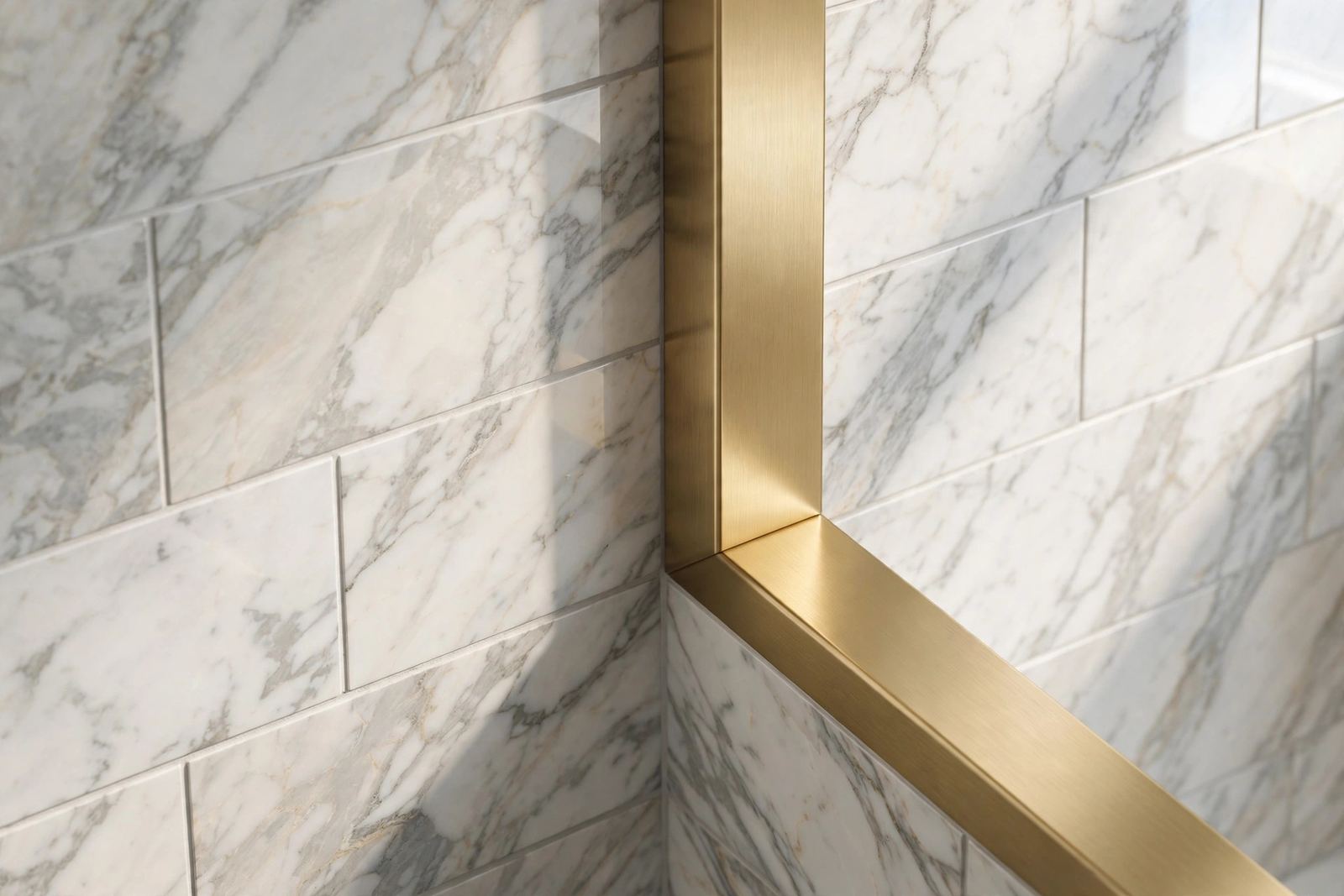
Natural stone changes three trim decisions. Marble, travertine, and granite vary in thickness from piece to piece, so the trim height cannot copy a ceramic job. Stone edges chip more easily than fired tile, so protection matters more. And the stone veining sets the finish, so the metal must match the stone rather than the tapware alone. This guide covers height, edge protection, finish pairing, and the order checks that follow from them.
The short answer is simple: measure the thickest tile in the batch. Size the trim to that piece, and confirm the finish against a real stone sample before you order. Calibrated stone makes this simple, while uncalibrated stone needs sorting and a taller trim. The rest of this guide explains each step and what to ask your supplier.
Why stone thickness decides trim height
Ceramic and porcelain leave the kiln at a fixed gauge, but stone is cut from a block, so pieces in one crate differ in thickness. Calibration mills the back of each tile to one thickness, while uncalibrated stone keeps its natural variation. A trim sized to the average tile leaves the thickest piece proud of the edge, or the thinnest piece sunk below it. Either fault shows at once on a polished stone face.
The fix starts before ordering: ask the stone supplier whether the batch is calibrated and what spread to expect. Measure a sample of tiles with a caliper, include the thickest and thinnest pieces, and sort the batch into thin, standard, and thick stacks. Set the finished height from the thickest stack, since thin tiles can be built up with adhesive while a thick tile cannot be pressed down.
Then size the trim to the thickest tile plus the adhesive bed. A trim that sits flush with the thickest stone reads as a clean line. A trim that falls short leaves a raw stone edge open to chips.
Confirm the height in writing with your trim supplier, and send the measured range rather than the nominal thickness printed on the box. The dimensions and compatibility chart shows how profile height lines up with tile thickness. The guide to sizing trim by tile thickness covers the adhesive allowance in more detail.
Stone batch and trim height at a glance
| Stone batch | What changes | Trim height rule |
|---|---|---|
| Calibrated marble or granite | Pieces share one thickness | Size to the stated gauge plus the adhesive bed |
| Uncalibrated marble or travertine | Pieces vary across the crate | Size to the thickest measured piece |
| Thick slab offcuts | Slab stock is often 20 or 30 mm thick | Check the profile range first, since a standard L profile may not cover the edge |
For wider context, see the tile-type guide, which covers stone as one tile type among several. This article goes deeper on stone alone, and the table above is a starting point, not a specification. The measured range from your own batch is the number that decides the order.
Stone edges chip, so the trim does real work
A fired ceramic edge is hard and uniform, while a stone edge follows the grain and the fissures in the block. Marble is soft enough to polish by hand. That softness also means a dropped pan or a trolley wheel can chip it. The trim takes that impact instead of the stone, so the edge stays clean through daily use.
Outside corners carry the most risk. A square-edge profile covers the full cut face and gives the corner a hard metal line. A round profile softens the corner and suits family bathrooms. On floors, a stainless profile resists the traffic that would dent a soft aluminum edge. Ask which profile your supplier rates for floor use before you specify it on a floor.
Inside corners need less armor, so a slim L profile reads as a shadow line and keeps grout out of the joint. The choice here is visual, not structural. Spend the protection budget on the outside corners and the floor edges first, since those are the edges that take hits. If you are new to trim profiles, what tile trim is explains the basic shapes before you choose one for stone.
Matching metal finishes to stone
Match the trim to the stone first and the tapware second: a cool white Carrara or grey-veined marble takes brushed stainless steel. The grey tone in the metal repeats the grey in the veining, and the brushed face hides water marks in a wet room. This is the safest pairing for a first stone order.
Warm stone calls for warm metal. Cream travertine, beige limestone, and gold-veined Calacatta sit well with solid brass. Brass also ages, and the patina suits stone that already shows age in its surface. Confirm the brass finish in writing, since lacquered, chrome-plated, and smoked chrome read very differently on the same stone. The brass finish guide compares those three finishes in full.
Dark stone can take a dark trim. Black granite or deep green marble pairs with black or antique bronze, which lets the stone carry the contrast. A bright polished trim on dark stone can look harsh, so check the pairing against a real sample rather than a screen image. The large-format tile guide covers the same pairing question for big slabs, where the trim line runs longer and shows more.
Installation points to put in the spec
Stone reacts to cleaners that ceramic ignores. Marble is calcium carbonate, so acids etch it. Vinegar, lemon-based cleaners, and limescale removers dull a polished face, and the damage cannot be washed off. Put a pH-neutral cleaner in the aftercare note, and warn the end client in writing before handover.
Grout can stain a trim finish. Cement grout left to dry on a brushed face leaves a film that is hard to remove. The installer should wipe the trim as the grout goes in, not at the end of the day. Ask your installer to confirm this step before work starts, and name it in the work order.
Light stone needs white adhesive. A grey adhesive can show through pale marble and tint the face. White adhesive costs more, so confirm who supplies it and who pays for it. This is a small line in the order, but it decides whether the stone keeps its color.
Sealing comes before handover, not after the first stain. A sealer slows stains but does not stop acid etching. The buyer should ask for the sealer type and the reseal interval in writing, so the aftercare note matches the stone that was actually laid. For the errors that cause most callbacks, see the common installation mistakes guide.
What to confirm before you order
Stone rewards the buyer who measures first. Send the stone supplier three questions: is the batch calibrated, what is the measured thickness range, and which adhesive suits the stone color. Then order the trim to the thickest piece, the finish that matches the stone in hand, and the profile rated for the location. The checks below turn those answers into an order.
- Stone type and whether the batch is calibrated, confirmed by the stone supplier
- Thickest and thinnest tile measured with a caliper, not the nominal thickness on the box
- Trim height sized to the thickest tile plus the adhesive bed, confirmed in writing
- Finish sample checked against the real stone, not a photo on a screen
- Profile rated for the location: floor, wall, or wet room
- Minimum order by material: aluminum 1,000 pieces, stainless steel 500, solid brass 200, PVC 2,000
- Sample lead time 7 days, bulk lead time 20 to 30 working days, with a sealed sample kept for 2 years
- Cleaner and sealer named in the aftercare note, with the reseal interval in writing
Order a finish sample against your stone before you commit to a full batch. A sample costs little, while a wrong finish across a whole project costs the order. Ask for the first technical reply within one working day, and keep the sealed sample as the reference for the bulk delivery.
Frequently asked questions
What trim height do I need for marble tile?
Size the trim to the thickest tile in your batch plus the adhesive bed. Measure a sample with a caliper, sort the batch, and send the measured range to your trim supplier rather than the nominal thickness on the box.
Can I use aluminum trim with marble?
Yes, on walls and dry areas. For floors and wet rooms, stainless steel resists traffic and moisture better. Ask your supplier which profile is rated for floor use before you specify it there.
Which finish goes with Carrara marble?
Brushed stainless steel is the safest match. Its grey tone repeats the grey veining, and the brushed face hides water marks. Warm stone such as travertine or Calacatta pairs better with solid brass.
Does marble need a different adhesive?
Light stone needs white adhesive. Grey adhesive can show through pale marble and tint the face. Confirm who supplies the white adhesive and who pays for it before the order is placed.
How do I clean stone and trim together?
Use a pH-neutral cleaner only. Vinegar, lemon-based cleaners, and limescale removers etch marble, and the damage cannot be washed off. A sealer slows stains but does not stop acid etching.