
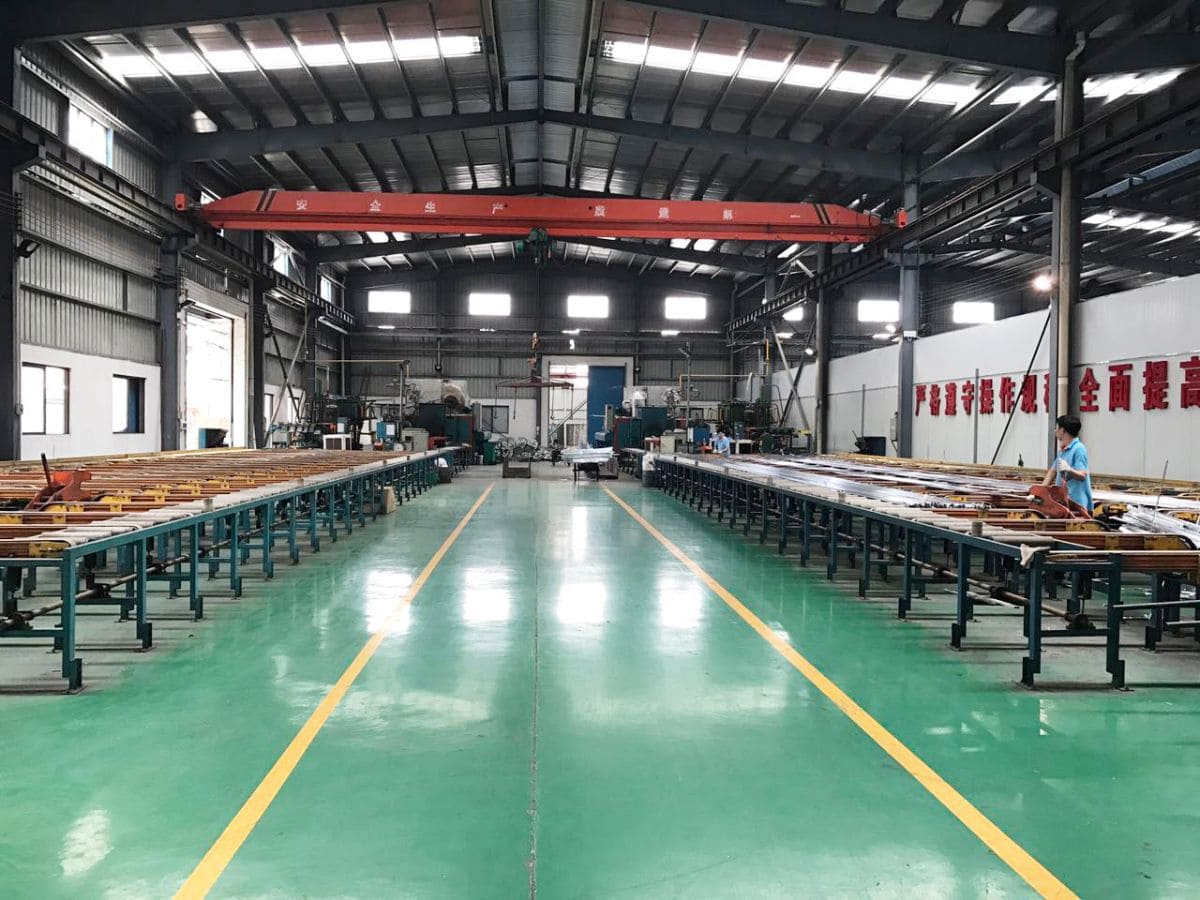
The minimum order quantity is not a number a factory picks from habit. It is the batch size where fixed setup and tooling costs stop dominating the unit price. Each material carries different fixed costs and a different stock form, so each material lands on a different MOQ. For the basics of the product, see what tile trim is.
| Material | Our MOQ | What sets it |
|---|---|---|
| Aluminium | 1,000 pcs | Custom die, billet press run, anodising batch |
| Stainless steel | 500 pcs | Coil roll-forming setup, made to order |
| Brass | 200 pcs | Dense and heavy, so a weight minimum means fewer pieces |
| PVC | 2,000 pcs | Colour compound batch, light weight means more pieces |
Why MOQ exists at all
Two fixed costs sit behind every MOQ. The first is tooling. A custom extrusion die is a one-time cost paid before the first usable profile exists, and it is spread over the run. Dies can cost thousands of pounds, according to UK extruder BWC Profiles. One extruder illustrates it with a hypothetical 900 dollar die: 9.00 dollars per piece at 100 pieces, 0.90 at 1,000, 0.30 at 3,000.
The second fixed cost is setup. Heating the press, mounting the die, calibrating, and running first-off checks cost roughly the same for a small run as for a large one. The first metres of every run are often scrapped while the profile settles. Press runs are measured in hundreds of kilograms.
Finishing has its own minimum. Anodising and powder coating are priced by batch and by rack, so a 30-piece order pays almost the same rack cost as a 300-piece order. A project can meet the extrusion MOQ and still face a finishing minimum. Ask about the MOQ for both.
Aluminium: 1,000 pieces
Aluminium trim is extruded from heated billet, and the press run is the floor. Three fixed costs have to be paid for before the first piece ships. They are a custom die, a minimum press run measured in hundreds of kilograms, and an anodising or powder-coating batch.
Standard colours carry the lowest finishing minimum; custom colours need sample coupons and a larger batch. The 1,000-piece MOQ is the point where those fixed costs stop dominating the unit price.
Stainless steel: 500 pieces
Stainless trim is roll-formed from pre-polished coil or sheet strip, not extruded from billet. The setup is a roll-forming line, the run is made to order, and no stock is held. One US roll former quotes a minimum of 2,000 lineal feet of moulding.
Higher grades raise both price and minimum. Non-standard alloys such as T316 and T321 cost more and carry a higher minimum than standard T304 or T430.
Brass: 200 pieces
Brass is the densest of the four materials, and density is the key to its low piece count. At about 8.5 grams per cubic centimetre against about 2.7 for aluminium, the same profile in brass weighs roughly three times more per piece. MOQ is usually set by weight, not by piece count, so a weight-based minimum is reached with roughly one-third the pieces in brass.
That is one reason piece counts differ, and it is reasoning, not a sourced proof of our numbers. Brass is also a premium material. It costs more per kilogram because it is mostly copper, and buyers accept a higher unit price, which lets a factory take a smaller run. Brass cannot be anodised, so it avoids the anodising batch minimum that aluminium carries.
PVC: 2,000 pieces
PVC sits at the other end of the scale: light, cheap per kilogram, and coloured by the batch. A custom colour needs a compounded masterbatch with a minimum workable quantity. Trade sources put typical PVC extrusion at 2,000 to 5,000 metres per colour.
Because PVC is light, a weight-based minimum converts into many pieces. Each colour is a separate compound batch, so the MOQ is effectively per colour, not per order. Small PVC runs exist at a premium, so the MOQ is a commercial floor, not a technical impossibility.
What you can do about it
The MOQ is negotiable, but only on the supplier’s terms. Never ask for a lower price and a lower MOQ in the same message, and never promise volumes you cannot back up. Get any agreed lower MOQ written on the proforma invoice. For the order flow, see our OEM and private label guide and our importing tile trim from China guide.
- Pay a higher unit price for a trial order, typically 10–30% more. Suppliers call this the most reliable way below MOQ.
- Use stock colours, materials, and finishes. A stock colour removes the material minimum.
- Share one die across SKUs. Put design variation at the last step, not the first.
- Consolidate colours across the range, so fewer masterbatch batches are needed.
- Commit a forecast with a specific second-order date, not a vague volume promise.
- Use a standard profile instead of a new die.
The gap between 200 and 2,000 pieces is not a preference. It is the shape of four production routes. Aluminium needs a die and a press run, stainless a roll-forming line, brass its density, and PVC a colour batch. Ask the supplier which fixed cost sets your MOQ, and the number starts to make sense.
For the price side of the same question, see the tile trim cost guide. Distributors planning stock should also read the 3-metre tile trim profiles guide and the building a tile trim range guide.
Frequently asked questions
Why is the MOQ for PVC tile trim so high?
PVC is light and cheap per kilogram, so a weight-based minimum converts into many pieces. Each custom colour also needs its own compound batch, typically 2,000 to 5,000 metres per colour, so the MOQ is effectively per colour.
Why is the brass MOQ lower than aluminium?
Partly density. Brass weighs about 8.5 grams per cubic centimetre against about 2.7 for aluminium, so a weight-based minimum is reached with roughly one-third the pieces. Brass also carries a premium unit price, which lets a factory take a smaller run.
Can I order below the MOQ?
Often yes, at a price. Paying 10 to 30 percent more per unit is the most reliable way, or use a stock colour or a standard profile to remove the material or tooling minimum. Get any agreed lower MOQ written on the proforma invoice.
Does the MOQ include finishing?
Not always. Anodising and powder coating have their own batch minimums, so a project can meet the extrusion MOQ and still face a finishing minimum. Ask about the MOQ for both extrusion and finishing.