If you buy tile trim for the New Zealand market, you are buying for a country where the environment does half the specifying for you. Peak UV in New Zealand runs about 40% higher than at comparable latitudes in Europe, and no point in the country is more than about 130 km from the sea — so sun-exposed finishes weather faster, and salt air reaches almost every building site. In practice, NZ buyers source trim four ways: from tile specialists and trade tiling suppliers holding the working range ex-stock, from building merchants and DIY sheds where trim sits as an accessory line, online through the specialists’ own web stores and marketplaces, and by direct import from Chinese factories when they need range depth, grade control or their own brand. Two things make New Zealand different from most markets in this series: the local shelf is already deep in the core profile — the anodised L-angle in full lengths — so an import range earns its place on grade and finish depth rather than on the basics; and the packing detail most importers forget, the treatment of wood pallets and crates, is one NZ border rules take seriously. This guide works through the channels, what to specify for NZ conditions, and the steps involved in importing from Foshan.
Where New Zealand buyers get their tile trim
Tile specialists and trade tiling suppliers. The working shelf of the NZ market sits with the tile channel. Tile chains such as Tilemax sell trims in store and online — Tilemax describes its L profile as the most commonly used trim in finishing tile edges — and trade suppliers such as Tilers Mate catalogue anodised aluminium L-angle from 6 mm to 22 mm in 2.5 m lengths, in matt and bright silver, champagne, brushed gold and black and more. For the buyer, this channel means immediate availability in the profiles and full lengths the local trade already works with. Its limits are the same as any stocked channel: the range is the range the supplier chose to land, and depth beyond the core — 316 for a coastal specification, a finish held consistent across batches — is where it runs out.
Building merchants and DIY sheds. The generalist building-merchant chains and hardware sheds carry trim as an accessory line alongside tiles and adhesives. This channel suits small jobs, retail buyers and fast replenishment of standard lines. It is not a specification channel: profiles stop at the mainstream, and grade, alloy and finish detail is rarely part of the offer.
Online and marketplaces. The specialists run their own web stores with national delivery, and marketplace listings cover the retail and one-off end of the market. Listings are useful for price discovery and for checking what the local shelf actually stocks — lengths, heights, finishes — before you commit to an import range. They are not where a distributor builds a specification: claims in a listing are the seller’s own.
Direct import from China. Importing from a Foshan factory is how NZ distributors and larger retailers get the full profile range in one shipment, specify material grade and finish instead of accepting a stock list, and apply their own branding. The trade-offs are concrete: minimum order quantities per material, a production lead time measured in weeks, a two-island distribution decision once the container lands, and an import workload that includes details the local channels absorb for you — down to the pallet the cartons arrive on. The channel comparison below summarises the decision.
| Channel | Best for | Range & spec control | Commitment |
|---|---|---|---|
| Tile specialists / trade suppliers | The working range, full lengths, immediate trade supply | Deep in core L-angle; thin on grades and step-up finishes | Low; ex-stock |
| Building merchants / DIY sheds | Small jobs, retail, fast replenishment | Mainstream accessory lines only | None — retail pricing |
| Online / marketplaces | Price discovery, one-off pieces, range research | Minimal; seller-by-seller variation | None — reseller margins |
| Direct import (Foshan) | Range building, grade/finish control, private label | Full — profile, grade, finish, length, packing | MOQ per material, production lead time, own import and QC workload |
What to specify for New Zealand conditions
Grade: salt air reaches almost everywhere
New Zealand is a long, narrow, coastal country: no location is more than about 130 km from the sea, and most construction sits in coastal cities and towns. That compresses the usual inland-versus-coast decision. 304 stainless covers general interior work, but the coastal share of NZ building is so large that many importers treat 316 as the default for anything outdoor, wet or commercial — balconies, decks, pool surrounds, shopfronts and coastal housing — because its molybdenum content is what resists chloride pitting and the tea staining that shows on 304 near the sea. That is the same rule set out in our 304 vs 316 vs 316L grade guide and applied to wet-area projects in our pool and outdoor tile trim guide. Anodized aluminum carries the mainstream range, brass stays on interior decorative work specified as H59 solid brass rather than a brass colour, as our brass tile trim selection guide sets out, and PVC belongs on interior lines.
UV: the finish decision is a durability decision
New Zealand’s peak UV is roughly 40% higher than at comparable latitudes in Europe, with summer UV index values that can exceed 13 — among the highest for a temperate country, driven by clean air and the southern summer sun. For trim, UV lands on the finish, not the metal: on sun-exposed edges — balcony and deck edging, entrances, north-facing commercial work — the anodised layer on aluminum is the working surface, so specify anodised finishes with a sound anodic layer for exterior positions and treat thin decorative coatings as interior-only. PVC in sustained direct sun is the wrong specification for the same reason; keep it inside or shaded. Whatever the finish, lock it the same way as everywhere in this series: approve a physical sample, seal it as the reference, and check bulk against it — the full logic is covered on our tile trim finishes and colours page.
Heights and lengths: full lengths, matched to the tile package
Trim height follows tile thickness plus the adhesive bed, so confirm each height against the actual tile package rather than ordering by habit, using the method in our tile trim size guide. Local trade catalogues list L-angle from 6 mm to 22 mm, which tells you the spread NZ tilers work across; for a first import range, 8, 10 and 12 mm cover the mainstream tile thicknesses behind it. On lengths, New Zealand is a full-length market: trade stock runs at 2.5 m, with 2.8 m seen in retail ranges, and site cutting is the norm — the opposite of short-piece retail markets such as the Philippines, covered in our tile trim in the Philippines sourcing guide. State the length plan in the RFQ; if part of the range will be resold as packaged retail, say so, because cutting and re-packing full lengths locally is slow, error-prone work.
Movement: part of NZ tiling practice
NZ tiling practice designs movement in from the start — BRANZ guidance on tiling sets out movement allowance at the perimeter of the tiled area, over movement joints in the substrate, within the body of the tiling and where two tiled surfaces meet, with sealant joints finishing the corners. For an importer, the range implication is simple: carry the movement-joint, transition and corner profiles that complete the system, so a tiler’s movement detailing does not send the order to another supplier.
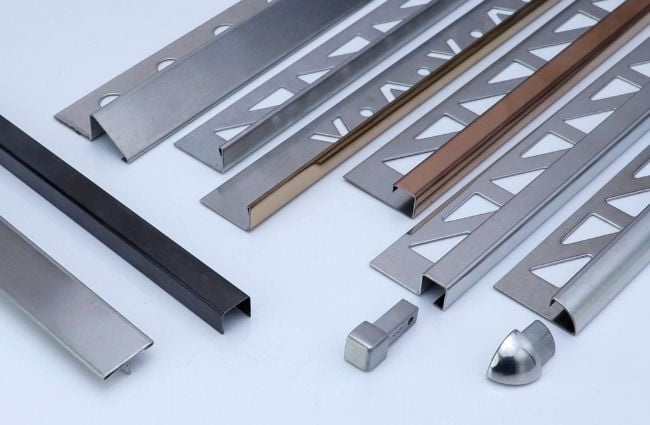
How importing from Foshan works, step by step
- Shortlist and samples. Confirm the factory makes the profiles you need in the grades above, then order samples of the exact profile, finish and height you plan to stock. At NIUYUAN, standard samples are ready in 7 days (custom profiles 7–10 days); check the finish against your tile range under local lighting — and for exterior lines, remember the sample is what your UV-exposed bulk will be judged against.
- Fix the specification in writing. Profile, material and grade, height, finish reference, length plan, protective film, and packing — including the pallet decision in the next step and whether cartons carry your brand. Most import disputes are specification gaps, not factory errors.
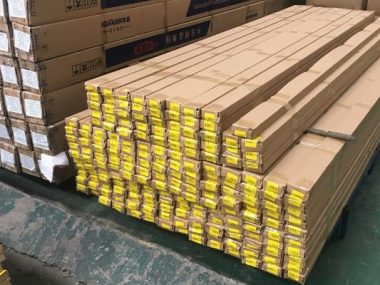
- Quotation, classification and the wood-packaging rule. Ask for the quotation on a named Incoterm and destination port. Before the first order, have your customs broker confirm the classification and the duty and GST treatment for your exact product lines — rates depend on classification, so confirm them for your goods rather than pricing off a generic figure. In the same pass, settle packing: New Zealand’s Ministry for Primary Industries requires wood packaging material entering the country — pallets, crates, dunnage — to be treated and carry ISPM 15 certification or marking. Agree at order stage that any wood packaging in your shipment is ISPM 15-compliant, or switch to plastic or manufactured-wood alternatives, so a pallet cannot hold your container at the border. The metal trim itself is not the biosecurity exposure; the packaging is.
- Production. At NIUYUAN, bulk production usually runs 20–30 working days after order confirmation, depending on profile, finish, quantity and packaging. Agree the inspection points — photos or video of finished goods and packing, including the pallets — before production starts.
- Freight and arrival. Tauranga is New Zealand’s largest container port and rails directly into Auckland through its MetroPort inland terminal; Ports of Auckland serves the country’s largest city market at the doorstep, and Lyttelton serves Christchurch and the South Island. New Zealand is two islands, so the entry decision is also a distribution decision: one North Island entry plus domestic linehaul, or a split entry for South Island volume. Settle it at quotation stage, where the comparison is still free.
- Clearance and domestic delivery. Your broker clears the shipment against the invoice, packing list and bill of lading; keep the specification sheet with the file, because it is what answers classification questions. The end-to-end China import process — documents, payment milestones and inspection options — is covered in our guide to importing tile trim from China.
Building a starter range for the New Zealand market
A first import range does not need every profile. It needs the profiles your tile range already sells, in the grades the coast and the sun each require, with a deliberate step up where the local shelf is thin:
| Tier | What to stock | Why |
|---|---|---|
| Core | Aluminum L-shaped, square-edge and round-edge profiles, 8/10/12 mm, silver, black and champagne anodized, 2.5 m full lengths | Matches the shelf standard the NZ trade already buys — L-angle depth is the local core, not the gap |
| Step-up | Stainless steel L-shaped and square-edge in 304 for interiors; the same profiles in 316 for coastal, outdoor and wet commercial work; anodised finishes specified for sun-exposed balcony and deck edges | The grade split and UV-durable finishes are the specification the stocked channels do not offer — and the ones NZ conditions actually test |
| Support | Movement-joint and transition profiles; PVC interior lines; brass profiles for interior decorative work; matching connectors, corner pieces and end caps | Movement detailing is built into NZ tiling practice, and a complete system keeps the whole order with one supplier |
The logic behind tiering a range this way — core profiles first, depth by tier, no duplicate shapes across materials — is set out in our guide to building a tile trim range for distributors. If the range will carry your own brand, decide the branding before the first production run: private-label cartons, labels and barcodes are part of the specification, as our OEM and private label guide explains, and they are far cheaper to set up on order one than to retrofit on order three.
Sourcing from NIUYUAN Metal
NIUYUAN Metal manufactures tile trim in Foshan, Guangdong — a 31,706 m² factory with 250+ staff, 40+ production machines and 3,000+ existing molds, producing aluminum (6063/6463), stainless steel (304/316), solid brass (H59) and PVC profiles plus LED strip profiles and accessories. For New Zealand buyers, the working numbers are: MOQs of 1,000 pcs for aluminum, 500 pcs for stainless steel, 200 pcs for brass and 2,000 pcs for PVC; samples in 7 days for existing profiles; bulk production in 20–30 working days; and OEM production with custom packaging for importers building their own brand. Quotations are built against a named destination port, and packing is agreed in the specification — including ISPM 15-compliant or non-wood pallet options for NZ shipments. Send the RFQ inputs below through our contact page and the quotation will be built against them.
What to send in your RFQ
- Profiles (shape and series) and the material and grade for each
- Trim height per profile, matched to your tile thickness and adhesive bed
- Finish reference for each line — photo, sample, or a finish from the finishes page
- Length plan: 2.5 m trade lengths, retail lengths, or a stated split of both
- Quantity per SKU, and the total per material against the MOQs above
- Packing: protective film, pieces per carton, pallet type (ISPM 15-compliant wood or non-wood), your labels/barcodes if private label
- Destination port (Tauranga, Auckland or Lyttelton) and the Incoterm you want quoted — and whether South Island volume ships on the same entry
FAQ
Where do NZ tile retailers and tilers buy tile trim?
Through four channels: tile specialists and trade tiling suppliers holding the working range — anodised L-angle in full lengths and a spread of heights and finishes; building merchants and DIY sheds carrying mainstream accessory lines; online through the specialists’ web stores and marketplaces; and direct import from Chinese factories for range depth, grade control and private label. Most established distributors use a mix — local channels for replenishment, direct import for the core range and the grades the shelf does not carry.
304 or 316 stainless trim for coastal New Zealand projects?
316 for anything coastal, outdoor or wet. No point in New Zealand is more than about 130 km from the sea and most building is coastal, so the exposure that pits 304 and leaves tea staining applies to a large share of NZ work — balconies, decks, pool surrounds and coastal housing included. Inland and general interior work is well served by 304. The grade comparison is set out in full in our 304 vs 316 vs 316L guide.
Does a tile trim shipment to New Zealand need biosecurity treatment?
The trim itself does not — metal and PVC profiles are not the exposure. The wood packaging is: New Zealand’s Ministry for Primary Industries requires wood packaging material entering the country, such as pallets and crates, to be treated and carry ISPM 15 certification or marking. Agree at order stage that your shipment’s wood packaging is ISPM 15-compliant, or that the factory packs on plastic or manufactured-wood alternatives, and have your broker confirm the current requirements for your shipment — non-compliant packaging is dealt with at the border at the importer’s cost and delay.
What are NIUYUAN’s MOQs and lead times for New Zealand orders?
MOQs are 1,000 pcs for aluminum, 500 pcs for stainless steel, 200 pcs for brass and 2,000 pcs for PVC. Existing-profile samples are ready in 7 days (custom profiles 7–10 days), and bulk production usually runs 20–30 working days after order confirmation, depending on profile, finish, quantity and packaging. Ocean transit and clearance are confirmed in the quotation for your destination port.
Can we order private-label trim for the New Zealand market?
Yes — OEM production and custom packaging are part of the standard offer, including branded cartons, labels and barcodes. Because NZ shelf stock is sold in full trade lengths, confirm the retail format in the same specification: the length split between trade and retail stock, per-piece sleeving and labelling, and pieces per carton, so the shipment arrives shelf-ready at both island destinations.