Tile trim in Indonesia is an importer’s business. Almost every metal profile on a store shelf here was made overseas, and the buyers who control the range — importers, distributors and building-material retailers — buy it by the container, mostly from Foshan. This guide covers how tile trim is sold in Indonesia, what to specify for an equatorial, largely coastal market, and how importing from Foshan works step by step, including the import approvals and surveyor checks to clear before you commit to an order.
The short version: match the channel to your business, specify grade 316 stainless wherever salt air, pools or harsh cleaning are involved, stock the 2.5 m lengths the local market already buys, and treat Indonesia’s import paperwork as part of the product specification — for steel and other listed industrial goods, an import approval and pre-shipment verification can stand between your deposit and your container.
How tile trim is sold in Indonesia
Four channels move almost all of it, and most importers and larger retailers work across two or three of them at once. Indonesia is an archipelago of more than 17,000 islands, but the building-materials trade is Java-first: the chains, the importers and both main container gateways sit there, and the rest of the country is supplied outward from Java landings.
Building-material supermarkets set the retail benchmark. Mitra10, run by PT Catur Sentosa Adiprana, publishes a network of 45 stores concentrated on Java — 23 of them in Greater Jakarta and West Java — inside a group reporting around 58,000 products from more than 750 suppliers. Depo Bangunan, listed on the Indonesia Stock Exchange, runs the same building-materials supermarket format. Trim sits in these stores as the accessory line to the tile department, and getting listed means meeting chain requirements on barcodes, packaging and continuity of supply.
Importers and distributors move the volume. Most metal trim enters Indonesia through importers based in Jakarta and Surabaya, who break bulk for regional wholesalers, project suppliers and smaller retailers. Trade data for ceramic tile shows how established the China route already is: in Volza’s import database, 52,927 of about 74,000 recorded Indonesian tile import shipments originated in China. Trim follows the same Foshan supply base, because it ships with the tile trade and sells against the tile on the shelf.
Toko bangunan wholesalers cover the rest of the map. The traditional building-material shop is still the working channel for contractors and small retailers outside the chain networks, supplied by regional wholesalers in cities such as Semarang, Medan and Makassar. Range depth there is thinner and the buying is price-led — which is exactly why documented grade and finish sell: they are the difference a wholesaler can point to.
Marketplaces show the street price. Local sellers list corner trim — known locally as “kuku macan”, or “lis profil keramik” — on Shopee, Tokopedia and Blibli, mostly in 2.5 m lengths in silver, black and gold, with shorter 125 cm pieces for small jobs. Read those listings to learn what the market pays at retail. Do not spec from them: grade, alloy and film thickness are rarely stated, and rarely verifiable.
| Channel | Best for | Range & spec control | Commitment |
|---|---|---|---|
| Building-material supermarkets | Retail reach and branded range-building | Buyer-controlled; documented grades and finishes expected | Listing terms, packaging standards, continuity of supply |
| Importers & distributors | Regional coverage without importing yourself | Their range and their spec choices, not yours | Distributor pricing and volume tiers |
| Toko bangunan wholesalers | Contractor and walk-in trade beyond the chains | Thin, price-led range | Small lots, fast turnover |
| Marketplaces | Price discovery and small top-up purchases | Listing-level information only; verify grade yourself | Per-order, no continuity |
| Direct import from Foshan | Owning the range, the spec and the margin | Full control of grade, finish, length and label | MOQs, import licensing and working capital |
What to specify for Indonesian conditions
Indonesia sits on the equator. Heat and humidity run all year, most demand sits in coastal cities, and bathrooms, pools and wet kitchens dominate trim use. Specification follows from those three facts.
Start with the grade
Grade 304 stainless is the safe default for standard interiors — dry walls, splashbacks and general commercial fit-outs. Step up to 316 wherever the building meets the sea or the pool deck: coastal Jakarta and Surabaya projects, Bali resort work, spas, and any area cleaned with chlorinated or acidic chemicals. The molybdenum in 316 is what resists the pitting that salt air and pool chemicals cause, and 316L is the version to name where corners are welded and polished. Our 304 vs 316 vs 316L comparison works through the grades in detail.
Where PVC and brass fit
Not every line in the range has to be metal. PVC trim covers budget residential bathrooms and rental fit-outs where impact resistance matters more than the finish, and it is a volume line in price-led toko bangunan trade — provided it is sold honestly as PVC, not as a metal substitute. Solid brass sits at the other end of the range: hotels, premium residential work and feature details, where its weight and warm tone are the point. Both belong in an Indonesian range as deliberate tiers — PVC under the aluminum core, brass above the stainless step-up — rather than as quiet substitutions inside a metal specification.
Match the finish to the environment
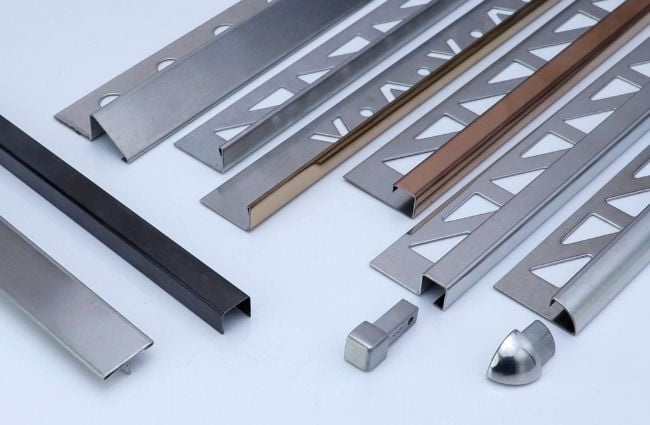
Jakarta’s average relative humidity sits around 80% across the year, so finishes live in damp air even indoors. On aluminum, the anodized layer is the protection — ask for the film thickness in writing rather than accepting “anodized” as a specification. On stainless, PVD colour keeps the corrosion resistance of the substrate under the colour, which is why it is the right route to gold, black and bronze in coastal and hotel work. Polished mirror finishes show salt spots and fingerprints fastest in humid air; brushed and satin versions of the same grade hide daily wear better. For pool and outdoor edges specifically, our pool and outdoor tile trim guide sets out the wet-area specification, and the tile trim finishes guide compares anodized, PVD, powder-coated and polished options side by side.
Get the height and the length right
Trim height follows tile thickness plus the adhesive bed — the rule, and the size chart behind it, are in our tile trim size guide. Stock the core heights that match the porcelain formats your tile suppliers move, and add heights only where a named project needs them. On length, follow the market: 2.5 m is the standard length in Indonesian retail listings, so a 2.5 m import length drops straight into local buying habits and rack systems. Shorter pieces exist at retail for repair jobs, but container economics are built on full lengths — agree one standard length per profile and hold it across reorders.
Clear the import paperwork before you commit
Indonesia runs a controlled import system, and metal profiles sit close to categories it watches. Importers must hold a Business Identification Number (NIB) registered as an API-U general importer or API-P producer importer. Since 30 August 2025, Ministry of Trade Regulation 22/2025 has governed imports of listed industrial goods — its scope expressly includes steel and ceramics — requiring an Import Approval (Persetujuan Impor) and technical verification or traceability, the surveyor-report step, for covered lines; some goods may enter only through designated ports. Mandatory SNI certification applies to specific listed product categories, and whether a decorative profile falls inside a mandatory scope turns on its exact HS classification. None of this is a reason not to import; it is a reason to run the check early. Give your broker or forwarder the HS code for every SKU before you pay a deposit, have them confirm the position in the Indonesia National Single Window’s trade repository (INTR), and file the answer with the order specification. Duty rates and clearance times are HS- and shipment-specific, so they belong to your broker’s advice, not to a guide.
How importing from Foshan works, step by step
The sequence is the same one set out in our guide to importing tile trim from China. The Indonesian difference is where the paperwork check falls — before production, not at the port.
1. Enquiry and samples. Send the profiles, heights, finishes and estimated quantities you want priced. Samples confirm colour and finish under your own lighting before anyone commits; our standard sample lead time is 7 days.
2. Specification and import check. The quote is built against a written spec sheet — alloy or steel grade, finish, height, length, quantity per SKU. In parallel, your broker confirms which approvals and verifications your HS lines need (see the section above), because an Import Approval has to be in place before the goods ship.
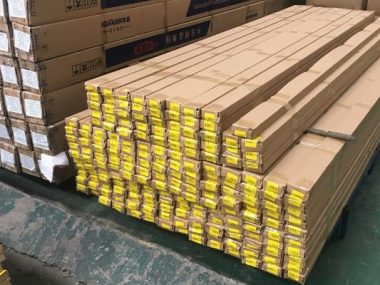
3. Production and quality checks. Extrusion or forming, surface treatment, dimensional and finish checks, then export packing. Our minimums run by material — 1,000 pieces for aluminum, 500 for stainless steel, 200 for brass and 2,000 for PVC — and bulk production runs 20–30 working days, so the reorder point belongs in the same conversation as the first order.
4. Documents and surveyor verification. Commercial invoice, packing list and certificate of origin as standard. Where your lines require a surveyor report, the inspection is arranged at origin before loading — build it into the production schedule rather than bolting it on afterwards.
5. The vessel, and choosing your gateway. Containers for Indonesia land mainly at two ports: Tanjung Priok in Jakarta, the country’s largest container port, serving Greater Jakarta and western Java; and Tanjung Perak in Surabaya, the gateway for East Java and the eastern islands. Choose by where your warehouse and your customers are — every domestic leg after landing is cost and handling your margin carries. Importers serving Sumatra or Sulawesi at real volume apply the same logic one island further out, landing containers at Belawan (Medan) or Makassar instead of redistributing everything from Java.
6. Arrival, clearance and distribution. Your broker clears the container against your NIB and API status and the approvals arranged in step 2. From a Java landing, outer-island supply moves on through domestic redistribution — one reason first-time importers usually land stock on Java and serve other islands through regional wholesalers until volumes justify a second gateway. The tile trim cost guide breaks down where the landed cost actually sits, line by line.
A practical starter range for the Indonesian market
Build the first range around what local listings already prove moves, then layer in the grades the climate justifies. The framework is the same one set out in our guide to building a tile trim range.
| Tier | What to stock | Why |
|---|---|---|
| Core | Aluminum L-shape and square edge in silver, matte black and gold-tone finishes; stainless square edge in brushed and mirror | The profiles and colours Indonesian marketplace sellers already move at 2.5 m; covers the volume of residential and commercial tile work |
| Step-up | Grade 316 square and L profiles for coastal and pool specifications; solid brass square edge for hotel and premium residential accents | The upgrades coastal specifications and hospitality projects ask for by name |
| Support | Matching corner pieces and connectors, transition and T profiles, sample boards for the counter | The pieces that stop a shelf looking unfinished, and give counter staff something to sell from |
For the premium accents, solid brass earns its place in hotel and high-end residential work — our brass tile trim selection guide covers grades and lacquer choices. If you sell under your own label into the chains, private label is part of the same order: carton marks, barcodes and Bahasa Indonesia retail artwork can be arranged with the goods, as set out in our OEM and private label guide.
Sourcing from NIUYUAN Metal
NIUYUAN Metal manufactures tile trim in Foshan, Guangdong, in a 31,706 m² facility with more than 250 staff, 40+ machines and over 3,000 moulds, producing more than 2 million pieces a month. The range covers aluminum (6063 and 6463), stainless steel (304 and 316), solid brass (H59) and PVC profiles — L-shape, square edge, round edge, T-shape, U-channel, skirting and transition strips, plus LED profiles and matching accessories — with OEM and private-label production across the range. Send your target profiles, heights, finishes and your destination port, Tanjung Priok or Tanjung Perak, through our contact page, and the reply will price against a written specification you can file next to your import approvals.
What to send in your RFQ
A complete first message gets a price you can act on:
- Profile and shape, with the height for each
- Length — 2.5 m standard, or your rack length
- Material and grade (aluminum alloy, 304 or 316 stainless, brass, PVC)
- Finish and colour, with a sample reference if you have one
- Quantity per SKU, checked against the minimums above
- Destination port — Tanjung Priok or Tanjung Perak
- Packaging and labelling, including own-label artwork if required
- The result of your broker’s HS and import-approval check
- Target date for the goods in your warehouse
Frequently asked questions
Where do Indonesian retailers and distributors buy tile trim?
Through four channels: building-material supermarkets such as Mitra10 and Depo Bangunan at retail; importers and distributors in Jakarta and Surabaya who break bulk for the regions; toko bangunan wholesalers serving contractors and small shops; and marketplaces for small, price-led purchases. Larger retailers and distributors increasingly import directly from Foshan to control grade, finish and label.
Which stainless steel grade should I specify for coastal Indonesia?
Grade 316. Its molybdenum content resists the pitting that salt air and chlorinated water cause in grade 304, which is why it is the standard specification for coastal buildings, pools and spas. Grade 304 remains the right, cheaper choice for dry interiors away from the coast.
What import approvals can apply to tile trim shipped to Indonesia?
It depends on the exact HS classification of each line. Importers need a Business Identification Number (NIB) registered as API-U or API-P. Listed industrial goods — a scope that includes steel and ceramics under Regulation 22/2025 — require an Import Approval (Persetujuan Impor) and technical verification by surveyor report before shipment, and mandatory SNI certification applies to specific listed categories. Have your broker confirm your lines in the INSW trade repository before you order.
Should a first container land at Jakarta or Surabaya?
At the port nearest your warehouse and your customers. Tanjung Priok in Jakarta is Indonesia’s largest container port and the natural landing for Greater Jakarta and western Java; Tanjung Perak in Surabaya serves East Java and onward distribution to the eastern islands. Landing at the wrong gateway adds a domestic leg that comes straight off your margin.
What length of tile trim should I stock in Indonesia?
2.5 m. It is the standard length in Indonesian retail and marketplace listings, it matches local racking and buying habits, and it keeps freight economics clean at container volume. Shorter lengths exist for repair work, but they belong to top-up buying, not to an import range.