If you buy tile trim for the Malaysian market, you are buying into a two-layer supply chain. Malaysia manufactures ceramic tiles at scale — domestic producers such as Guocera and White Horse run large plants in Selangor and Johor — and it also imports heavily, with market data putting China at 86% of ceramic tile import value. Tile trim reaches Malaysian buyers through the channels built around those tiles: tile-specialist chains and brand showrooms for shelf stock, building-material wholesalers and dealer networks for standard lines, online marketplaces for the retail end, and direct import from Chinese factories — most of them in Foshan — when a buyer needs range depth, grade control or its own branding. This guide works through how each channel operates, what to specify for Malaysia’s year-round humidity and long coastlines, and the steps involved in importing from Foshan.
Where Malaysian buyers get their tile trim
Tile-specialist chains and brand showrooms. The shelf end of the Malaysian market is organised. Jubin BMS, the tile and sanitary-ware chain operated by BMS Holdings, runs 20 retail showrooms — 16 in Peninsular Malaysia and four in Sarawak — and is the largest tile retailer in Johor. The domestic tile makers sell the same way: White Horse, for example, distributes through its own Ceramic World showrooms plus a network of marketing offices and distribution centres serving dealers nationwide. For the buyer, the model means broad off-the-shelf choice and immediate availability at retail pricing — but the trim on the shelf is an accessory line the chain or brand has chosen, in the profiles, grades and finishes it decided to stock.
Building-material wholesalers and dealers. Below the chains sits the working layer that supplies contractors, tilers and smaller retailers: regional wholesalers and brand dealer networks holding standard aluminium and PVC trim lines ex-stock. This channel suits repeat orders of standard profiles with short lead times and no import workload. Its limits are the same as anywhere: the range stops where the wholesaler’s stock list stops, and specification detail — stainless grade, finish consistency across batches — is rarely part of the offer.
Online marketplaces. Shopee and Lazada carry the retail and DIY end of the market, and the chains treat them as a sales channel rather than a competitor — Jubin BMS itself runs an official Shopee store. Marketplace listings are useful for price discovery and one-off pieces. They are not a specification channel: grade, alloy and finish claims in a listing are the seller’s own, and lengths and finishes vary from seller to seller.
Direct import from China. Importing from a Foshan factory is how Malaysian distributors and larger retailers get the full profile range in one shipment, specify material grade and finish instead of accepting a stock list, and apply their own branding. The trade-offs are concrete: minimum order quantities per material, a production lead time measured in weeks, and quality control that becomes your responsibility to specify and check rather than the retailer’s. The channel comparison below summarises the decision.
| Channel | Best for | Range & spec control | Commitment |
|---|---|---|---|
| Tile chains / brand showrooms | Immediate project needs, small quantities | Fixed to shelf stock | None — retail pricing |
| Wholesalers / dealers | Standard aluminium and PVC lines, fast replenishment | Limited to the wholesaler’s stock list | Low; ex-stock |
| Marketplaces | One-off retail pieces, price discovery | Minimal; seller-by-seller variation | None — reseller margins |
| Direct import (Foshan) | Range building, grade/finish control, private label | Full — profile, grade, finish, length, packing | MOQ per material, production lead time, own QC |
What to specify for Malaysian conditions
Grade for a tropical, coastal market
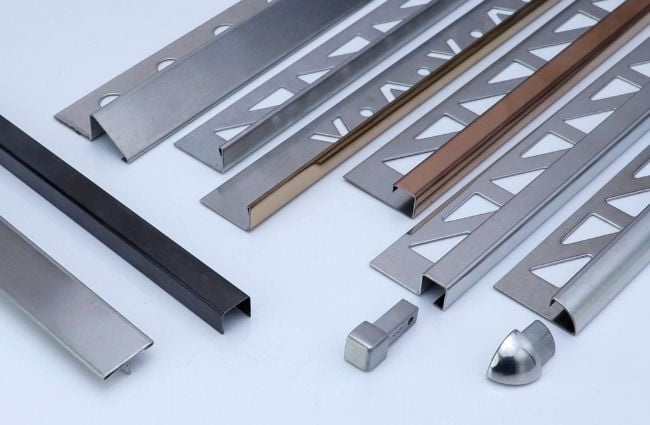
Malaysia is humid all year, and most of its population and construction sits near a coast — the Peninsular west and east coasts, plus Sabah and Sarawak across the South China Sea. Corrosion behaviour, not appearance, should therefore drive the material decision. Anodized aluminum is the volume default for good reason: the anodized layer is what stands between the metal and the climate, and it carries the mainstream residential and commercial range. For stainless steel, keep the grade decision simple and consistent: 304 covers general inland and interior use, while coastal sites, outdoor edges, pool surrounds and wet commercial areas call for 316, whose molybdenum content is what resists chloride pitting and the tea staining that shows on 304 near the sea. That is the same rule set out in our 304 vs 316 vs 316L grade guide and applied to wet-area projects in our pool and outdoor tile trim guide. Brass stays where it belongs — interior decorative work, specified as H59 solid brass rather than a brass colour, as our brass tile trim selection guide sets out — and PVC covers budget and interior wet-area lines.
Heights: stock 8, 10 and 12 mm first
Trim height follows tile thickness plus the adhesive bed, so the heights a market asks for mirror the tiles it lays. Malaysian retail ranges span the full format spread — a leading chain’s current listings run from 300×300 mm ceramics to 600×1200 mm porcelain — and factory offers aimed at the region converge on 8, 10 and 12 mm as the standard stocked heights. For a first import order, those three heights in your core profiles are the rational start; match each one to the actual tile body and adhesive bed using the method in our tile trim size guide rather than ordering by tile face size alone.
Lengths: the 2.44 m shelf standard
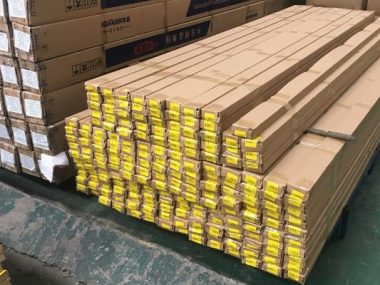
Malaysian shelf stock is sold in full lengths. Factory offers for this region lead with 2.44 m (8 ft) as the standard piece, with 2.5, 2.7 and 3.0 m available for project work. That makes the length decision simpler than in short-piece markets, but it still has to be made before you order: shelf and resale stock should follow the 2.44 m standard your customers already buy, while project supply can take the longer lengths and cut on site. State the split — how many cartons at shelf length, how many at project lengths — in the RFQ, because cutting and re-packing full lengths locally is slow, error-prone work.
Finishes Malaysian buyers ask for
Silver, gold, black, rose gold and champagne recur across regional offers — the safest core finish set for a first range, in anodized or powder-coated aluminum, with brushed and polished stainless above it. The full finish logic — anodized vs powder coat vs PVD, and locking a finish with a sealed sample before bulk — is covered on our tile trim finishes and colours page.
How importing from Foshan works, step by step
- Shortlist and samples. Confirm the factory makes the profiles you need in the grades above, then order samples of the exact profile, finish and height you plan to stock. At NIUYUAN, standard samples are ready in 7 days (custom profiles 7–10 days); use them to check the finish against your tile range under local lighting, not a photo.
- Fix the specification in writing. Profile, material and grade, height, finish reference, length plan, protective film, and packing — including whether cartons carry your brand. Most import disputes are specification gaps, not factory errors.
- Quotation and classification. Ask for the quotation on a named Incoterm and destination port. Before the first order, have your customs broker confirm the PDK classification and the duty and SST treatment for your exact product lines, including whether a China–ASEAN preferential rate applies to your classification — rates depend on classification, so confirm them for your goods rather than pricing off a generic figure.
- Production. At NIUYUAN, bulk production usually runs 20–30 working days after order confirmation, depending on profile, finish, quantity and packaging. Agree the inspection points — photos or video of finished goods and packing — before production starts.
- Freight and arrival. Port Klang — Northport and Westports — is Malaysia’s busiest container port and the default gateway for the Klang Valley. Penang serves the northern states and the Johor ports serve the south; if your customers are in Sabah or Sarawak, compare a direct East Malaysia call against Port Klang arrival plus domestic transshipment, and settle it at quotation stage, where the comparison is still free.
- Clearance and domestic delivery. Your broker clears the shipment against the invoice, packing list and bill of lading; keep the specification sheet with the file, because it is what answers classification questions. The end-to-end China import process — documents, payment milestones and inspection options — is covered in our guide to importing tile trim from China.
Building a starter range for the Malaysian market
A first import range does not need every profile. It needs the profiles your tile range already sells, in the heights and finishes above, with a deliberate step up for coastal work:
| Tier | What to stock | Why |
|---|---|---|
| Core | Aluminum L-shaped, square-edge and round-edge profiles, 8/10/12 mm, silver, black, gold anodized, 2.44 m shelf lengths | Covers the mainstream residential and renovation trade sold through showrooms, dealers and marketplaces |
| Step-up | Stainless steel L-shaped and square-edge in 304 for interiors; the same profiles in 316 for coastal and wet commercial work | The grade split is the specification shelf channels do not offer — and the one coastal projects actually need |
| Support | PVC interior lines for budget projects; brass profiles for interior decorative work; matching connectors, corner pieces and end caps | Completes the installation system so a project is not lost over a missing accessory |
The logic behind tiering a range this way — core profiles first, depth by tier, no duplicate shapes across materials — is set out in our guide to building a tile trim range for distributors. If the range will carry your own brand, decide the branding before the first production run: private-label cartons, labels and barcodes are part of the specification, as our OEM and private label guide explains, and they are far cheaper to set up on order one than to retrofit on order three. The Philippines edition of this series, our tile trim in the Philippines sourcing guide, covers the same channel decision for that market.
Sourcing from NIUYUAN Metal
NIUYUAN Metal manufactures tile trim in Foshan, Guangdong — a 31,706 m² factory with 250+ staff, 40+ production machines and 3,000+ existing molds, producing aluminum (6063/6463), stainless steel (304/316), solid brass (H59) and PVC profiles plus LED strip profiles and accessories. For Malaysian buyers, the working numbers are: MOQs of 1,000 pcs for aluminum, 500 pcs for stainless steel, 200 pcs for brass and 2,000 pcs for PVC; samples in 7 days for existing profiles; bulk production in 20–30 working days; and OEM production with custom packaging for importers building their own brand. Send the RFQ inputs below through our contact page and the quotation will be built against them.
What to send in your RFQ
- Profiles (shape and series) and the material and grade for each
- Trim height per profile, matched to your tile thickness and adhesive bed
- Finish reference for each line — photo, sample, or a finish from the finishes page
- Length plan: 2.44 m shelf lengths, project lengths (2.5 / 2.7 / 3.0 m), or a stated split of both
- Quantity per SKU, and the total per material against the MOQs above
- Packing: protective film, pieces per carton, your labels/barcodes if private label
- Destination port (Port Klang, Penang, Johor, or East Malaysia) and the Incoterm you want quoted
FAQ
Where do Malaysian tile retailers buy tile trim?
Through four channels: tile-specialist chains and brand showrooms such as Jubin BMS and the tile makers’ own dealer networks for shelf stock; building-material wholesalers holding standard aluminium and PVC lines; online marketplaces such as Shopee and Lazada for retail pieces; and direct import from Chinese factories for range depth, grade control and private label. Most established retailers use a mix — local channels for replenishment, direct import for the core range.
304 or 316 stainless trim for coastal Malaysian projects?
316. Inland and general interior work is well served by 304, but Malaysia’s coastal air, outdoor edges, pool surrounds and wet commercial areas expose trim to chlorides that pit 304 and leave tea staining. The grade comparison is set out in full in our 304 vs 316 vs 316L guide.
What trim heights should a Malaysian importer stock first?
8, 10 and 12 mm in the core profiles. Those heights match the tile thicknesses behind the formats the Malaysian market lays most — from 300×300 mm ceramics to 600×1200 mm porcelain — and factory offers for the region cluster around them. Confirm each height against the actual tile body plus adhesive bed before ordering — the method is in our size guide.
What are NIUYUAN’s MOQs and lead times for Malaysian orders?
MOQs are 1,000 pcs for aluminum, 500 pcs for stainless steel, 200 pcs for brass and 2,000 pcs for PVC. Existing-profile samples are ready in 7 days (custom profiles 7–10 days), and bulk production usually runs 20–30 working days after order confirmation, depending on profile, finish, quantity and packaging. Ocean transit and clearance are confirmed in the quotation for your destination port.
Can we order private-label trim for the Malaysian market?
Yes — OEM production and custom packaging are part of the standard offer, including branded cartons, labels and barcodes. Because Malaysian shelf stock is sold in full 2.44 m lengths, confirm the retail format in the same specification: the length split between shelf and project lengths, per-piece sleeving and labelling, and pieces per carton, so the shipment arrives shelf-ready.