Mexico makes its own ceramic and porcelain tile at scale, and its showroom networks reach every major city, so buyers are not short of tile. Metal edge profiles are a different story: the local channel sells tile first, and trim arrives as an allied product, not as a graded range.
So the real question for a Mexican importer or distributor is narrower. With local tile supply already strong, when does a Foshan top-up order still make commercial sense? What has to be checked before it is placed?
The short version: Foshan still earns the top-up order when the gap in your range is breadth, not basic supply. One Foshan factory order combines four materials in a single written specification, with several finishes, matching accessories and your own-label packing.
Local buying stays the right route for fast, standard lines. The Foshan route is for lines your current suppliers do not carry, cannot finish consistently, or will not pack under your label. Confirm the import position for every SKU with your broker first.
The choice Mexican buyers already have
Start from the supply that already exists, because the Foshan decision only makes sense against it. Most buyers use more than one route below, and each covers a different part of the range, with a clear limit.
Tile makers with their own showroom networks
Mexico is a tile-making country, not a trim-making one. Interceramic began in Chihuahua in 1979 and now sells through more than 200 franchise stores across Mexico. Vitromex, based in Saltillo, has made tile for more than 50 years and now sits inside Mohawk Industries, which bought it in 2022. Grupo Lamosa cites nine tile plants in Mexico.
These companies sell tile, setting materials and allied products through showrooms and distributors. Their strength is tile itself, in deep ranges. Metal edge profiles sit at the edge of that offer. A distributor buys the tile maker’s trim line as an add-on. That is the limit: when a project asks for grade 316 or brass by name, the tile showroom rarely holds it as a stocked line.
Handmade ceramic trims and the Talavera tradition
Mexico also has its own trim tradition, and it is ceramic, not metal. Handmade Talavera trims are made in Mexico from terracotta clay, with a hand-glazed face and an unglazed back. One US retailer sells mud bullnose pieces in 4 inch and 6 inch lengths, priced per linear foot, with delivery of about six weeks.
These pieces suit traditional and rustic work: backsplash frames, countertop borders and niche edges. Each piece varies slightly in glaze and size, because each is made by hand. That variation is part of the look, and it is also the limit. A distributor cannot reorder an identical ceramic trim. Metal trim serves a different job: it protects a cut edge on modern porcelain, where no matching bullnose exists.
The brand-name default from the North American spec channel
Across North America, the name most installers ask for is Schluter. Its profiles are sold through tile distributors, showrooms and online wholesalers. Installers use the brand name the way people say Kleenex. The core range is familiar to every tile crew. JOLLY is the square L-shaped edge for walls, niches and backsplashes. RONDEC is the rounded edge for outside corners and shower niches. SCHIENE covers floor edges, RENO handles transitions, and DILEX covers movement joints.
In the North American spec channel, stock is sold by the stick, in inches. The standard length is 8 ft 2-1/2 in (2.5 m), and some finishes also come in 10 ft lengths. Heights run in fractions of an inch: 1/4, 5/16, 3/8, 7/16 and 1/2 in.
The limit is the catalogue itself: a distributor buys the profiles, finishes and lengths the brand stocks. A finish outside that set, a custom height, or a house-label carton is not part of the same transaction. For a Mexican buyer, the added question is units and language: the range is specified in inches, with labels in English. A Foshan order can be specified in millimetres from the start, with Spanish carton marks.
Direct import from Foshan
This is the top-up route this guide covers, and direct import gives the buyer control of grade, finish, length and label. The cost is minimum quantities, import paperwork and working capital in a container. The buyer writes the specification, and the factory builds to it.
Foshan factories quote overseas buyers directly on FOB, CIF and EXW terms, through directory listings and trade platforms. That competition is a real option for Mexican buyers too, and origin alone is no longer a selling point. What one Foshan supplier offers is still that supplier’s range, not the whole Foshan supply base.
| Sourcing route | Best for | Range & spec control | Commitment |
|---|---|---|---|
| Local tile-maker channel | Tile-led sales, trim as add-on | The tile maker’s allied lines | Showroom terms, short local legs |
| Handmade ceramic trim | Traditional and rustic borders | Handmade glaze and size | Per-foot pricing, weeks of lead time |
| Brand-name spec channel | Fast reorder of standard profiles | The brand’s stocked range | Per-stick buying, inch-based sizing |
| Direct Foshan top-up order | Filling range gaps | Full control of grade, finish and label | Material MOQs, import checks, container capital |
Why Foshan still gets the top-up order
None of the reasons below is “Foshan is cheaper” as a blanket claim. Landed cost depends on the SKU, finish and shipment. Our tile trim cost guide sets out how to compare quotes line by line. The reasons are structural: breadth in one order and minimums that fit a mixed range. Custom and packing work is handled by the same factory; see our tile trim profiles page.
1. Breadth across materials in a single specification
A distributor’s shelf rarely fails on the core aluminum L-shape. It fails at the edges: a coastal project asks for grade 316, and a hotel specification names a solid brass accent. A price-led channel needs a PVC line.
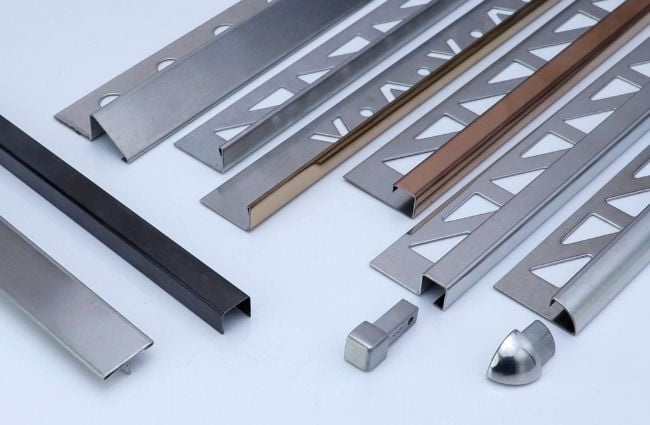
Sourcing each gap from a different supplier means different minimums, different finish standards and no single file that says what was agreed. At NIUYUAN, one specification covers aluminum 6063 and 6463, stainless steel 304 and 316, solid brass H59, and PVC. The range spans L-shape, square edge, round edge, T-shape, U-channel, skirting and transition profiles, plus LED profiles.
| Range layer | What a Foshan top-up can add | Why it is hard to fill locally in one order |
|---|---|---|
| Core metal | Aluminum (6063 / 6463) L-shape, square edge, round edge | Usually available locally |
| Step-up metal | Stainless 304 for interiors, 316 for coastal and pool work; brass (H59) for hotels | Rarely held as a graded range |
| Volume tier | PVC profiles for budget and price-led channels | Rarely inside the same graded specification |
| Completion | Matching corners, connectors, end caps, transitions, T profiles, LED profiles | Dropped first when gaps are bought separately |
2. Minimums that fit a mixed container, not a single SKU bet
The brass figure matters most. A brass accent line can be tested at 200 pieces inside a mixed container, while the aluminum core carries the volume. Samples come first: 7 days standard, 7–10 days for custom profiles. Colour and finish are confirmed against the range you already sell before the order is committed.
3. Custom profiles and your own label, from the same factory
Two gaps local buying rarely closes are a profile that does not exist yet, and a range that carries your label. NIUYUAN works from more than 3,000 existing moulds, so a semi-custom requirement can often be matched before new tooling.
OEM and private-label production runs across the range. Carton marks, labels, barcodes and retail artwork are arranged with the goods, and the wording can be printed in Spanish. Our OEM and private label guide sets out how it works. The top-up can arrive shelf-ready under your own name.
4. One finish standard across the whole top-up
Finish inconsistency is the quiet reason repeat orders move factories: a gold that shifts between batches costs more in returns than the profile itself. In a single Foshan order, every SKU’s finish is locked in the same specification and checked against the same sealed samples. Anodized film thickness is named in writing for aluminum. PVD colour goes over stainless where colour has to survive humid and coastal air. Our tile trim finishes guide compares the options.
What to specify when the Foshan order is a top-up
A top-up order has a different specification job from a first range. It has to sit next to stock you already hold. It must not create a second version of the same shelf line. Check fit first, then price.
Match the range you already sell, in metric
Start from what tile trim actually does in your range: it protects edges and gives a clean finish, so audit your range against that job. For each gap line, record the profile and the height. Add the length your racking already uses, the finish name your team uses, and the channel it will sell through. Trim height follows the same rule everywhere: tile thickness plus the adhesive bed; see our tile trim size guide.
Mexico works in metric, so state every height in millimetres and every length in metres. The common Foshan export length is 2.5 m, and other lengths are cut to order, so confirm the length your racking already uses before production.
Where a finish has to match, send physical samples of your existing lines with the enquiry. A photograph under showroom light is not a colour standard. Record the supplier and batch for each line, so the new stock can be traced to its match.
Name the grade, especially for coastal and wet work
Mexican hotel, resort and residential work puts trim in humid, coastal and wet conditions. Grade choice matters more there than for dry interiors. Grade 304 stainless is the safe default for dry interiors; step up to 316 where salt air, pool water or strong cleaning chemicals are involved.
That step matters most on the coasts, where Caribbean and Pacific resort jobs face salt air and pool chemicals. A US contractor guide notes that plain anodized aluminum can pit and dull outside in coastal air. Stainless steel or PVC holds up better.
The molybdenum in 316 resists the pitting those conditions cause in 304. Our 304 vs 316 vs 316L comparison works through the grades, and our pool and outdoor guide sets out the wet-area specification. For hotel work, solid brass earns its place; see our brass selection guide.
Decide what stays local
A Foshan top-up is not an argument for importing everything. Fast-moving standard lines that a local supplier delivers reliably usually stay local, because the local reorder cycle is the advantage there. Reserve the Foshan order for what local supply cannot do in one specification: graded step-up lines, breadth across materials, completion accessories and own-label packing. That split is the same exercise set out in our guide to building a tile trim range.
How a Foshan top-up order works, step by step
The sequence follows the same steps as our guide to importing tile trim from China. The matching work happens at the start, because this is a top-up into an existing range. The import check happens before production.
1. Range audit and enquiry
Send the gap list of profiles, heights, lengths, finishes and quantities, plus physical samples of any existing line the new stock has to match. The enquiry is priced as one mixed specification, not as separate single-SKU quotes.
2. Samples against your current stock
Samples confirm colour, finish and profile fit next to your current lines; standard samples take 7 days, and 7–10 days for custom profiles. Approve in writing, and the approved set becomes the sealed standard for production.
3. Specification and import check, in parallel
The quote is built against a written spec sheet: grade, finish, height, length, quantity per SKU, packing and labelling. In parallel, give your broker the HS code for every SKU. Have them confirm what applies to each line on entry into Mexico before you pay a deposit.
That means the importer-of-record position and registration, the documents needed, and any requirements that turn on the exact classification. The USMCA covers trade with the United States and Canada, not imports from China. A Foshan shipment is treated under Mexico’s general import rules. Duty rates, taxes and clearance timing are HS- and shipment-specific, so take them from your broker for that shipment. File the broker’s answer next to the specification.
4. Production and quality checks
Production covers extrusion or forming, surface treatment, and dimensional and finish checks against the sealed samples, then export packing. Bulk production runs 20–30 working days, so set reorder points for the fastest lines now. Local supply covers demand while the container is in production.
5. Documents and loading
Standard documents are the commercial invoice, packing list and certificate of origin, plus whatever the step 3 check identified. Confirm the packing list against the spec sheet SKU by SKU before loading, and keep loading photos.
6. Arrival, clearance and range integration
Your broker clears the container against the position confirmed in step 3. On arrival, check the top-up lines against the sealed samples before they enter stock, and record which lines came from which order. File the check with the shipment papers.
A practical top-up range for a Mexican distributor
Build the Foshan order around the gaps: step-up lines first, then breadth, completion and own-label lines.
| Tier | What to top up from Foshan | Why |
|---|---|---|
| Step-up lines | Grade 316 profiles for coastal and pool work, brass for hotel accents | The grades projects ask for by name |
| Breadth lines | Finishes beyond the local set: PVD gold, black, bronze | Same shelf lines, wider choice, one finish standard |
| Completion lines | Matching corners, connectors, end caps, transitions, T profiles, LED profiles | The pieces that stop a range looking unfinished |
| Own-label lines | Your best-moving lines with your labels and barcodes in Spanish | Turns the top-up into a house range your channels reorder by name |
Sourcing from NIUYUAN Metal
NIUYUAN Metal manufactures tile trim in Foshan, Guangdong, in a facility covering 31,706 m² with more than 250 staff, 40+ machines and over 3,000 moulds. Monthly output is more than 2 million pieces.
The range covers aluminum (6063 and 6463), stainless steel (304 and 316), solid brass (H59) and PVC profiles. Shapes span L-shape, square edge, round edge, T-shape, U-channel, skirting and transition strips, plus LED profiles, with OEM and private-label production. Send your gap list, heights and finishes through our contact page. The reply will price against a written specification for your broker’s import check file.
What to send in your RFQ
A complete first message gets a price you can act on:
- The gap list from your range audit: profile, shape and height
- Heights in millimetres, lengths in metres, per profile
- Material and grade (aluminum alloy, 304 or 316 stainless, brass, PVC)
- Finish and colour, with a physical sample of the existing line to match
- Quantity per SKU, checked against the minimums above
- Destination port in Mexico, as your forwarder advises
- Packaging and labelling, including own-label artwork in Spanish
- Your broker’s HS and import check result for each SKU
- Target date for the goods in your warehouse
Frequently asked questions
Why would a Mexican distributor import tile trim from Foshan at all, with strong local tile supply?
For breadth, not for basic supply: local buying covers fast, standard lines well. A Foshan top-up fills the gaps local supply usually cannot close in one specification. Those gaps are grade 316 stainless and solid brass step-up lines. They also include a wider finish set held to one sealed-sample standard. Matching accessories, LED profiles and own-label packing come combined in a single mixed container.
Does importing from Foshan mean replacing my local suppliers?
No, the workable split keeps fast-moving standard lines with the local supplier who delivers them. The Foshan order is reserved for step-up grades, breadth, completion pieces and own-label lines. Local supply covers demand during the 20–30 working days a Foshan bulk order is in production.
What are the minimum quantities for a mixed Foshan order?
Minimums run by material: 1,000 pieces for aluminum, 500 for stainless steel, 200 for brass and 2,000 for PVC. They apply per material, not to the container as a whole. So a mixed top-up can test a brass line at 200 pieces alongside the aluminum core.
What import checks should I run before ordering from Foshan?
Give your broker or forwarder the HS code for every SKU before you pay a deposit. Have them confirm the importer-of-record position and registration, the documents needed, and any requirements that turn on the exact classification of each line. The USMCA covers trade with the United States and Canada, not imports from China. Duty rates, taxes and clearance timing are HS- and shipment-specific. Take them from your broker for that shipment.
Can a Foshan top-up order carry my own label, in metric sizes and Spanish?
Yes, OEM and private-label production runs across the NIUYUAN range. Carton marks, labels, barcodes and retail artwork can be arranged with the goods, in Spanish where you need it. Heights and lengths are specified in millimetres and metres. All of it is confirmed in the same written spec sheet.