US tile trim buyers are not short of options, because one brand name dominates the spec channel and distributors stock its profiles by the stick. Tile showrooms, big-box stores and online wholesalers all carry edge profiles in inches. Foshan factories also sell direct into the US, with FOB and CIF terms as standard.
So the real question for a US importer or distributor is narrower. With domestic and multi-origin supply already available, when does a Foshan top-up order still make commercial sense? What has to be checked before it is placed?
The short version: Foshan still earns the top-up order when the gap in your range is breadth, not basic supply. One Foshan factory order combines four materials in a single written specification. Aluminum, stainless steel, solid brass and PVC come with several finishes, matching accessories and your own-label packing.
Domestic buying stays the right route for fast, standard lines. The Foshan route is for lines your current suppliers do not carry, cannot finish consistently, or will not pack under your label. Confirm the import position for every SKU with your broker before you pay a deposit.
The choice US buyers already have
Start from the supply that already exists, because the Foshan decision only makes sense against it. Most established buyers use more than one route below, and each covers a different part of the range, with a clear limit.
The brand-name default and the US spec channel
In the US, the name most installers ask for is Schluter. Its American subsidiary dates to 1986, and its profiles are sold through tile distributors, showrooms and online wholesalers. Installers use the brand name the way people say Kleenex, so it often stands for tile edge trim in general.
The core range is familiar to every US tile crew. JOLLY is the square L-shaped edge for walls, niches and backsplashes. RONDEC is the rounded edge for outside corners and shower niches. SCHIENE covers floor edges, RENO handles transitions to lower floors, and DILEX covers movement joints.
US stock is sold by the stick, in inches. The standard length is 8 ft 2-1/2 in (2.5 m), and some finishes also come in 10 ft lengths. Heights run in fractions of an inch, commonly 1/4, 5/16, 3/8, 7/16 and 1/2 in. That inch-based sizing is the first thing a Foshan order has to match.
The limit is the catalogue itself: a distributor buys the profiles, finishes and lengths the brand stocks. A finish outside that set, a custom height, or a house-label carton is not part of the same transaction.
Foshan competitors already sell into the US
Hero Metal, a Foshan maker, lists the USA among its main markets and names US clients in its own company pages. Its listings also show exports to building-material supermarkets in America and North America. Other Foshan factories quote US buyers directly on FOB, CIF and EXW terms.
That competition is a real option for US buyers too, and origin alone is no longer a Foshan selling point. What a multi-origin supplier offers in the US is still that supplier’s range, finishes and packing terms, not the whole Foshan supply base.
Direct import from Foshan
This is the top-up route this guide covers. Direct import gives the buyer control of grade, finish, length and label. The cost is minimum quantities, import paperwork and working capital tied up in a container.
| Sourcing route | Best for | Range & spec control | Commitment |
|---|---|---|---|
| Brand-name domestic stock | Fast reorder of standard profiles | The brand’s stocked profiles, finishes and lengths | Per-stick buying, short domestic legs |
| Multi-origin supplier (US marketing) | Origin flexibility inside one range | That supplier’s profiles, finishes and packing terms | Supplier minimums and programme terms |
| Trading company sourcing from China | Coverage without your own import file | The trader’s factories and spec choices, not yours | Trader pricing and volume tiers |
| Direct Foshan top-up order | Filling range gaps: extra materials, finishes, accessories, own-label lines | Full control of grade, finish, length and label in one specification | Material MOQs, import checks and container working capital |
Why Foshan still gets the top-up order
None of the reasons below is “Foshan is cheaper” as a blanket claim. Landed cost depends on the SKU, finish and shipment. Our tile trim cost guide sets out how to compare quotes line by line. The reasons are structural: breadth in one order and minimums that fit a mixed range. Custom and packing work is handled by the same factory that makes the profiles; see our tile trim profiles page for the full range.
1. Breadth across materials in a single specification
A distributor’s shelf rarely fails on the core aluminum L-shape. It fails at the edges: a coastal project asks for grade 316, and a hotel specification names a solid brass accent. A price-led channel needs a PVC line, and a display needs the LED profile and matching corner pieces.
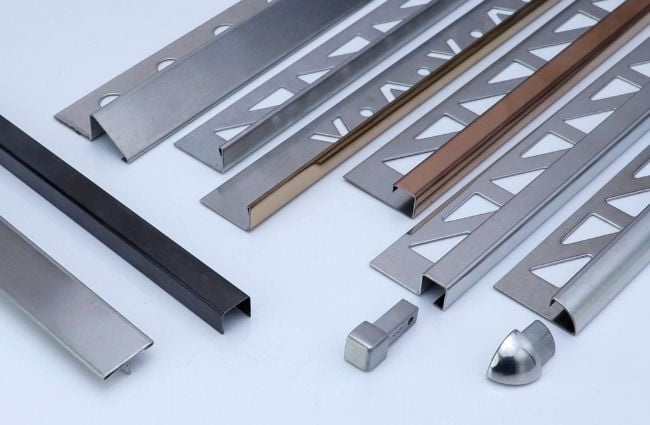
Sourcing each gap from a different supplier means different minimums, different finish standards and no single file that says what was agreed. At NIUYUAN, one specification covers aluminum 6063 and 6463, stainless steel 304 and 316, solid brass H59, and PVC. The range spans L-shape, square edge, round edge, T-shape, U-channel, skirting and transition profiles, plus LED profiles. The whole gap list, from one factory, against one written spec sheet.
| Range layer | What a Foshan top-up can add | Why it is hard to fill in the US in one order |
|---|---|---|
| Core metal | Aluminum (6063 / 6463) L-shape, square edge, round edge, in your existing finishes | Usually available domestically; top up only for finish consistency |
| Step-up metal | Stainless steel 304 for interiors, 316 for coastal and pool work; solid brass (H59) square edge for premium and hotel work | Rarely held as a graded range; name grade and alloy in writing |
| Volume tier | PVC profiles for budget residential and price-led channels, sold honestly as PVC | A commodity line, rarely inside the same graded specification |
| Completion | Matching corner pieces, connectors, end caps, transition and T profiles, LED profiles | The first pieces dropped when gaps are bought separately |
2. Minimums that fit a mixed container, not a single SKU bet
A top-up order only works if the minimums let you spread a container across the range, not bet it on one profile. NIUYUAN’s minimums run by material: 1,000 pieces for aluminum, 500 for stainless steel, 200 for brass and 2,000 for PVC. The brass figure matters most. A premium accent line can be tested at 200 pieces inside a mixed container, while the aluminum core carries the volume.
Samples come first: 7 days standard, and 7–10 days for custom profiles. Colour and finish are confirmed against the range you already sell before the order is committed.
3. Custom profiles and your own label, from the same factory
Two gaps domestic buying rarely closes are a profile that does not exist yet, and a range that carries your label. The label is yours, not the factory’s. NIUYUAN works from more than 3,000 existing moulds, so a semi-custom requirement can often be matched before new tooling.
OEM and private-label production runs across the range. Carton marks, labels, barcodes and retail artwork are arranged with the goods. Our OEM and private label guide sets out how it works. The top-up can arrive shelf-ready under your own name instead of as an unbranded import.
4. One finish standard across the whole top-up
Finish inconsistency is the quiet reason repeat orders move factories. A gold that shifts between batches costs more in returns than the profile itself. So does a black that arrives in two tones from two suppliers.
In a single Foshan order, every SKU’s finish is locked in the same specification and checked against the same sealed samples. Anodized film thickness is named in writing for aluminum. PVD colour goes over stainless where colour has to survive humid and coastal air. Our tile trim finishes guide compares the options side by side.
What to specify when the Foshan order is a top-up
A top-up order has a different specification job from a first range. It has to sit next to stock you already hold, bought domestically or imported before. It must not create a second, incompatible version of the same shelf line.
Match the range you already sell, in inches
Start from what tile trim actually does in your range. It protects edges and gives a clean finish, so audit your range against that job. For each gap line, record the profile and the height. Add the length your racking already uses, the finish name your team uses, and the channel it will sell through. Trim height follows the same rule everywhere: tile thickness plus the adhesive bed, worked through in our tile trim size guide.
US sizing needs one extra line in the specification. State every height in inches as well as millimetres, and every length in feet as well as metres. The domestic standard is 8 ft 2-1/2 in sticks. A Foshan order in metric-only lengths will not slot into the same racking or the same job math. Write both units on the spec sheet, and confirm the conversion before production.
Where a finish has to match, send physical samples of your existing lines with the enquiry. A photograph under showroom light is not a colour standard. Record the supplier and batch for each line too, so the new stock can be traced to its match.
Name the grade, especially for coastal and wet work
US hotel, resort and residential work puts trim in humid, coastal and wet conditions, so grade choice matters more than for dry interiors. Grade 304 stainless is the safe default for dry interiors. Step up to 316 wherever salt air, pool water or chlorinated and acidic cleaning is involved.
That step matters most on the coasts, where Florida and Gulf Coast jobs face salt air and pool chemicals. A US contractor guide notes that plain anodized aluminum can pit and dull outside in coastal air. Stainless steel or PVC holds up better there.
The molybdenum in 316 resists the pitting those conditions cause in 304. Our 304 vs 316 vs 316L comparison works through the grades, and our pool and outdoor tile trim guide sets out the wet-area specification. For the premium tier, solid brass earns its place in hotel and high-end residential work; see our brass tile trim selection guide.
Decide what stays domestic
A Foshan top-up is not an argument for importing everything. Fast-moving standard lines that a domestic supplier delivers reliably usually stay domestic, because the domestic reorder cycle is the advantage there. That is the split to write down before you quote.
Reserve the Foshan order for what domestic supply cannot do in one specification: graded step-up lines, breadth across materials, completion accessories and own-label packing. That split is the same exercise set out in our guide to building a tile trim range, applied to a range that already exists.
How a Foshan top-up order works, step by step
The sequence follows the same steps as our guide to importing tile trim from China. The US difference is emphasis. The matching work happens at the start, because this is a top-up into an existing range. The import check happens before production, not at the port.
1. Range audit and enquiry
Send the gap list of profiles, heights, lengths, finishes and estimated quantities, plus physical samples of any existing line the new stock has to match. The enquiry is priced as one mixed specification, not as separate single-SKU quotes.
2. Samples against your current stock
Samples confirm colour, finish and profile fit next to your current lines. Standard sample lead time is 7 days, and 7–10 days for custom profiles. Approve in writing, and the approved set becomes the sealed standard for production.
3. Specification and import check, in parallel
The quote is built against a written spec sheet: grade, finish, height, length, quantity per SKU, packing and labelling. In parallel, give your broker or forwarder the HS code for every SKU. Have them confirm before you pay a deposit what applies to each line on entry into the US.
That means the importer-of-record position, the documents needed, and any requirements that turn on the exact classification. Duty rates, taxes and clearance timing are HS- and shipment-specific, so they belong to your broker’s advice for that shipment, not to a guide. File the broker’s answer next to the specification.
4. Production and quality checks
Production covers extrusion or forming, surface treatment, and dimensional and finish checks against the sealed samples, then export packing. Bulk production runs 20–30 working days, so set reorder points for the fastest lines in the same conversation. Domestic supply keeps covering demand while the container is in production.
5. Documents and loading
Standard documents are the commercial invoice, packing list and certificate of origin, plus whatever the step 3 check identified. Confirm the packing list against the spec sheet SKU by SKU before loading, and keep loading photos in the shipment file.
6. Arrival, clearance and range integration
Your broker clears the container against the position confirmed in step 3. On arrival, check the top-up lines against the sealed samples before they enter stock. Record which lines came from which order, so you can reorder the identical line later.
A practical top-up range for a US distributor
Build the Foshan order around the gaps: step-up lines first, then breadth, completion and own-label lines.
| Tier | What to top up from Foshan | Why |
|---|---|---|
| Step-up lines | Grade 316 square and L profiles for coastal and pool work, solid brass square edge for hotel accents | The grades projects ask for by name |
| Breadth lines | Finishes beyond the domestic set: PVD gold, black and bronze on stainless | Same shelf lines, wider choice, one finish standard |
| Completion lines | Matching corner pieces, connectors and end caps, transition and T profiles, LED profiles | The pieces that stop a range looking unfinished |
| Own-label lines | Your best-moving imported lines with your labels and barcodes | Turns the top-up into a house range your channels reorder by name |
Sourcing from NIUYUAN Metal
NIUYUAN Metal manufactures tile trim in Foshan, Guangdong, in a facility covering 31,706 m² with more than 250 staff, 40+ machines and over 3,000 moulds. Monthly output is more than 2 million pieces.
The range covers aluminum (6063 and 6463), stainless steel (304 and 316), solid brass (H59) and PVC profiles. Shapes span L-shape, square edge, round edge, T-shape, U-channel, skirting and transition strips, plus LED profiles, with OEM and private-label production. Send your gap list, heights, finishes and destination port through our contact page. The reply will price against a written specification you can file next to your broker’s import check.
What to send in your RFQ
A complete first message gets a price you can act on:
- The gap list from your range audit: profile, shape and height for each
- Heights in inches and millimetres, lengths in feet and metres, per profile
- Material and grade (aluminum alloy, 304 or 316 stainless, brass, PVC)
- Finish and colour, with a physical sample of the existing line to match
- Quantity per SKU, checked against the minimums above
- Destination port in the USA, as advised by your forwarder
- Packaging and labelling, including own-label artwork if required
- The result of your broker’s HS and import check for each SKU
- Target date for the goods in your warehouse
Frequently asked questions
Why would a US distributor import tile trim from Foshan at all, with domestic supply available?
For breadth, not for basic supply, because domestic buying covers fast, standard lines well. A Foshan top-up order fills the gaps domestic supply usually cannot close in one specification. Those gaps are grade 316 stainless and solid brass step-up lines. They also include a wider finish set held to one sealed-sample standard. Matching accessories, LED profiles and own-label packing come combined in a single mixed container.
Does importing from Foshan mean replacing my domestic suppliers?
No, the workable split keeps fast-moving standard lines with the domestic supplier who delivers them. The Foshan order is reserved for step-up grades, breadth, completion pieces and own-label lines. Domestic supply covers demand during the 20–30 working days a Foshan bulk order is in production.
What are the minimum quantities for a mixed Foshan order?
Minimums run by material: 1,000 pieces for aluminum, 500 for stainless steel, 200 for brass and 2,000 for PVC. They apply per material, not to the container as a whole. So a mixed top-up can test a premium brass line at 200 pieces alongside the aluminum core that carries the volume.
What import checks should I run before ordering from Foshan?
Give your broker or forwarder the HS code for every SKU before you pay a deposit. Have them confirm the importer-of-record position, the documents needed, and any requirements that turn on the exact classification of each line. Duty rates, taxes and clearance timing are HS- and shipment-specific. Take them from your broker for that shipment, and file the answer with the order specification.
Can a Foshan top-up order carry my own label, and in US sizes?
Yes, OEM and private-label production runs across the NIUYUAN range, so carton marks, labels, barcodes and retail artwork can be arranged with the goods. Heights and lengths are specified in inches and feet as well as millimetres and metres. All of it is confirmed in the same written spec sheet as the profiles, finishes and quantities.